Yandex's AI Dev Day shows how AI is already changing development at Avito, Ozon and T-Bank
Yandex held AI Dev Day, where major companies showed AI without the usual hype: agents already write tests, do code review, and help SREs and designers. At Yandex, T-Bank, Ozon and others, the effect is already measured in merge time, postmortems and hours of work. But the main takeaway is sober: gains come not from a single model but from the combination of context, MCP, metrics and human-in-the-loop.
AI-processed from Habr AI; edited by Hamidun News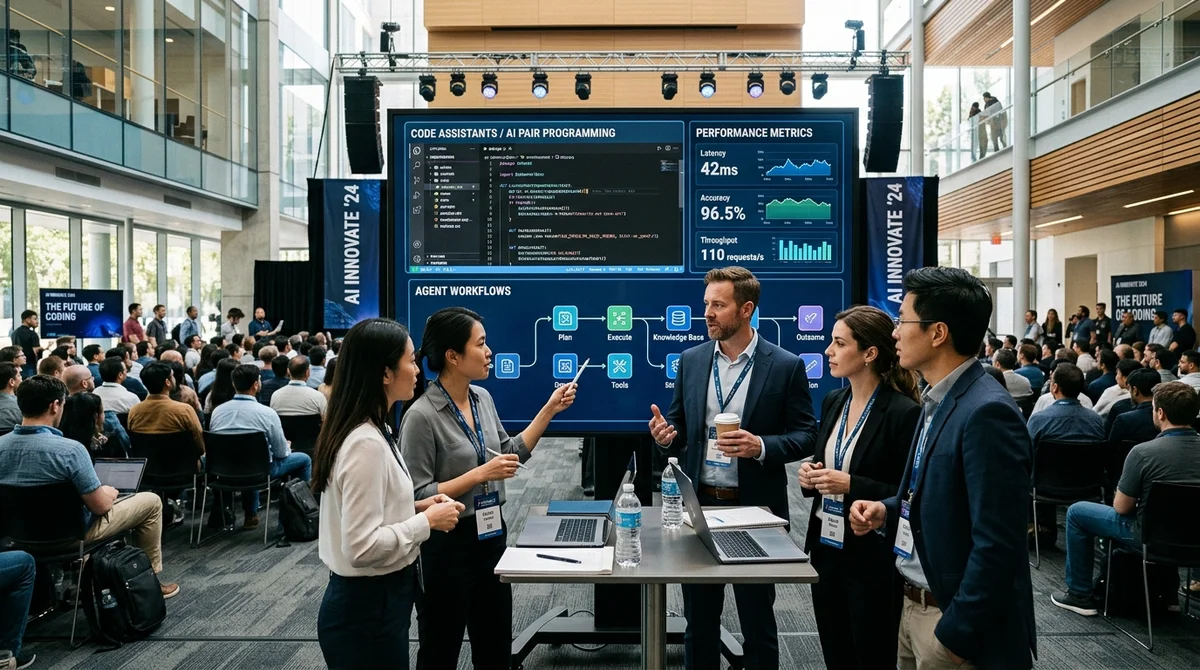
Yandex hosted AI Dev Day and effectively showed that AI in software development has moved past the demo stage. On stage, companies such as Avito, Ozon, T-Bank, Sber and Yandex Go talked not about hype but about metrics, limitations and the places where agents already save hours.
From assistants to agents
The main shift, heard in almost every talk, is that the market is moving from simple IDE suggestions to agents that can change code on their own, write tests, search internal information, do code review and even analyze incidents.
Avito stressed that fine-tuning open-source models for a company does not always give the best result: it is often more important to give a strong model good context, access to documentation and tools via MCP. Other teams are making a similar bet: not on a "magic model" but on a working combination of agent + context + infrastructure.
At Yandex this already looks like a systemic platform. About 57% of engineers use the internal assistant, and in backend and frontend the share reaches 60–75%. More than 90% of internal infrastructure is already covered by MCP servers, and among active users 23% of code in agent mode is generated automatically. The emphasis is shifting from the simple adoption metric to a tougher question: where exactly can an agent work almost autonomously, with a human stepping in only for the hard parts?
Where the impact is already visible
The most useful part of AI Dev Day was not the talk about the future but the production numbers. Companies now measure not only how many people use the assistant, but also time to release, review speed, test quality and the cost of incidents. In effect, AI has begun to be assessed like any other engineering tool: if it does not move business metrics, a wow effect is not enough.
- At Yandex, developers who use AI commit roughly 10% more, and in Go, Python and JavaScript up to 20%; some technical tasks handled by agents dropped from 20 minutes to 2.
- At T-Bank, median merge time fell by 12%, and for "ambassador" teams lead time dropped by 30% over the year; unit test generation grew fourfold.
- At Ozon, about 1,100 people use the agentic assistant daily, roughly a quarter or a third of development, and automated review in GitLab proved so popular that the launch had to be limited.
- At Sber, an AI system for designers cut mockup review from an hour to two minutes, and the creation of a new screen from 16 hours to five minutes.
- At Yandex Go, AI already helps analyze about 400 incidents a day and saves roughly 30 minutes per postmortem for each case.
The range of tasks is also expanding quickly. It is no longer just code generation, but also search over internal knowledge, automatic checklists, analyst support, design review and SRE scenarios. A year ago AI mostly looked like a smart autocomplete; now companies are trying to build it into the entire SDLC, from task definition to analyzing consequences in production.
Why the enthusiasm is limited
Despite the strong cases, speakers were fairly sober about the limits. Avito said plainly that it sees almost no noticeable speedup of the whole development cycle so far: 4–5% at most in individual teams. The reason is simple: writing code takes only part of working time, while the bottlenecks lie in review, approvals, testing and delivering changes. So mass code generation does not solve the problem by itself: it can simply move the bottleneck further down the process.
Quality and control are a separate pain point. Models can cut corners on tests, fake a tool call, produce boring boilerplate design or make mistakes in an internal domain-specific language. At Yandex Go, for example, SRE scenarios ended up switching to English prompts because results in Russian were worse. In addition, truly useful agents need an expensive foundation: observability, a service dependency graph, change auditing, service catalogs and proper scenario metrics, not just pretty demos.
"There will be no apocalypse.
There will be a harsh but fascinating evolution."
That is why almost all the talks came down to one idea: human-in-the-loop has not gone anywhere. Ozon is cautious about external models because of the risk of code leaks. Sber had to separately fight conservative design and hallucinations. Yandex measures not only the benefits but also side effects such as maintaining generated code. AI here is no longer a toy, but not an autonomous employee either; it is more of an accelerator that requires good rules, tools and constant validation.
What this means
After AI Dev Day it is hard to say that enterprise AI for development is only an experiment. The experiment is over: the fight now is over who has better context, metrics, processes and infrastructure. AI does not eliminate developers, but it noticeably changes the price of routine work, the role of review, and the demands on people who can manage agents rather than just write code by hand.
- Nov 1, 2026Local models lose to Opus and Codex: 0.21 on a MacBook versus 1.00 for Codex
- Nov 1, 2026Adobe's EditAgent judge picks a usable edit 81.3% of the time, versus 74.8% for EditScore
- Nov 1, 202616 models tested on 7 search tools: Exa averaged 10.5 out of 14, SearXNG about 3
- Nov 1, 2026Google's StreamVibe video agent beats other models by 10.7% on response timing and quality
Key Questions Answered
What are the key details on From assistants to agents?
The main shift, heard in almost every talk, is that the market is moving from simple IDE suggestions to agents that can change code on their own, write tests, search internal information, do code review and even analyze incidents. Avito stressed that fine-tuning open-source models for a company does not always give the best result: it is often more important to give a strong model good context, access to documentation and tools via MCP. Other teams are making a similar bet: not on a "magic model" but on a working combination of agent + context + infrastructure. At Yandex th
Where the impact is already visible?
The most useful part of AI Dev Day was not the talk about the future but the production numbers. Companies now measure not only how many people use the assistant, but also time to release, review speed, test quality and the cost of incidents. In effect, AI has begun to be assessed like any other engineering tool: if it does not move business metrics, a wow effect is not enough. At Yandex, developers who use AI commit roughly 10% more, and in Go, Python and JavaScript up to 20%; some technical tasks handled by agents dropped from 20 minutes to 2. At T-Bank, median merge time
Why the enthusiasm is limited?
Despite the strong cases, speakers were fairly sober about the limits. Avito said plainly that it sees almost no noticeable speedup of the whole development cycle so far: 4–5% at most in individual teams. The reason is simple: writing code takes only part of working time, while the bottlenecks lie in review, approvals, testing and delivering changes. So mass code generation does not solve the problem by itself: it can simply move the bottleneck further down the process. Quality and control are a separate pain point. Models can cut corners on tests, fake a tool call, produce
Build & Ship Production AI Agents Without Boilerplate Code
Start your free 72-hour trial at Hamidun Academy (academy.hamidun.com) — interactive lessons on Claude Code & Cursor, live Tech Radar, and production agent templates.
The AI world, distilled — once a week
Seven stories that actually mattered, hand-picked. No noise, no reposts, no press releases.
Done! Check your inbox for a confirmation.