OpenAI releases GPT-5.4 mini and nano: near-flagship quality at a lower price
OpenAI has released GPT-5.4 mini and nano, lightweight versions of the GPT-5.4 family built for fast, high-volume tasks. On several benchmarks, mini nearly matches the full-size model while running more than twice as fast. Nano is designed for cheap classification, data extraction and simple subagents. Mini is already available in ChatGPT, Codex and the API, while nano remains API-only.
AI-processed from ZDNet AI; edited by Hamidun News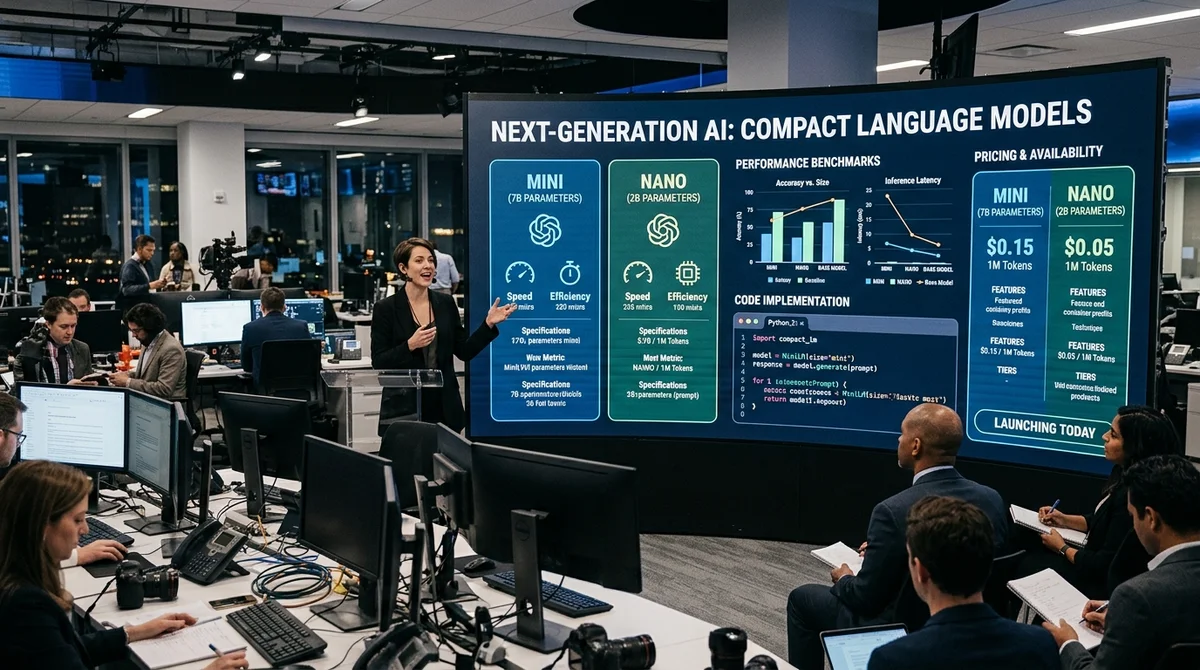
On March 17, 2026, OpenAI introduced GPT-5.4 mini and GPT-5.4 nano, two compact versions of the GPT-5.4 family for tasks where speed, price and the ability to run a model at scale matter. The main surprise is that on several key tests, mini gets noticeably closer to the full-size GPT-5.4 than people usually expect from a "lightweight" model.
Nearly a flagship
GPT-5.4 mini is positioned not as a stripped-down compromise but as a working model for real products. According to OpenAI, it scored 54.4% on SWE-Bench Pro versus 57.7% for the full GPT-5.4, and 72.1% on OSWorld-Verified versus 75.0%. There is a gap, but it no longer looks like a chasm. Mini also runs more than twice as fast as the previous-generation GPT-5 mini, which for user-facing scenarios often matters more than a few extra benchmark points.
The smaller GPT-5.4 nano goes further toward efficiency. OpenAI calls it the smallest and cheapest version of GPT-5.4 and recommends it for classification, data extraction, ranking and simple coding subagents. It is not a model for everything, but rather a building block for larger systems in which one strong agent plans the work and a set of small, fast models handles the routine. This approach is increasingly moving from labs into production services.
Where it fits
The point of the release is not just new names but a shift in emphasis: more and more AI products are limited not by maximum answer quality but by the balance between quality, latency and the cost of each request. If a model responds quickly, uses tools competently and does not break on multimodal tasks, it often delivers more value to a business than a heavy flagship that thinks longer and costs more. For services with a large volume of requests, this immediately translates into product economics and user retention.
- AI coding assistants with fast edits and debugging
- Subagents that search codebases and documents in parallel
- Computer-use systems that read screenshots and interfaces
- Multimodal applications working with text and images in real time
- High-volume background tasks such as classification and field extraction
OpenAI specifically highlights setups that combine several models of different classes. In such a scheme, the large model handles planning, coordination and final checks, while mini or nano carry out narrow subtasks in parallel. For developers, this means cheaper orchestration without a complete loss of quality. For end users, it means more responsive products in which AI no longer feels slow and heavy. And that matters more than any one-off jump on a dry benchmark.
Pricing and availability
GPT-5.4 mini has a fairly wide range of uses. The model is available in the API, Codex and ChatGPT, and supports text and image inputs, tool use, function calling, web search, file search, computer use and skills. The context window is 400 thousand tokens. Pricing is $0.75 per million input tokens and $4.50 per million output tokens. In Codex, mini uses only 30% of the GPT-5.4 quota, so it can be used for cheaper auxiliary tasks and parallel subagents.
GPT-5.4 nano is available only through the API and costs even less: $0.20 per million input tokens and $1.25 per million output tokens. In ChatGPT, mini is already available to Free and Go users through Thinking mode, and for other users it can serve as a fallback for GPT-5.4 Thinking. In practice, this splits the lineup very clearly: mini becomes the mass-market workhorse for everyday products, and nano becomes a utility engine for simple, frequent and cheap backend operations.
What this means
The launch of GPT-5.4 mini and nano shows that the model race is entering a new phase: the winners will not be only the strongest models, but also those that deliver near-flagship results at low price and low latency. For the market, it is a signal that the next wave of AI products will be built not around a single "smartest" model but around combinations of large and small ones. Such combinations, rather than lone super-models, will define the next cycle of applied AI.
- Nov 1, 2026Local models lose to Opus and Codex: 0.21 on a MacBook versus 1.00 for Codex
- Nov 1, 2026Kimi scores 96.2% on a 1C database analytics test and emerges as a fallback if Claude access is blocked
- Nov 1, 2026OpenAI Rewrites GPT Behavior Rules: Five Values and a Chain of Command
- Nov 1, 2026Google admits AI Mode cuts search revenue, shares fall 15%
Key Questions Answered
What are the key details on Nearly a flagship?
GPT-5.4 mini is positioned not as a stripped-down compromise but as a working model for real products. According to OpenAI, it scored 54.4% on SWE-Bench Pro versus 57.7% for the full GPT-5.4, and 72.1% on OSWorld-Verified versus 75.0%. There is a gap, but it no longer looks like a chasm. Mini also runs more than twice as fast as the previous-generation GPT-5 mini, which for user-facing scenarios often matters more than a few extra benchmark points. The smaller GPT-5.4 nano goes further toward efficiency. OpenAI calls it the smallest and cheapest version of GPT-5.4 and recom
Where it fits?
The point of the release is not just new names but a shift in emphasis: more and more AI products are limited not by maximum answer quality but by the balance between quality, latency and the cost of each request. If a model responds quickly, uses tools competently and does not break on multimodal tasks, it often delivers more value to a business than a heavy flagship that thinks longer and costs more. For services with a large volume of requests, this immediately translates into product economics and user retention. AI coding assistants with fast edits and debugging Subage
What are the key details on Pricing and availability?
GPT-5.4 mini has a fairly wide range of uses. The model is available in the API, Codex and ChatGPT, and supports text and image inputs, tool use, function calling, web search, file search, computer use and skills. The context window is 400 thousand tokens. Pricing is $0.75 per million input tokens and $4.50 per million output tokens. In Codex, mini uses only 30% of the GPT-5.4 quota, so it can be used for cheaper auxiliary tasks and parallel subagents. GPT-5.4 nano is available only through the API and costs even less: $0.20 per million input tokens and $1.25 per million ou
Build & Ship Production AI Agents Without Boilerplate Code
Start your free 72-hour trial at Hamidun Academy (academy.hamidun.com) — interactive lessons on Claude Code & Cursor, live Tech Radar, and production agent templates.
The AI world, distilled — once a week
Seven stories that actually mattered, hand-picked. No noise, no reposts, no press releases.
Done! Check your inbox for a confirmation.