Meta spends on AI like a hyperscaler but doesn't show the growth of Amazon and Google
Meta is raising its bets on AI and infrastructure again, but the market doesn't see the same quality of return it sees at the cloud giants. Capital expenditure of up to $145 billion looks too bold given the weak link between that spending and clear revenue growth. Management's cautious tone on the investor call only deepened the doubts. *Meta is designated an extremist organization and banned in Russia.
AI-processed from Bloomberg Tech; edited by Hamidun News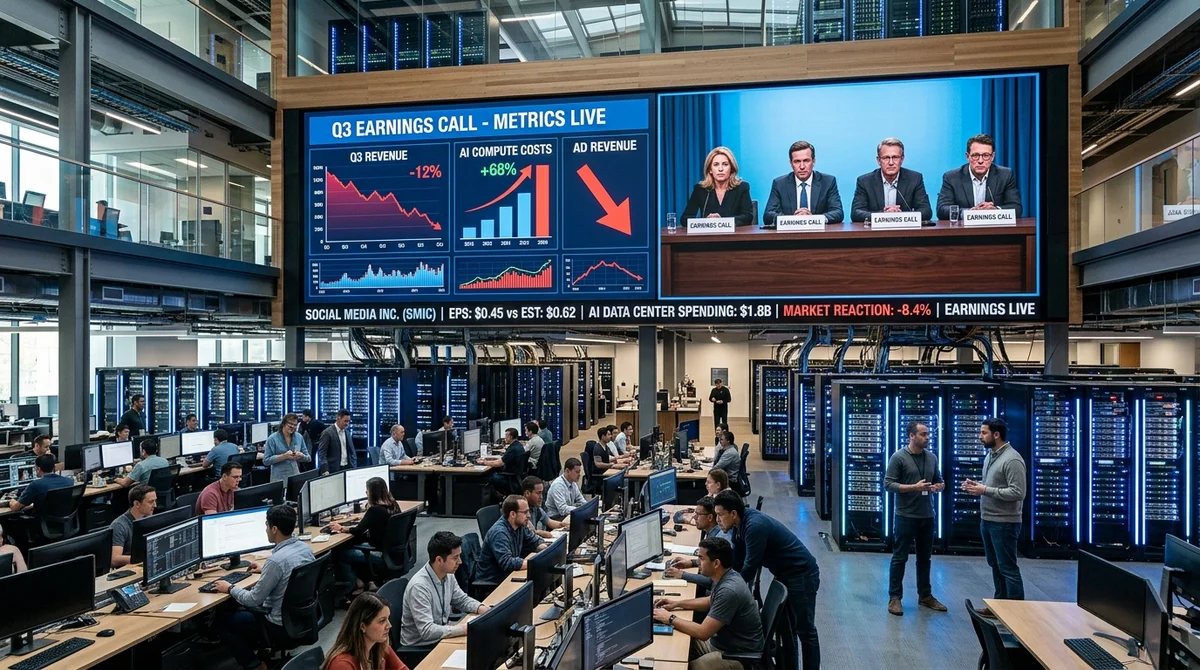
Meta is ramping up spending on AI and infrastructure at a scale usually associated with Amazon, Google and other cloud giants. But according to Bloomberg Opinion columnist Dave Lee, the company does not yet show the quality of growth that would justify such investment.
What the criticism is
The core of the critique is simple: Meta is trying to look like a cloud-market player, even though its business works differently. Amazon and Google have a clear engine for paying back big investments in servers, chips and data centers: selling cloud services to companies willing to pay for compute, storage and AI tools. Meta has no such model in its pure form. Its main cash flow still comes from advertising, not from an enterprise cloud, and that is where critics ask how justified the current scale of capital expenditure is.
Lee points not only to the sums themselves but also to the contrast with true hyperscalers. When Amazon or Google spend tens of billions on infrastructure, the market can tie that spending to growing demand for cloud and generative AI. In Meta's case, no such direct line is visible yet. The company talks a lot about its AI ambitions, but is noticeably less convincing on how those investments will quickly turn into a new, durable source of revenue. In other words, the bet looks big, while the case behind it is not fully assembled.
Why the market is nervous
The doubts grow against the backdrop of the announced spending level. We are talking about capital expenditure of up to $145 billion, a figure that by itself sharply raises the bar for expectations. If a company invests in infrastructure almost like a top-tier cloud provider, investors expect comparable signs of efficiency: rising demand, faster monetization, new B2B products, or at least a confident tone on the call with analysts. Instead, as Lee notes, management sounded cautious. That caution matters because it hints that even inside Meta, they are not yet ready to promise a quick payoff too firmly.
There is a psychological side as well. When management is truly confident in the trajectory of the business, you can usually hear it in the wording: the company explains in detail which workloads are growing, who pays for the capacity and how margins will improve over time. According to Bloomberg Opinion, that feeling is still missing from Meta's account. The result is dissonance: the spending looks like a bet on the next technology cycle, while the explanation of that bet looks like an unfinished investor presentation. For the market, that is almost always a signal that more questions are coming, not more trust.
Where the money goes
The problem for Meta is not that AI investment is wrong in itself. The market has long accepted that big platforms have to build data centers, buy accelerators and expand compute capacity. The question is different: which metrics should prove the strategy works. Meta has made expensive bets on the future before that were received ambiguously, which is why the current spending cycle is being scrutinized especially harshly.
- Purchases of GPUs and server infrastructure
- Construction and expansion of data centers
- Support for internal AI models and advertising systems
- Experiments with products where monetization is still unclear
For investor sentiment to soften, Meta needs to show a clearer mechanism for returns on investment. That could be growth in revenue from AI tools for advertisers, higher efficiency in the core advertising business, or a new service line where compute is turned into a product for sale. For now, the company sits between two stories: it spends like an infrastructure leader but earns with the logic of a media platform. That gap is what makes its AI bet especially vulnerable to criticism.
What this means
For Meta, this is a moment when talk about AI is no longer enough: the market wants metrics that link huge investment to real business growth. If the company does not show such a link in the coming quarters, pressure on its spending strategy will only grow.
*Meta is designated an extremist organization and banned in Russia.
- Nov 1, 202616 models tested on 7 search tools: Exa averaged 10.5 out of 14, SearXNG about 3
- Nov 1, 2026Google's StreamVibe video agent beats other models by 10.7% on response timing and quality
- Nov 1, 2026OpenAI Rewrites GPT Behavior Rules: Five Values and a Chain of Command
- Nov 1, 2026Voice bots built on LLMs turn to Jev, a fast classifier, for decisions in 200–500 ms
Key Questions Answered
What the criticism is?
The core of the critique is simple: Meta is trying to look like a cloud-market player, even though its business works differently. Amazon and Google have a clear engine for paying back big investments in servers, chips and data centers: selling cloud services to companies willing to pay for compute, storage and AI tools. Meta has no such model in its pure form. Its main cash flow still comes from advertising, not from an enterprise cloud, and that is where critics ask how justified the current scale of capital expenditure is. Lee points not only to the sums themselves but a
Why the market is nervous?
The doubts grow against the backdrop of the announced spending level. We are talking about capital expenditure of up to $145 billion, a figure that by itself sharply raises the bar for expectations. If a company invests in infrastructure almost like a top-tier cloud provider, investors expect comparable signs of efficiency: rising demand, faster monetization, new B2B products, or at least a confident tone on the call with analysts. Instead, as Lee notes, management sounded cautious. That caution matters because it hints that even inside Meta, they are not yet ready to promi
Where the money goes?
The problem for Meta is not that AI investment is wrong in itself. The market has long accepted that big platforms have to build data centers, buy accelerators and expand compute capacity. The question is different: which metrics should prove the strategy works. Meta has made expensive bets on the future before that were received ambiguously, which is why the current spending cycle is being scrutinized especially harshly. Purchases of GPUs and server infrastructure Construction and expansion of data centers Support for internal AI models and advertising systems Experiments
Test Frontier LLMs & Autonomous Agents in One Workspace
Run Claude Opus 5.5, GPT-6, Gemini 3.1, and DeepSeek side-by-side in Nomad AI (nomadnet.ai) — unified model routing, deep research, and multimodal workflows under one subscription.
The AI world, distilled — once a week
Seven stories that actually mattered, hand-picked. No noise, no reposts, no press releases.
Done! Check your inbox for a confirmation.