Amazon, Google and Meta Increase Debt for New AI Infrastructure Race
Big Tech no longer has sufficient cash flow alone for the AI race. Amazon, Google and Meta have sharply increased borrowing to build data centers and purchase chips: Amazon alone raised nearly $54 billion equivalent, and total bond issuance from major hyperscalers is already breaking records. Investors remain calm for now, but the market is waiting for proof that these expenditures will actually pay off.
AI-processed from Bloomberg Tech; edited by Hamidun News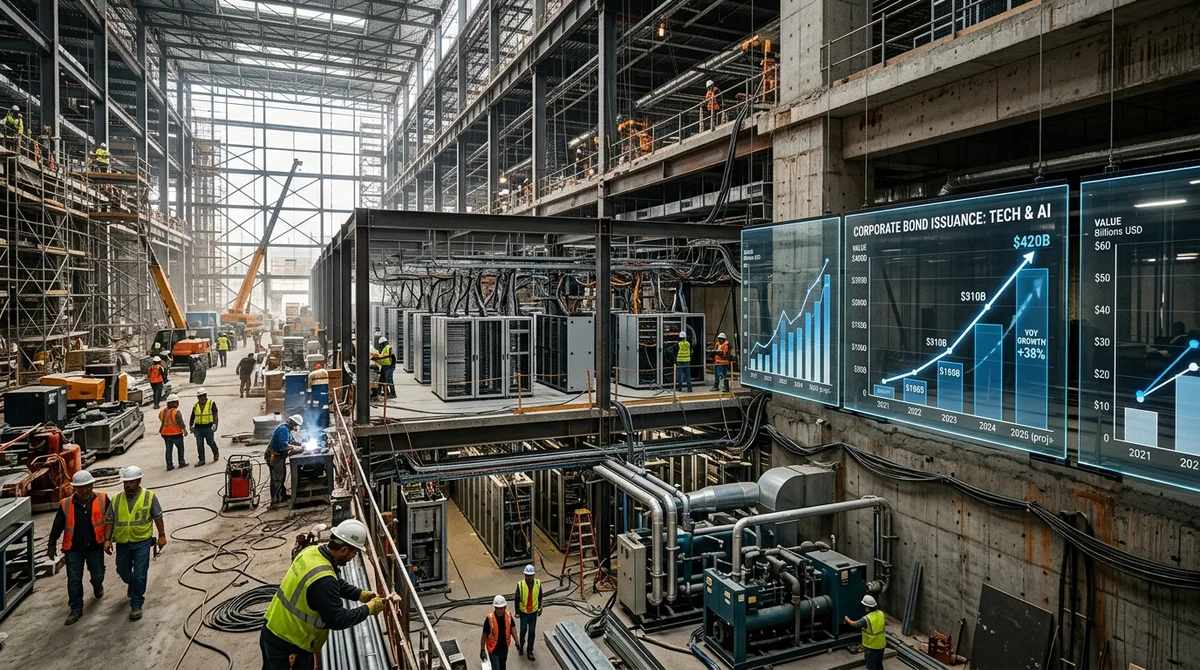
The race for generative AI is changing not only Big Tech products but also their financial model. Companies that for years could finance growth from operating cash flow now increasingly turn to the debt market to accelerate data center construction and purchase of computing power.
Why money is no longer enough
Until recently, Google, Meta, and Amazon looked like companies that barely needed debt: high margins, huge cash reserves, and growing stock allowed them to finance expansion without drastic measures. But generative AI turned out to be a different category of expenses. This is not about launching another service, but about building industrial-scale infrastructure — data centers, networks, cooling systems, and clusters of expensive accelerators on which models are trained and run.
Because of this, the logic of financing itself is changing for the major players. Instead of spending only current profits, they are adding large borrowings to them. Amazon in March for the first time entered the European debt market and attracted €14.
5 billion, and before that borrowed about $37 billion in the US. Alphabet in February placed a global issue of approximately $31.5 billion, including rare ultra-long-dated bonds.
Meta borrowed about $30 billion last fall. For an industry that long lived with almost no debt pressure, this is already a new norm.
Scale of the new construction
The reason is simple: AI has become a capital-intensive business. Tech giants simultaneously create their own models, serve millions of users, and rent capacity to startups and corporate clients through the cloud. This mode requires constant expansion of the computing base, and very quickly — before competitors get ahead.
- Amazon after American and European placements raised almost $54 billion equivalent.
- The five largest AI hyperscalers issued approximately $121 billion in bonds in 2025 compared to an average of $28 billion in 2020–2024.
- After Amazon's deal, BofA analysts raised their forecast for new borrowing in the sector for 2026 to $175 billion.
- Alphabet reported that its capital expenditures in 2026 could reach $185 billion.
- Most of this money goes to data centers, energy, networks, and AI chips.
It is also important that it's not only about protecting current positions. The cloud divisions of these companies are already earning from others' AI boom, selling computing power to startups and corporations. The greater the demand for models and inference, the stronger the incentive to build new capacity in advance. Otherwise, the company risks falling behind the market and losing both margins and customers.
Why the market isn't panicking
The paradox is that investors currently perceive this debt surge calmly. Amazon, Alphabet, and Meta still have strong balance sheets, high credit ratings, and large cash flows. Therefore, their bonds are being snapped up very actively: for example, demand for Alphabet's dollar offering in February far exceeded the placement volume.
In fact, the market is betting that the largest platforms will be the first to monetize AI infrastructure and be able to return investments through cloud, advertising, subscriptions, and corporate services. But the risk doesn't go away. If demand for AI services turns out to be lower than expected or equipment becomes obsolete faster than anticipated, debt burden will become more noticeable and investment returns weaker.
An additional question is how long markets will patiently finance giant budgets without a clear answer to where exactly the main source of profit is located. So far, investors are willing to believe that the winners will be the largest and fastest. But it's precisely this credit comfort that drives the race even harder.
What it means
The AI transition is becoming not only a technological but also a financial race. Winners will not be just those with the best model, but those who can attract capital faster and cheaper, build infrastructure, and turn computing into revenue before the market gets tired of waiting.
Want to stop reading about AI and start using it?
AI News is a curated feed of AI/tech news. Hamidun Academy teaches you to use AI systematically in your work.
The AI world, distilled — once a week
Seven stories that actually mattered, hand-picked. No noise, no reposts, no press releases.
Done! Check your inbox for a confirmation.