Amazon, Google and Meta Are Piling On Debt to Fund the New AI Infrastructure Race
Cash flow alone no longer covers Big Tech's AI spending. Amazon, Google and Meta have sharply increased their borrowing to build data centers and buy chips. Amazon alone has raised the equivalent of nearly $54 billion, and bond issuance by the largest hyperscalers has hit record levels. Investors remain calm for now, but the market wants proof that this spending will actually pay off. *Meta is designated an extremist organization and banned in Russia.
AI-processed from Bloomberg Tech; edited by Hamidun News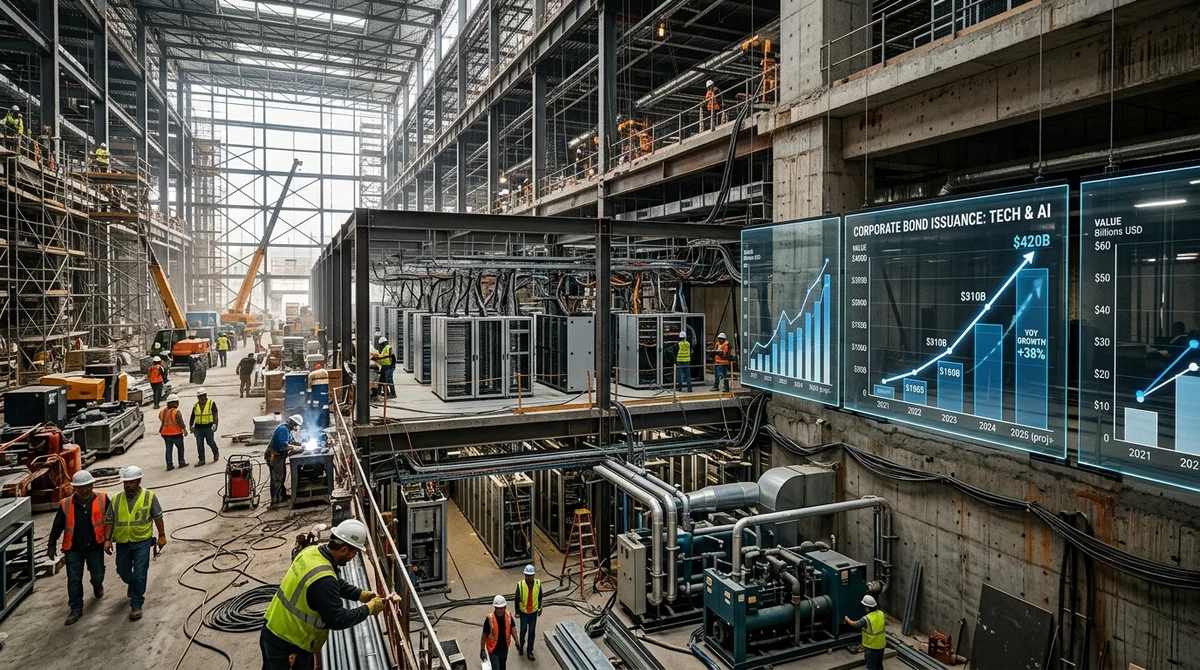
The generative AI race is changing more than Big Tech's products. It is also changing how these companies pay for growth. For years, they could fund expansion out of operating cash flow. Now they increasingly turn to the debt market to speed up data center construction and buy more compute.
Why the cash is no longer enough
Until recently, Google, Meta and Amazon looked like companies that barely needed debt. High margins, huge cash reserves and rising stock prices let them fund expansion without drastic moves. Generative AI, however, turned out to be a different category of spending. This isn't about launching one more service. It means building industrial-scale infrastructure: data centers, networks, cooling systems and clusters of expensive accelerators that train and run the models.
As a result, the biggest players are rethinking how they finance themselves. Instead of spending only current profits, they now add large-scale borrowing on top. In March, Amazon tapped the European debt market for the first time and raised €14.5 billion, after borrowing roughly another $37 billion in the US. In February, Alphabet sold a global bond offering worth about $31.5 billion, including rare ultra-long-dated notes. Meta borrowed about $30 billion back in the fall. For an industry that long operated with almost no debt pressure, this is now the new normal.
The scale of the buildout
The reason is simple: AI has become a capital-intensive business. The tech giants are building their own models, serving millions of users and renting capacity to startups and enterprise customers through the cloud, all at the same time. That requires constantly expanding their compute base, and doing it fast, before competitors pull ahead.
- After its US and European offerings, Amazon has raised the equivalent of nearly $54 billion.
- The five largest AI hyperscalers issued about $121 billion in bonds in 2025, compared with an average of $28 billion in 2020–2024.
- After the Amazon deal, BofA analysts raised their forecast for new sector borrowing in 2026 to $175 billion.
- Alphabet has said its capital expenditures in 2026 could reach $185 billion.
- Most of this money goes to data centers, energy, networking and AI chips.
This isn't only about defending current positions, either. The cloud divisions of these companies already profit from other players' AI boom by selling compute to startups and corporations. The higher the demand for models and inference, the stronger the incentive to build new capacity ahead of time. Otherwise, a company risks falling behind the market and losing both margins and customers.
Why the market isn't panicking
The paradox is that investors are, for now, taking this debt surge in stride. Amazon, Alphabet and Meta still have strong balance sheets, high credit ratings and large cash flows. That's why their bonds sell briskly: demand for Alphabet's dollar offering in February, for example, exceeded the issue size many times over. In effect, the market is betting that the largest platforms will be the first to monetize AI infrastructure and will be able to recoup their investments through cloud, advertising, subscriptions and enterprise services.
The risk hasn't gone away, though. If demand for AI services falls short of expectations, or hardware becomes obsolete faster than projected, the debt load will become more noticeable and returns on investment will weaken. Another open question is how long markets will patiently fund massive budgets without a clear answer about where the main source of profit actually lies. For now, investors are willing to believe the biggest and fastest players will win. But that same credit comfort is pushing the race even harder.
What it means
The AI transition is becoming a financial race as well as a technological one. The winners won't simply be those with the best model. They will be the companies that can raise capital faster and more cheaply, build the infrastructure and turn compute into revenue before the market gets tired of waiting.
*Meta is designated an extremist organization and banned in Russia.
- Nov 1, 2026Google taught its StreamVibe video agent to decide when to step in on its own: +10.7%
- Nov 1, 2026OpenAI Rewrites GPT Behavior Rules: Five Values and a Chain of Command
- Nov 1, 2026Voice bots built on LLMs turn to Jev, a fast classifier, for decisions in 200–500 ms
- Nov 1, 2026Google admits AI Mode cuts search revenue, shares fall 15%
Key Questions Answered
Why the cash is no longer enough?
Until recently, Google, Meta and Amazon looked like companies that barely needed debt. High margins, huge cash reserves and rising stock prices let them fund expansion without drastic moves. Generative AI, however, turned out to be a different category of spending. This isn't about launching one more service. It means building industrial-scale infrastructure: data centers, networks, cooling systems and clusters of expensive accelerators that train and run the models. As a result, the biggest players are rethinking how they finance themselves. Instead of spending only curren
What are the key details on The scale of the buildout?
The reason is simple: AI has become a capital-intensive business. The tech giants are building their own models, serving millions of users and renting capacity to startups and enterprise customers through the cloud, all at the same time. That requires constantly expanding their compute base, and doing it fast, before competitors pull ahead. After its US and European offerings, Amazon has raised the equivalent of nearly $54 billion. The five largest AI hyperscalers issued about $121 billion in bonds in 2025, compared with an average of $28 billion in 2020–2024. After the Ama
Why the market isn't panicking?
The paradox is that investors are, for now, taking this debt surge in stride. Amazon, Alphabet and Meta still have strong balance sheets, high credit ratings and large cash flows. That's why their bonds sell briskly: demand for Alphabet's dollar offering in February, for example, exceeded the issue size many times over. In effect, the market is betting that the largest platforms will be the first to monetize AI infrastructure and will be able to recoup their investments through cloud, advertising, subscriptions and enterprise services. The risk hasn't gone away, though. If
Test Frontier LLMs & Autonomous Agents in One Workspace
Run Claude Opus 5.5, GPT-6, Gemini 3.1, and DeepSeek side-by-side in Nomad AI (nomadnet.ai) — unified model routing, deep research, and multimodal workflows under one subscription.
The AI world, distilled — once a week
Seven stories that actually mattered, hand-picked. No noise, no reposts, no press releases.
Done! Check your inbox for a confirmation.