MIT Teaches Generative AI to Reconstruct Hidden Objects Using Wireless Signals
MIT improved wireless 'vision' for robots: a generative model reconstructs hidden parts of objects from mmWave signal reflections similar to Wi-Fi. The…
AI-processed from MIT News; edited by Hamidun News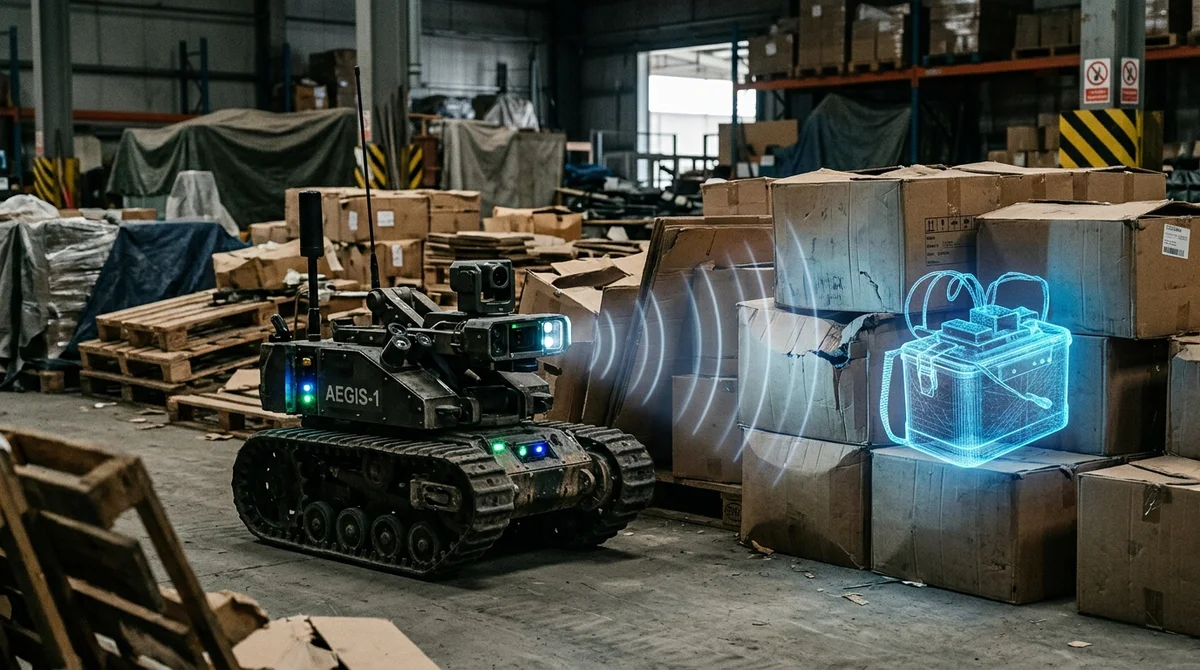
MIT Taught Generative AI to Reconstruct Hidden Objects from Wireless Signals
MIT researchers improved a wireless "vision" system that recognizes objects hidden behind obstacles by analyzing reflections of millimeter-wave signals. A generative model now reconstructs the missing parts of the shape and helps robots more accurately understand what's behind cardboard, plastic, drywall, or fabric.
How it works
Previous versions of such systems already knew how to use mmWave signals to assemble a rough 3D model of an object hidden behind a barrier. The problem was in the physics of reflection: waves often travel in one direction and don't return to the sensor. Because of this, the system usually only "saw" the top part of an object, while the sides and bottom surfaces remained empty zones. For a robot, this is critical: if the shape is reconstructed inaccurately, the manipulator struggles to determine how to safely grasp an object and how it's positioned in space.
To work around this limitation, the MIT team added a generative model that receives incomplete reconstruction and reconstructs a plausible complete shape. However, they lacked real mmWave datasets for training, so the researchers took a different approach: they took large computer vision image datasets and adapted them to wireless reflection properties, including specularity and noise. On this synthetic basis, they trained the Wave-Former system. It first suggests possible object surfaces based on reflections, then the model fills in the gaps, and finally refines the geometry to a complete 3D reconstruction.
Accuracy and scenes
In tests, Wave-Former reconstructed the shapes of approximately 70 everyday objects — from cans and boxes to fruits and kitchen utensils. Objects were hidden behind cardboard, wood, drywall, plastic, and fabric, or placed under such materials. According to MIT, the new approach provided nearly 20 percent more accurate reconstruction compared to the best previous methods. For practical applications, this is an important step: the system not only detects the presence of an object, but gets closer to understanding its actual shape, volume, and boundaries.
"We use AI to finally unlock the potential of wireless vision," says
Fadel Adib, who led the work.
The team didn't stop there and built a second system — RISE, which reconstructs not just individual objects, but an entire room. For this, it only needs one stationary radar and human movement inside the space. When a person walks, part of the signal reflects off them, then off walls and furniture, and then returns to the sensor. Such secondary reflections are usually considered noise and discarded, but MIT taught the model to extract scene layout from them. In experiments on more than 100 human movement trajectories, RISE was on average approximately twice as accurate as existing methods.
Where it will be useful
The practical value here lies not only in accuracy, but also in the format of application. Scene analysis doesn't require a mobile robot with a sensor that must drive around and scan the space from different points. A single stationary radar is sufficient. Plus, the method doesn't rely on conventional cameras, so it's better suited for scenarios where people's privacy in the frame is important.
- Checking box and package contents before shipping
- Finding items hidden under other objects in a warehouse or at home
- Reconstructing a room layout with a single stationary sensor
- Determining human position for safer robot movement
- Scenarios where using cameras is undesirable due to privacy concerns
If the technology becomes more detailed and robust, it will have a chance to move beyond the laboratory. The MIT team directly states that the next step is larger foundation models for wireless signals, similar to how GPT, Claude, and Gemini work with text and images. This approach could transform wireless sensing from a narrow research tool into a universal perception layer for robots and smart spaces.
What this means
MIT demonstrates an interesting shift: instead of manually squeezing maximum value from each reflection, researchers give the generative model the task to infer missing geometry from partial data. If this approach scales, robots will be able to more confidently "see" behind barriers where an ordinary camera is useless or undesirable.
Want to stop reading about AI and start using it?
AI News is a curated feed of AI/tech news. Hamidun Academy teaches you to use AI systematically in your work.