Jan Lane: Why AI Threats Break Cyber Defenses Even With Record Corporate Budgets
Cybersecurity keeps getting more expensive, yet companies still miss attacks. Jan Lane of Visio Cyber AI says the problem is not a shortage of solutions but a chaotic collection of them: teams drown in alerts, cannot see the big picture and react too late. As AI-driven threats grow, businesses need a single strategy, AI to prioritize signals, and training for employees.
AI-processed from TNW; edited by Hamidun News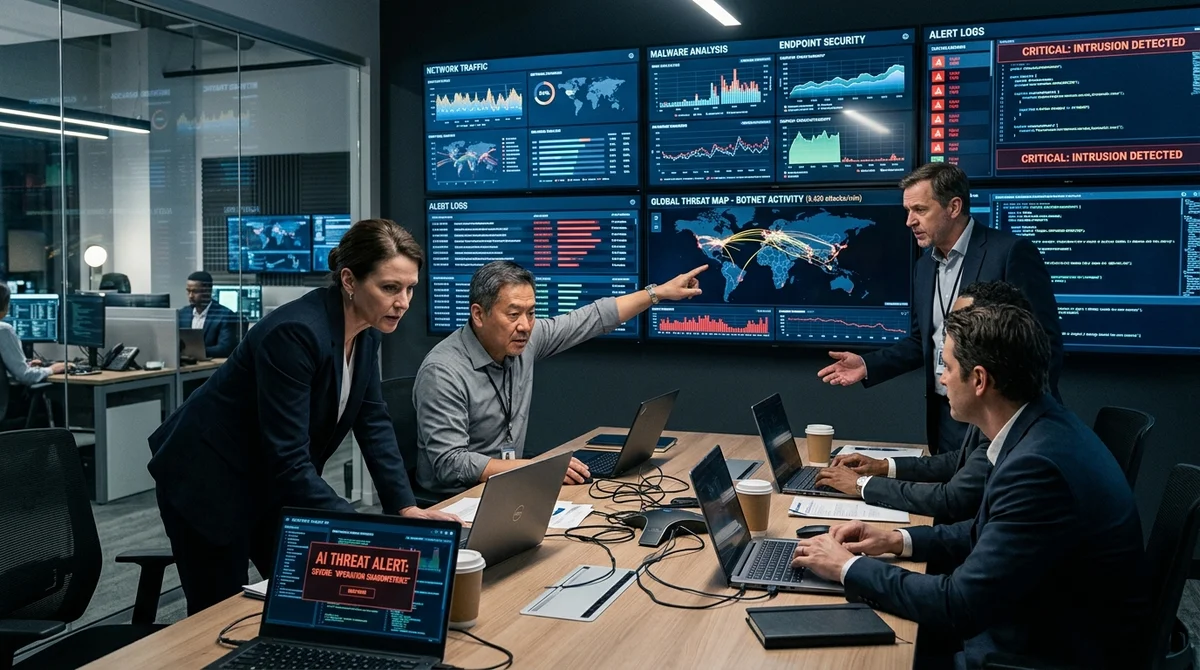
Companies are spending more and more on cybersecurity, but that does not guarantee real protection. Visio Cyber AI founder Jan Lane believes that in the era of AI threats, businesses lose not for lack of solutions but because they have no clear strategy, poor integration and overloaded teams.
The illusion of security
From the outside, the picture looks convincing: global cybersecurity spending in 2026 is expected to exceed $522 billion. But damage from cybercrime is growing in parallel, and it may reach $10.5 trillion a year. Lane argues that this gap shows something uncomfortable: bigger budgets alone do not make companies more resilient.
Businesses buy new tools, expand their stack and sign vendor contracts, only to discover that at the critical moment they cannot see the whole picture and respond too slowly. Lane says that in many companies, security turns into a kit of poorly connected products. Each tool produces its own signals, warnings and reports, but they do not add up to a single decision-making system. As a result, teams look at their infrastructure through separate "windows" rather than one unified dashboard. This creates a false sense of control: protection seems stronger because there are many tools, while in practice they create fragmentation and competing noise.
Noise instead of response
This is most painful in security operations centers. Analysts receive thousands of alerts every day, and a significant share turn out to be false positives or events with no priority. Lane stresses that the alerts themselves are not the problem: they are necessary and show that defenses are working. But when there are too many signals, the team stops distinguishing an urgent threat from background noise, and truly dangerous incidents risk getting lost in the stream.
Lane estimates that this noise is not caused by random failures but by a repeating, predictable set of management mistakes. Companies often assume that adding new solutions automatically strengthens security, when without integration and clear roles the opposite happens. In her view, weakness arises not in any one product but in how leadership assembles the entire security perimeter and which signals the team can process in time.
- companies add products without checking how they work together;
- executives treat cybersecurity as an IT department task rather than a business risk;
- teams lack a unified view of the environment and clear incident prioritization;
- employees remain the weak link because of phishing, compromised credentials and a lack of training.
What grows out of this is no longer a technical problem but a management one. Leadership focuses on growth and financial results but underestimates how a cyber incident hits revenue, customer trust and the company's ability to keep operating. One serious breach can lead not only to downtime but also to fines, lawsuits and a long reputational recovery. According to Lane, many recognize the scale of the risk only after an incident, when the price of the mistake is already obvious.
AI versus AI
Lane believes the growth of AI threats cannot be met with the old playbook. If attackers speed up their attacks with AI, defenders need AI too: to prioritize alerts, cut false positives and quickly spot genuinely dangerous patterns. This is not about a fashionable label on yet another product, but about an intelligent layer that helps teams see the whole environment and make decisions faster, in real time.
"As AI threats grow, you need to use AI to fight AI."
This logic is especially relevant given that 95% of IT and security professionals expect threats to intensify because of AI, and more than 80% of cyberattacks already use AI in one form or another.
But automation alone is not enough. Lane separately emphasizes the role of employees: human error remains one of the main causes of breaches. Resilience is therefore built not only on technology but also on a team's cyber hygiene, training in recognizing attacks and discipline in handling access.
What this means
The main takeaway for business is simple: the winners are not those with the most security tools, but those who understand risk faster and act in a coordinated way. In the era of AI attacks, cybersecurity becomes a question of managerial clarity, not just of buying new tools.
Key Questions Answered
What are the key details on The illusion of security?
From the outside, the picture looks convincing: global cybersecurity spending in 2026 is expected to exceed $522 billion. But damage from cybercrime is growing in parallel, and it may reach $10.5 trillion a year. Lane argues that this gap shows something uncomfortable: bigger budgets alone do not make companies more resilient. Businesses buy new tools, expand their stack and sign vendor contracts, only to discover that at the critical moment they cannot see the whole picture and respond too slowly. Lane says that in many companies, security turns into a kit of poorly connec
What are the key details on Noise instead of response?
This is most painful in security operations centers. Analysts receive thousands of alerts every day, and a significant share turn out to be false positives or events with no priority. Lane stresses that the alerts themselves are not the problem: they are necessary and show that defenses are working. But when there are too many signals, the team stops distinguishing an urgent threat from background noise, and truly dangerous incidents risk getting lost in the stream. Lane estimates that this noise is not caused by random failures but by a repeating, predictable set of manage
What are the key details on AI versus AI?
Lane believes the growth of AI threats cannot be met with the old playbook. If attackers speed up their attacks with AI, defenders need AI too: to prioritize alerts, cut false positives and quickly spot genuinely dangerous patterns. This is not about a fashionable label on yet another product, but about an intelligent layer that helps teams see the whole environment and make decisions faster, in real time. "As AI threats grow, you need to use AI to fight AI." This logic is especially relevant given that 95% of IT and security professionals expect threats to intensify becaus
Test Frontier LLMs & Autonomous Agents in One Workspace
Run Claude Opus 5.5, GPT-6, Gemini 3.1, and DeepSeek side-by-side in Nomad AI (nomadnet.ai) — unified model routing, deep research, and multimodal workflows under one subscription.
The AI world, distilled — once a week
Seven stories that actually mattered, hand-picked. No noise, no reposts, no press releases.
Done! Check your inbox for a confirmation.