Google DeepMind unveils AI co-clinician for doctors and telemedicine
Google DeepMind has announced AI co-clinician, a research system designed to support doctors and patients under a specialist's supervision. In blind tests, physicians more often preferred its answers to clinical queries, and in telemedicine simulations the model was able to conduct basic visual and voice interviews. But the company itself stresses that this is not a finished medical product and not a replacement for a doctor.
AI-processed from DeepMind Blog; edited by Hamidun News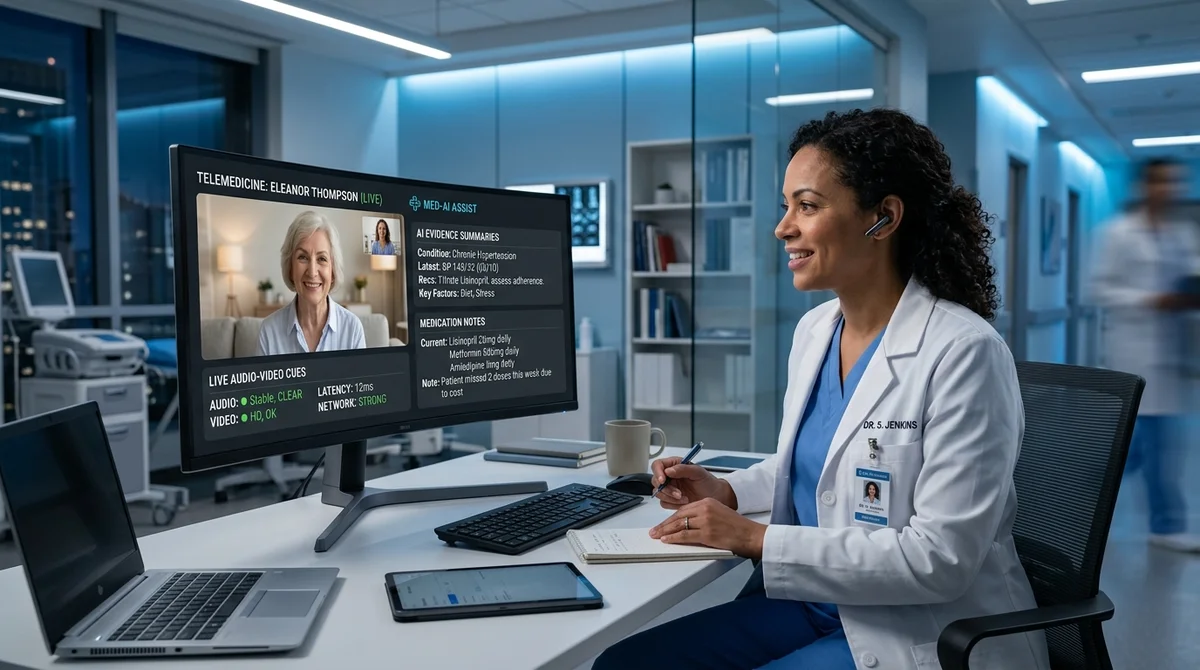
On April 30, 2026, Google DeepMind introduced AI co-clinician, a research initiative for a system meant to help doctors and patients as part of a clinical team, not to override a specialist's judgment. The company is testing whether such an AI can speed up access to evidence-based information, answer medication questions better and support telemedicine consultations under a physician's supervision.
Why the project exists
DeepMind starts from a simple problem: healthcare systems do not have enough people. The company cites a WHO forecast of a shortage of more than 10 million health workers by 2030. Against that backdrop, AI is often pitched as a universal fix, but in practice doctors do not need merely a chatty chatbot. They need a tool they can trust in real clinical scenarios, with verifiable answers, clear limitations and the ability to leave the final decision to a human.
That is why DeepMind describes the model as a co-clinician rather than an autonomous doctor. The idea is that the patient, the doctor and the AI form a triad: the system helps gather data, find relevant guidelines and support the patient through treatment, while clinical responsibility stays with the specialist. The company calls this approach a step toward AI-augmented care, where AI expands the team's capabilities instead of handing down final verdicts itself.
"Medicine has always been a team sport, and AI agents can add new
players to it."
How the system was tested
For doctor-AI scenarios, DeepMind worked with academic physicians to adapt the NOHARM framework. It scores two types of errors: when the system says something wrong, and when it fails to mention critically important information. In blind comparisons, doctors consistently preferred AI co-clinician's answers to popular tools for synthesizing evidence-based information. In a separate analysis of 98 realistic primary care queries, the system handled 97 cases without critical errors, which DeepMind presents as an improvement over two other widely used AI systems.
The model was also put through hard questions about medications and therapeutic interventions. For this, the team used the RxQA set built from OpenFDA, which tests not only factual knowledge but also medical reasoning. According to the company, AI co-clinician gained most noticeably on open-ended questions, which is how they come up in real practice, rather than in multiple-choice format.
- 98 realistic primary care queries
- 97 of 98 cases without critical errors
- An advantage on open-ended questions about drugs and therapy
- 20 synthetic clinical scenarios for telemedicine simulations
- Comparable or better results than primary care physicians on 68 of 140 criteria
Another line of research covers a multimodal mode for telemedicine. DeepMind, together with doctors from Harvard and Stanford, tested the system on live audio and video, building on work from Gemini and Project Astra. In simulations with 20 clinical scenarios, the agent did things text-only systems cannot do: for example, coaching the correct inhaler technique or guiding a patient through shoulder movements to identify a possible rotator cuff injury. The company's overall conclusion is cautious, though: across more than 140 parameters, expert physicians still came out ahead, especially at spotting warning symptoms and performing critically important examinations.
Limitations and safeguards
This is arguably the key part of the news: DeepMind is very explicit that it is not selling AI co-clinician as a finished medical product. The company writes that the current research collaborations are not intended for diagnosing, treating or preventing disease, or for providing medical advice. The work is about studying how such systems can be evaluated safely and where they are actually useful, without inflated promises.
For patient-facing telemedicine scenarios, DeepMind uses a two-agent architecture: a Planner module continuously tracks the course of the consultation, while a Talker module conducts the dialogue and is supposed to stay within safe clinical boundaries. For doctor-facing scenarios, the system emphasizes a "clinical-grade" level of evidence, including verification of retrieved information and citation checks. In parallel, the company is launching staged evaluations with partners in the US, India, Australia, New Zealand, Singapore and the UAE to test the approach in different healthcare contexts.
What this means
DeepMind shows an important shift: medical AI is increasingly measured not only by exam-style tests but by its ability to work inside a real clinical process. Replacing doctors is a very long way off, but the role of an assistant that helps with the evidence base, medication questions and part of the telemedicine routine now looks less like an abstract demo and more like a subject of systematic evaluation.
- Nov 1, 202616 models tested on 7 search tools: Exa averaged 10.5 out of 14, SearXNG about 3
- Nov 1, 2026Google's StreamVibe video agent beats other models by 10.7% on response timing and quality
- Nov 1, 2026OpenAI Rewrites GPT Behavior Rules: Five Values and a Chain of Command
- Nov 1, 2026Voice bots built on LLMs turn to Jev, a fast classifier, for decisions in 200–500 ms
Key Questions Answered
Why the project exists?
DeepMind starts from a simple problem: healthcare systems do not have enough people. The company cites a WHO forecast of a shortage of more than 10 million health workers by 2030. Against that backdrop, AI is often pitched as a universal fix, but in practice doctors do not need merely a chatty chatbot. They need a tool they can trust in real clinical scenarios, with verifiable answers, clear limitations and the ability to leave the final decision to a human. That is why DeepMind describes the model as a co-clinician rather than an autonomous doctor. The idea is that the pat
How the system was tested?
For doctor-AI scenarios, DeepMind worked with academic physicians to adapt the NOHARM framework. It scores two types of errors: when the system says something wrong, and when it fails to mention critically important information. In blind comparisons, doctors consistently preferred AI co-clinician's answers to popular tools for synthesizing evidence-based information. In a separate analysis of 98 realistic primary care queries, the system handled 97 cases without critical errors, which DeepMind presents as an improvement over two other widely used AI systems. The model was a
What are the key details on Limitations and safeguards?
This is arguably the key part of the news: DeepMind is very explicit that it is not selling AI co-clinician as a finished medical product. The company writes that the current research collaborations are not intended for diagnosing, treating or preventing disease, or for providing medical advice. The work is about studying how such systems can be evaluated safely and where they are actually useful, without inflated promises. For patient-facing telemedicine scenarios, DeepMind uses a two-agent architecture: a Planner module continuously tracks the course of the consultation,
Test Frontier LLMs & Autonomous Agents in One Workspace
Run Claude Opus 5.5, GPT-6, Gemini 3.1, and DeepSeek side-by-side in Nomad AI (nomadnet.ai) — unified model routing, deep research, and multimodal workflows under one subscription.
The AI world, distilled — once a week
Seven stories that actually mattered, hand-picked. No noise, no reposts, no press releases.
Done! Check your inbox for a confirmation.