Roblox is building Reality, an AI-rendering platform betting on photorealistic graphics
Roblox is developing Reality, a hybrid platform in which a conventional engine handles physics, synchronization and game state, while AI enhances the image on top of the finished scene. Part of the visual layer will be built on video world models. The company is aiming for 2K at 60 fps, but the technology does not yet run in real time and requires nearby data centers with powerful Nvidia accelerators. The engine keeps the core job of deciding what happens in the world. AI is trusted only with how that world looks on screen. The company's own description of the current version is that it cannot yet work in real time.
AI-processed from 3DNews AI; edited by Hamidun News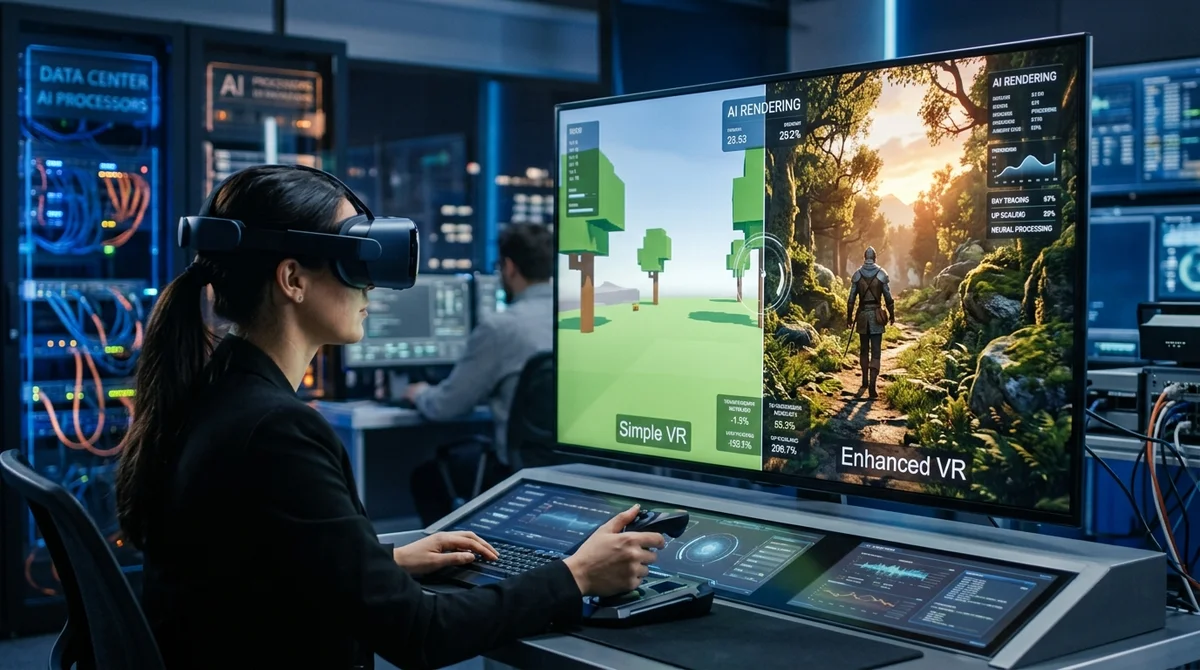
Roblox is preparing Reality, a new technical foundation for its platform in which part of the visual layer will be generated by an AI world model. The company wants to keep a familiar game engine for logic and synchronization, and hand the drawing of a more complex, detailed and visually rich picture to neural networks.
How Reality works
Reality is described as a hybrid system. Its core is still the familiar Roblox cloud engine, but on top of it the company wants to add so-called Video World Models, which will run on cloud edge infrastructure closer to the user. This matters for latency: the shorter the path to the nearest data center, the better the chance that such an approach can look smooth at all and not fall apart into motion artifacts.
The engine itself does not go anywhere and continues to do the most important part of the work. It handles game state, player positions, physics, interactions between objects and session synchronization. In other words, Roblox is not trying to replace the classic game runtime entirely with a generative model. The company proposes dividing the duties: the engine calculates what happens in the world, and AI improves how that world looks on screen.
What AI will draw in
Once the base engine outputs video and spatial scene data, an additional higher-quality visual layer is meant to be built on top of them. It could include more complex textures, lighting, movement of secondary objects and a detailed environment. Conceptually, this resembles image-enhancement methods already familiar to the market, although Roblox is betting on its own architecture and a broader visual pipeline.
In practical terms, this could give the platform several effects at once:
"DLSS 5 at home" is how the foreign press has already labeled
Roblox's approach.
- Denser, more realistic textures without a full overhaul of older game worlds
- Complex lighting and visual nuances on top of existing geometry
- A livelier environment with extra objects and small animations
- Higher visual quality without moving all of the game's logic into a generative model
This is especially interesting for Roblox because of its huge base of existing user-made content. Instead of rebuilding the entire game catalog for a new engine, the company can try to use accumulated data as the basis for AI rendering. If the scheme works, developers inside the ecosystem could potentially get a way to refresh their visuals and bring them closer to a level that was previously out of reach for a typical Roblox project. This is especially important for creators with limited resources.
Reality's technical limits
For now all of this remains a lab technology, not a finished consumer feature. The current version, according to the company's description, is not yet capable of working in real time. The goal is ambitious: 2K resolution at 60 frames per second. To get close to those figures, Roblox is counting on connecting data centers nearest to the user with accelerators of the Nvidia H200 or B200 class. That means this is not a lightweight software add-on but heavy cloud infrastructure with very expensive hardware.
There are also fundamental limitations in world models themselves. They still handle state persistence, long-term memory, custom game rules and full simulation poorly, in a mode where everything must be predictable and consistent. That is why Roblox explicitly separates the roles: the integrity of gameplay stays with the traditional engine, and AI is trusted only with visual elements. For the same reason, a direct comparison with DLSS 5 is not quite accurate: Nvidia already has solutions built for real-time operation, whereas Reality is only moving toward that goal.
What this means
Roblox is trying not merely to improve graphics but to rethink the very architecture of a mass-market game platform. If Reality reaches a working 2K/60 fps mode without critical latency, the market will get an important precedent: generative models will be able to enhance the visual side of large online worlds without breaking their game logic.
- Nov 2, 2026Anthropic needs to grow revenue 32% a year to cover $850 billion in contracts
- Nov 2, 2026TensorFold 1.2.0 boosts Qwen3.8-27B throughput on M3 Ultra by 44.2% at 16 streams
- Nov 1, 2026Local models lose to Opus and Codex: 0.21 on a MacBook versus 1.00 for Codex
- Nov 1, 2026Habr author fine-tunes YOLOv8l on dental X-rays and pushes mAP50 to 0.642
Key Questions Answered
How Reality works?
Reality is described as a hybrid system. Its core is still the familiar Roblox cloud engine, but on top of it the company wants to add so-called Video World Models, which will run on cloud edge infrastructure closer to the user. This matters for latency: the shorter the path to the nearest data center, the better the chance that such an approach can look smooth at all and not fall apart into motion artifacts. The engine itself does not go anywhere and continues to do the most important part of the work. It handles game state, player positions, physics, interactions between
What AI will draw in?
Once the base engine outputs video and spatial scene data, an additional higher-quality visual layer is meant to be built on top of them. It could include more complex textures, lighting, movement of secondary objects and a detailed environment. Conceptually, this resembles image-enhancement methods already familiar to the market, although Roblox is betting on its own architecture and a broader visual pipeline. In practical terms, this could give the platform several effects at once: "DLSS 5 at home" is how the foreign press has already labeled Roblox's approach. Denser, mo
What are the key details on Reality's technical limits?
For now all of this remains a lab technology, not a finished consumer feature. The current version, according to the company's description, is not yet capable of working in real time. The goal is ambitious: 2K resolution at 60 frames per second. To get close to those figures, Roblox is counting on connecting data centers nearest to the user with accelerators of the Nvidia H200 or B200 class. That means this is not a lightweight software add-on but heavy cloud infrastructure with very expensive hardware. There are also fundamental limitations in world models themselves. They
Test Frontier LLMs & Autonomous Agents in One Workspace
Run Claude Opus 5.5, GPT-6, Gemini 3.1, and DeepSeek side-by-side in Nomad AI (nomadnet.ai) — unified model routing, deep research, and multimodal workflows under one subscription.
The AI world, distilled — once a week
Seven stories that actually mattered, hand-picked. No noise, no reposts, no press releases.
Done! Check your inbox for a confirmation.