AWS unveils a system for migrating and upgrading production LLMs with prompt optimization
AWS has outlined the Generative AI Model Agility Solution, a framework for teams that want to migrate or upgrade production LLMs without chaos or downtime. The approach centers on prompt conversion and optimization, backed by formal quality evaluation procedures before release. It targets companies that want to switch between vendors, model versions, and pricing terms faster and more safely.
AI-processed from AWS Machine Learning Blog; edited by Hamidun News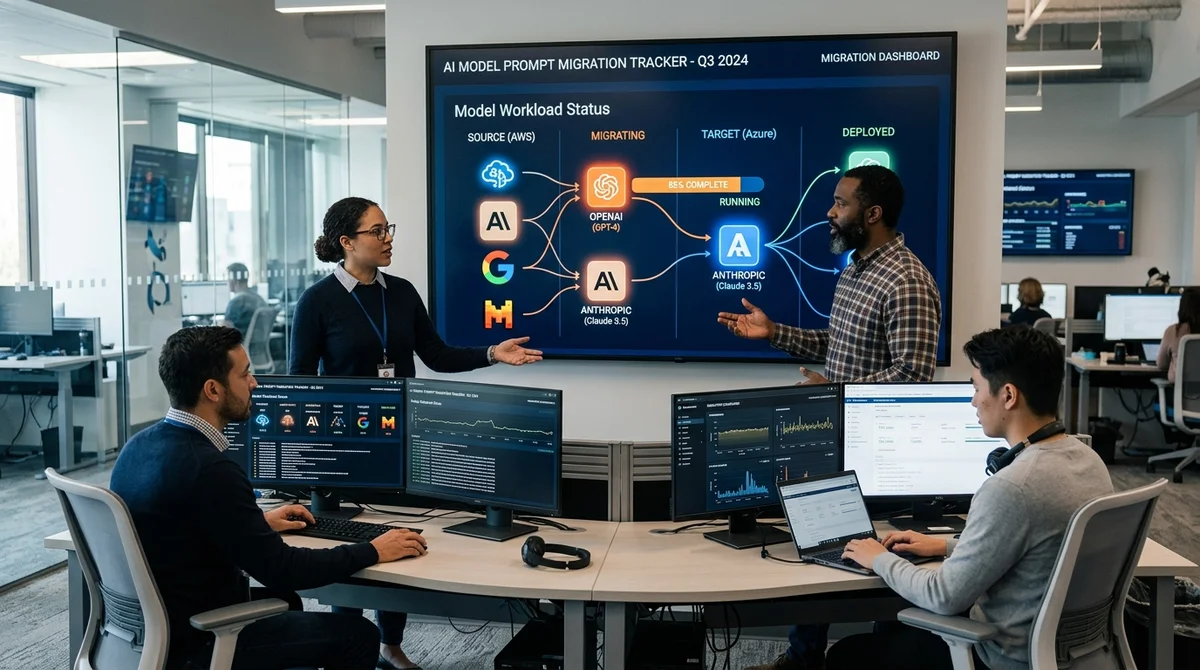
AWS has introduced the Generative AI Model Agility Solution, a set of practices and tools for teams that need to migrate or upgrade large language models in production. The idea is to swap the underlying LLM without frantically rewriting the whole application, following instead a formal playbook that checks prompts, quality, and business metrics.
Why migration matters
Most AI products launch on a single model and quickly hit its limits: costs climb, latency falls short, rate limits change, a stronger model ships from another vendor, or the business imposes new security requirements. In a demo, this looks like a simple API swap, but a real system is more complicated. The same prompt on a new model can turn too verbose, follow the output format less reliably, make more factual errors, or handle Russian differently.
AWS frames migration not as a one-off manual task but as an engineering problem with a repeatable process. That is an important shift: if a company runs dozens of use cases, retrieval chains, structured outputs, and automated actions, swapping the model without discipline quickly turns into a series of hidden breakages. In production, those failures hurt more than answer quality — they also hit support, costs, and user trust.
What AWS is offering
The announcement centers on a systematic framework for migrating and upgrading LLMs in production. AWS covers not just tooling but methodology: how to prepare the transition, how to convert prompts, how to optimize them for the new model's behavior, and how to codify best practices so the team can repeat the process. In effect, it standardizes work that many companies still do by hand and by gut feeling.
Under this approach, a team goes through several required steps:
- inventories its current prompts, templates, and critical use cases
- adapts instructions to the target model's format and style
- optimizes prompts for the new model's behavior, constraints, and strengths
- runs quality, cost, and latency checks before release
- prepares a staged rollout and a rollback path in case of regressions
Notably, AWS ties migration specifically to prompt conversion and optimization. That is a practical emphasis. In most AI systems, the problem is not that the new model is "bad" but that the application keeps talking to it in the old model's language. If you don't adapt system instructions, few-shot examples, tool-calling formats, and evaluation criteria, even a strong LLM can perform worse than its predecessor simply because of the wrong scaffolding.
What to watch in production
The main hidden risk in swapping an LLM is not the chat response itself but the behavior of the whole pipeline around it. Use cases are especially sensitive when the model must return strict JSON, call a tool correctly, follow a moderation policy, or avoid breaking a RAG pipeline. Differences between models often show up not in average text quality but in the details: response length, robustness on long context, tendency to refuse, instruction-following accuracy, and predictability on edge cases.
That is why the value of the AWS approach lies in formalizing the comparison. Instead of a subjective "this model seems to answer better," the team gets a process: adapt the prompt, run the test suite, compare against the baseline model, find regressions, and only then ship the changes. This mode is especially useful while the LLM market moves this fast: new versions ship constantly, pricing models change, and dependence on a single vendor becomes a product risk in its own right.
What it means
AWS is essentially packaging the idea of model agility into a working operational scheme: don't lock yourself into one LLM, and build the system so the model can be replaced without panic or a full product rewrite. For companies already putting generative AI into production, this is becoming not a secondary optimization but a core capability — the ability to quickly rebalance between quality, cost, and business requirements.
- Oct 31, 2026Worldwide Express hands disputed invoices to AI agents and cuts unresolved disputes by 75%
- Oct 30, 2026AWS gives coding agents a live site preview straight from an isolated session
- Oct 30, 2026MoEngage Opens 400 Private APIs to AI Agents Through AgentCore Gateway, Without Building Its Own MCP Servers
- Oct 29, 2026NVIDIA Nemotron 3.5 Super VL: 120B Parameters, 12B Active, Running on AWS
Key Questions Answered
Why migration matters?
Most AI products launch on a single model and quickly hit its limits: costs climb, latency falls short, rate limits change, a stronger model ships from another vendor, or the business imposes new security requirements. In a demo, this looks like a simple API swap, but a real system is more complicated. The same prompt on a new model can turn too verbose, follow the output format less reliably, make more factual errors, or handle Russian differently. AWS frames migration not as a one-off manual task but as an engineering problem with a repeatable process. That is an importan
What AWS is offering?
The announcement centers on a systematic framework for migrating and upgrading LLMs in production. AWS covers not just tooling but methodology: how to prepare the transition, how to convert prompts, how to optimize them for the new model's behavior, and how to codify best practices so the team can repeat the process. In effect, it standardizes work that many companies still do by hand and by gut feeling. Under this approach, a team goes through several required steps: inventories its current prompts, templates, and critical use cases adapts instructions to the target model'
What to watch in production?
The main hidden risk in swapping an LLM is not the chat response itself but the behavior of the whole pipeline around it. Use cases are especially sensitive when the model must return strict JSON, call a tool correctly, follow a moderation policy, or avoid breaking a RAG pipeline. Differences between models often show up not in average text quality but in the details: response length, robustness on long context, tendency to refuse, instruction-following accuracy, and predictability on edge cases. That is why the value of the AWS approach lies in formalizing the comparison.
Test Frontier LLMs & Autonomous Agents in One Workspace
Run Claude Opus 5.5, GPT-6, Gemini 3.1, and DeepSeek side-by-side in Nomad AI (nomadnet.ai) — unified model routing, deep research, and multimodal workflows under one subscription.
The AI world, distilled — once a week
Seven stories that actually mattered, hand-picked. No noise, no reposts, no press releases.
Done! Check your inbox for a confirmation.