Alibaba has shipped nearly 500,000 AI chips, but admits it trails Nvidia
Alibaba has revealed the scale of its chip business: T-Head has shipped about 470,000 AI chips, and most of them go not only to the group's own use but to outside customers. The real hook is elsewhere: the company openly admits it trails Nvidia on performance, and is betting on a cheaper, tightly integrated package of chips, Alibaba Cloud and Qwen models. The disclosure is unusually frank for a major tech company, and it frames Alibaba's strategy as one of price, availability and efficiency rather than a benchmark race.
AI-processed from 3DNews AI; edited by Hamidun News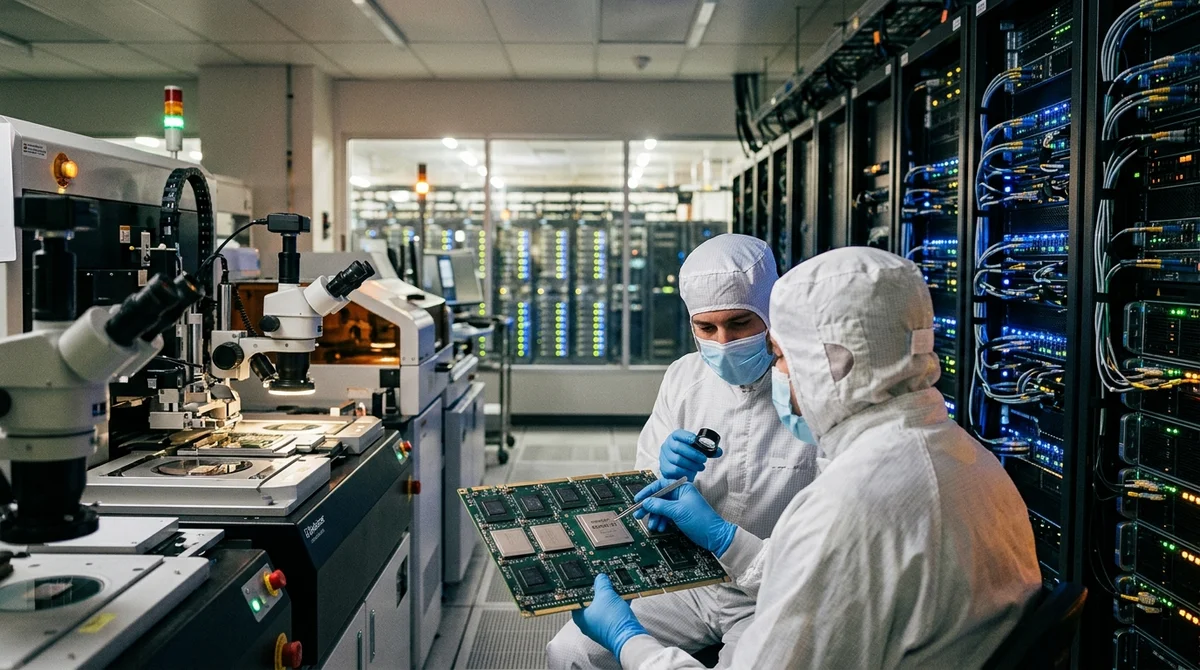
Alibaba has disclosed for the first time how many of its own AI chips it has produced: its T-Head unit has shipped nearly 470,000 devices. The company did not sugarcoat the situation and said plainly that these chips still trail Nvidia's products on performance.
How many chips are out there
The figure came up during Alibaba's earnings report for the third quarter of fiscal 2026. According to management, T-Head has brought its chips to commercial stage over the past two years and has shipped about 470,000 units in total. These are not lab prototypes but real hardware already used for AI workloads.
For the Chinese market, where access to the most powerful American accelerators is restricted by US export rules, a volume like this is an important signal in itself.
Even more important, Alibaba is not talking only about internal use. According to the company, more than 60% of T-Head chips already go to external customers, and revenue from this line has reached roughly 10 billion yuan a year.
That means this is no longer a purely corporate R&D project. Alibaba now has its own semiconductor business, which is meant not just to support the cloud inside the group but to work as a commercial element of its entire AI strategy.
Where Alibaba falls short
The most notable part of the statement is a candor that is rare among large tech companies. Alibaba did not pretend to have caught up with the global leaders. CEO Eddie Wu acknowledged that T-Head chips still trail foreign equivalents.
In a Chinese market where news about homegrown hardware is usually presented as a show of technological sovereignty, this level of openness is almost unheard of. It is also an important marker: the company is selling the market not a myth of a breakthrough but an honest picture of where it stands.
"Our chips still lag behind foreign equivalents," said
Alibaba CEO Eddie Wu.
But Alibaba is not betting on a head-on benchmark race. Wu explained that the company wants to design its chips more closely together with Alibaba Cloud infrastructure and the Qwen family of models. The idea is to win not on the raw speed of a single accelerator but on price, availability and efficiency in specific scenarios. For a customer, that can matter more than simply the highest test score, especially if alternative chips are hard to buy or have long waits.
Why Alibaba wants its own stack
For Alibaba, in-house chips are not only a matter of margin but also of access to compute. Under US restrictions, Chinese companies cannot count on stable supplies of the most advanced accelerators. So Alibaba treats T-Head as a way to guarantee itself computing capacity for years ahead.
The company separately stresses that it remains the only major Chinese cloud provider with its own chip development, which means it can control the whole chain more tightly, from hardware to model to service.
Against this backdrop, it is easier to see why Alibaba is investing so aggressively in the AI + Cloud combination. The company's cloud unit grew 36% year over year in the quarter, to $6.19 billion, and revenue from AI products has shown triple-digit growth for the tenth quarter in a row. At the same time, Alibaba has set a big goal: to raise annual external cloud and AI revenue to $100 billion within five years.
What this vertical integration gives the company:
- more predictable supplies of computing capacity;
- the ability to optimize inference for Qwen models;
- lower costs for AI services in the cloud;
- selling not a standalone chip but a whole stack to enterprise customers.
What it means
Alibaba has not yet shown a chip that can go toe to toe with Nvidia's best. But it has shown something else: the Chinese market has moved from talk of technological sovereignty to mass production of its own AI accelerators and their real monetization.
For the industry, it is a signal that the next phase of competition will run not only along the line of "who is faster" but also along the line of "who builds a cheaper, more accessible and more manageable AI stack."
- Nov 2, 2026TensorFold 1.2.0 boosts Qwen3.8-27B throughput on M3 Ultra by 44.2% at 16 streams
- Nov 1, 2026Local models lose to Opus and Codex: 0.21 on a MacBook versus 1.00 for Codex
- Nov 1, 2026Habr author fine-tunes YOLOv8l on dental X-rays and pushes mAP50 to 0.642
- Nov 1, 2026Voice bots built on LLMs turn to Jev, a fast classifier, for decisions in 200–500 ms
Key Questions Answered
How many chips are out there?
The figure came up during Alibaba's earnings report for the third quarter of fiscal 2026. According to management, T-Head has brought its chips to commercial stage over the past two years and has shipped about 470,000 units in total. These are not lab prototypes but real hardware already used for AI workloads. For the Chinese market, where access to the most powerful American accelerators is restricted by US export rules, a volume like this is an important signal in itself. Even more important, Alibaba is not talking only about internal use. According to the company, more t
Where Alibaba falls short?
The most notable part of the statement is a candor that is rare among large tech companies. Alibaba did not pretend to have caught up with the global leaders. CEO Eddie Wu acknowledged that T-Head chips still trail foreign equivalents. In a Chinese market where news about homegrown hardware is usually presented as a show of technological sovereignty, this level of openness is almost unheard of. It is also an important marker: the company is selling the market not a myth of a breakthrough but an honest picture of where it stands. "Our chips still lag behind foreign equivalen
Why Alibaba wants its own stack?
For Alibaba, in-house chips are not only a matter of margin but also of access to compute. Under US restrictions, Chinese companies cannot count on stable supplies of the most advanced accelerators. So Alibaba treats T-Head as a way to guarantee itself computing capacity for years ahead. The company separately stresses that it remains the only major Chinese cloud provider with its own chip development, which means it can control the whole chain more tightly, from hardware to model to service. Against this backdrop, it is easier to see why Alibaba is investing so aggressivel
Test Frontier LLMs & Autonomous Agents in One Workspace
Run Claude Opus 5.5, GPT-6, Gemini 3.1, and DeepSeek side-by-side in Nomad AI (nomadnet.ai) — unified model routing, deep research, and multimodal workflows under one subscription.
The AI world, distilled — once a week
Seven stories that actually mattered, hand-picked. No noise, no reposts, no press releases.
Done! Check your inbox for a confirmation.