BotHub lists 10 free AI tools for text, code, video, 3D and documents
BotHub has compiled 10 free AI tools for different use cases, from text and code generation to video, 3D and document work. The list includes MiniMax-M2, Firebase Studio, Qwen3 VL, NotebookLM, Genspark and Elai. The overall picture: there are more free AI tools than before, but almost every service has limits, and outputs still need to be double-checked.
AI-processed from Habr AI; edited by Hamidun News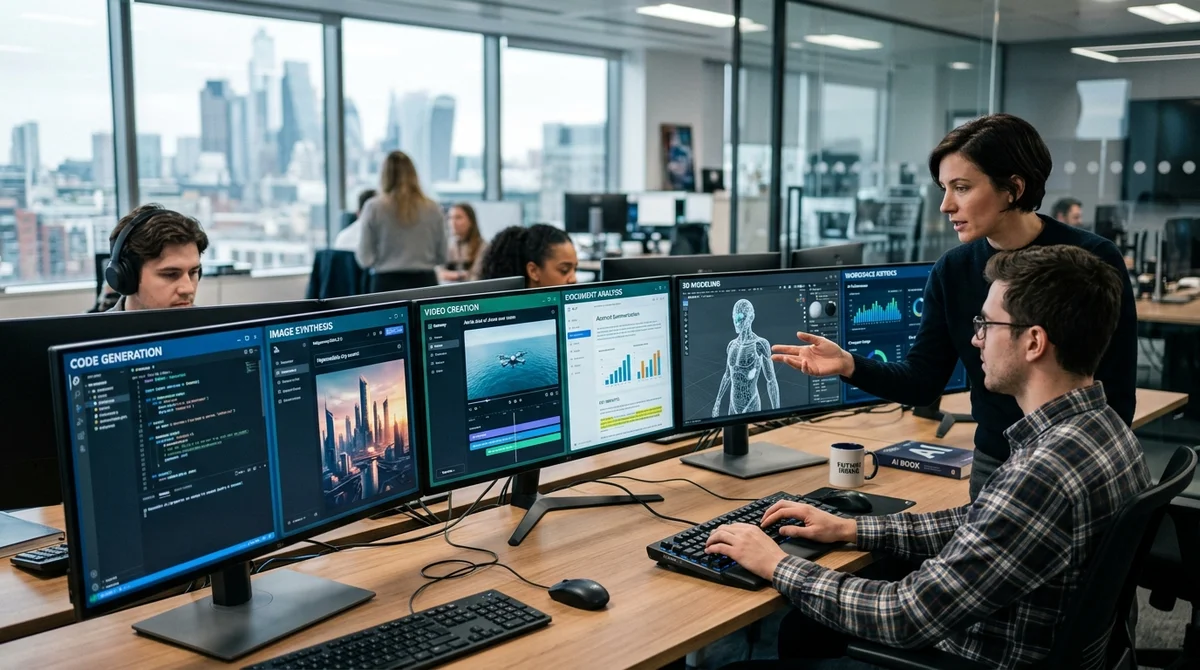
BotHub has published a roundup of ten free AI tools that cover almost the entire basic AI toolkit of 2026: text, code, images, video, 3D and document work. The list includes both general-purpose platforms and narrow services for developers, designers and content creators.
What made the list
The roundup rests on a simple idea: big brands like ChatGPT or Midjourney are already familiar to everyone, but a layer of less hyped yet useful tools has quickly grown up beside them. BotHub put together the Russian AI platform BotHub, the open-source model MiniMax-M2, the development environment Firebase Studio, the image editor Reve Image, the multimodal model Qwen3 VL, the video generator Krea Realtime Video, the 3D service Hitem3D, the agent platform Genspark, the avatar generator Elai and the research tool NotebookLM.
- BotHub: a single platform for text, code, documents, audio and images, no VPN required.
- MiniMax-M2 and Firebase Studio: tools for people who write code, test apps and work with repositories.
- Reve Image, Krea Realtime Video and Elai: a set for creating graphics, video and AI avatars.
- Qwen3 VL and NotebookLM: services for analyzing images, video, documents and your own sources.
- Hitem3D and Genspark: tools for 3D models and for agent-based task execution without code.
The article covers not only capabilities but also how access works. Some tools can be used right in the browser, some run through Hugging Face or an API, and some offer a free allowance only as an introduction. As a result, the list reads less like a ranking of the "best overall" and more like a practical starter map: where to try generation, where to test coding scenarios, and where to quickly build media content or a research base.
Who it is for
For developers, MiniMax-M2 and Firebase Studio stand out. The former is notable for strong results in coding, agentic workflows and multi-file edits, while the latter promises to bring prototyping, code editing, previews and deployment together in one place. For multimodal work, Qwen3 VL is the natural companion: it handles not only text but also images and video, which is useful for interfaces, content analytics and computer vision tasks.
For content creators and marketers, the focus shifts to Reve Image, Krea Realtime Video, Elai and Genspark. Reve Image bets on generating and editing images in a single window. Krea takes a more "live" approach to video, with a frame-by-frame stream and the ability to change the prompt on the fly. Elai lets you quickly assemble a clip with a digital presenter, and Genspark tries to go beyond ordinary search and carry a task through to a result using its own built-in agents.
NotebookLM and Hitem3D address a separate class of tasks. The former is useful for people who work with PDFs, notes and websites and want to ask questions about their own materials rather than the open web. The latter turns 2D images into 3D models and can be useful for prototyping, visualization and preparing objects for printing.
Taken together, the roundup shows that the free AI toolkit is no longer limited to a single chatbot: it is now a set of specialized workspaces.
Where the limits are
In this ten, the word "free" does not always mean truly unlimited. For BotHub it means a starter package of tokens; for Firebase Studio, a cap on the number of workspaces in preview; for Genspark, daily credits; for Elai, just one minute of video; and for NotebookLM, the free features are also tied to the service's internal limits. For MiniMax-M2 and Qwen3 VL, free access often runs into a technical barrier: you need to deal with local deployment, an API or an inference environment.
"It is still too early to trust neural networks unconditionally."
This is arguably the main takeaway of the original article. Even if a service can write code, build presentations, rework images or answer questions about documents, you still need to check the result by hand. Hitem3D needs a good source image, Elai needs a clean reference, NotebookLM needs a correct set of sources, and generative models in general need a decent prompt and fact verification. Free access lowers the barrier to entry, but it does not cancel out the cost of mistakes.
What this means
The BotHub roundup gives a good picture of the market in 2026: useful AI tools are spreading into narrow use cases and becoming more accessible without a subscription to a single flagship service. For users, it is a chance to build their own stack for specific tasks instead of trying to solve everything with one model.
- Nov 1, 2026Pika Labs releases open video model H3 Flex: 6 steps instead of 50
- Nov 1, 2026Google's StreamVibe video agent beats other models by 10.7% on response timing and quality
- Oct 31, 2026AI cartoon series: a 24-second episode built ten ways, the best cost 162 credits
- Oct 31, 2026Anthropic: Fold Subagents Back Into a Single Loop — One Customer's Tasks Ran Twice as Fast
Key Questions Answered
What made the list?
The roundup rests on a simple idea: big brands like ChatGPT or Midjourney are already familiar to everyone, but a layer of less hyped yet useful tools has quickly grown up beside them. BotHub put together the Russian AI platform BotHub, the open-source model MiniMax-M2, the development environment Firebase Studio, the image editor Reve Image, the multimodal model Qwen3 VL, the video generator Krea Realtime Video, the 3D service Hitem3D, the agent platform Genspark, the avatar generator Elai and the research tool NotebookLM. BotHub: a single platform for text, code, document
Who it is for?
For developers, MiniMax-M2 and Firebase Studio stand out. The former is notable for strong results in coding, agentic workflows and multi-file edits, while the latter promises to bring prototyping, code editing, previews and deployment together in one place. For multimodal work, Qwen3 VL is the natural companion: it handles not only text but also images and video, which is useful for interfaces, content analytics and computer vision tasks. For content creators and marketers, the focus shifts to Reve Image, Krea Realtime Video, Elai and Genspark. Reve Image bets on generatin
Where the limits are?
In this ten, the word "free" does not always mean truly unlimited. For BotHub it means a starter package of tokens; for Firebase Studio, a cap on the number of workspaces in preview; for Genspark, daily credits; for Elai, just one minute of video; and for NotebookLM, the free features are also tied to the service's internal limits. For MiniMax-M2 and Qwen3 VL, free access often runs into a technical barrier: you need to deal with local deployment, an API or an inference environment. "It is still too early to trust neural networks unconditionally." This is arguably the main
Test Frontier LLMs & Autonomous Agents in One Workspace
Run Claude Opus 5.5, GPT-6, Gemini 3.1, and DeepSeek side-by-side in Nomad AI (nomadnet.ai) — unified model routing, deep research, and multimodal workflows under one subscription.
The AI world, distilled — once a week
Seven stories that actually mattered, hand-picked. No noise, no reposts, no press releases.
Done! Check your inbox for a confirmation.