MIT Teaches Robots to Quickly Navigate Unfamiliar Environments
MIT researchers have developed a new method that allows robots to rapidly map large and unpredictable spaces. The technology can be applied in…
AI-processed from MIT News; edited by Hamidun News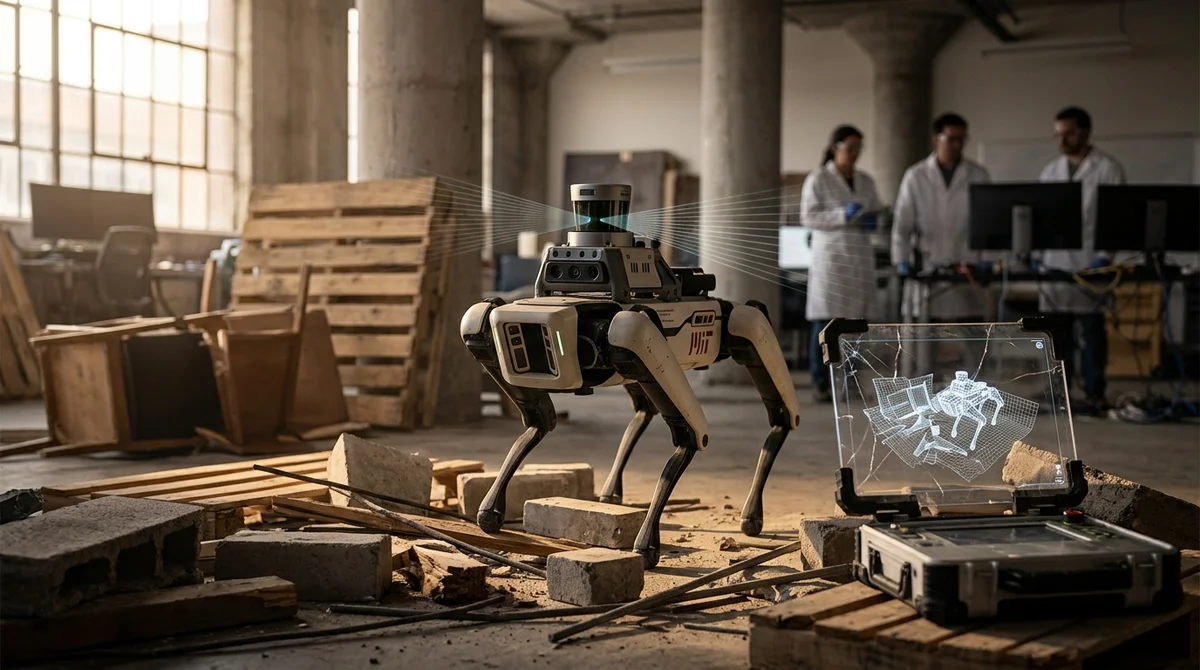
Imagine a robot that, like an experienced explorer, instantly navigates through unfamiliar and dangerous surroundings. A team from the Massachusetts Institute of Technology (MIT) has taken an important step toward turning this dream into reality, presenting an innovative approach to mapping large territories. The new development will allow robots to quickly and accurately create maps of their environment, opening broad prospects for application in search and rescue operations, autonomous navigation, and other critical areas.
At the heart of this breakthrough lies a sophisticated algorithm that enables the robot to analyze data from its sensors and build a three-dimensional model of the terrain in real time. The key distinction from existing solutions lies in the speed and efficiency of this process. The robot is capable of rapidly adapting to changing conditions, avoiding obstacles and plotting the optimal route. This is particularly important in situations where every second counts, such as when searching for victims in a disaster zone.
Traditional mapping methods often prove ineffective in dynamic and unpredictable conditions. They require significant computational resources and time, making them unsuitable for real-time use. MIT's development solves this problem by offering a more flexible and scalable approach. The algorithm is optimized to run onboard the robot, allowing it to function autonomously, without the need for constant connection to an external server.
This technology has enormous potential for various industries. In search and rescue operations, robots equipped with the new mapping system will be able to quickly survey destroyed buildings and other hard-to-reach locations, significantly improving the chances of saving lives. In the field of autonomous navigation, MIT's development will enable the creation of more reliable and safe systems for unmanned vehicles, drones, and other robotic transport. Additionally, the technology can find application in industry, construction, and other areas where precise and rapid mapping of large territories is required.
The impact of MIT's development extends far beyond individual applications. It contributes to the advancement of fundamental research in robotics and artificial intelligence. Scientists and engineers gain a powerful tool for studying and modeling complex spatial problems. This, in turn, stimulates the creation of new and even more advanced systems capable of solving problems that today seem impossible.
In conclusion, the new mapping approach developed at MIT represents a significant step forward in the field of robotics. It opens the door for creating more autonomous, efficient, and reliable robots capable of operating in the most complex and dangerous conditions. In the future, we will likely see widespread adoption of this technology in various sectors, from search and rescue operations to autonomous transportation and industrial automation. The key advantage is the ability to quickly and accurately create maps in real time, making this development particularly valuable for solving problems that require rapid response and adaptation to changing conditions.
Want to stop reading about AI and start using it?
AI News is a curated feed of AI/tech news. Hamidun Academy teaches you to use AI systematically in your work.