Silicon Valley animal advocates want to recruit AI researchers as allies
In early February, San Francisco hosted an unusual gathering: for the first time, animal advocates and AI engineers sat down together to discuss how machine learning could help protect animals. The agenda covered tracking poaching through satellite imagery, using LLMs to decode whale communication, and monitoring livestock conditions with sensors. The Bay Area animal rights movement is deliberately recruiting AI specialists as allies.
AI-processed from MIT Technology Review; edited by Hamidun News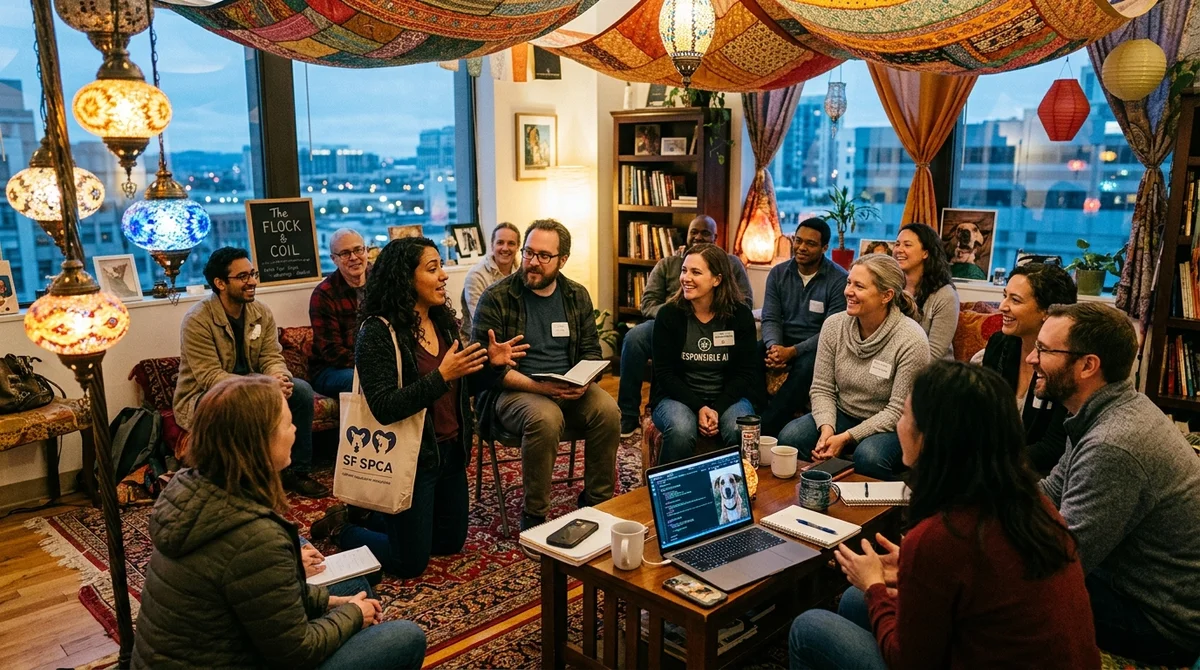
Animal rights activists in San Francisco are increasingly looking for allies among AI researchers, and judging by the first meetings, they're getting a response.
Two worlds meet
In early February, a few dozen people gathered at Mox, a small coworking space in San Francisco: animal advocates, wildlife researchers, and engineers from AI companies. Guests took off their shoes at the door. Persian rugs covered the floor, and mosaic lamps glowed under colorful canopies. The organizers deliberately avoided a corporate feel: live conversation mattered more than polished slides.
One speaker, a representative of a wildlife conservation organization, got specific. Hundreds of millions of animals suffer every year, traditional protection methods have hit a ceiling, and the movement needs allies with a different toolkit. He wasn't looking for sympathizers. He was looking for engineers.
The evening was part of an organized campaign: the Bay Area animal welfare community is deliberately recruiting AI specialists as allies.
What AI already does for animals
Animal protection and machine learning have overlapped for a long time, but the field is gaining momentum right now. Attendees pointed to several areas where progress is already visible:
- Wildlife monitoring: CV models identify species in camera-trap images more accurately and faster than any volunteer, processing tens of thousands of photos in a matter of hours
- Poaching detection: acoustic analysis of forests and satellite imagery make it possible to track illegal hunting in real time
- Decoding animal communication: the Earth Species Project applies LLM techniques to analyze whale songs, elephant calls, and bird vocalizations
- Monitoring living conditions: sensors and ML models on farms track signs of stress and pain in animals before situations become critical
- Fighting illegal trade: AI systems help detect listings for protected species on the dark web
Specific initiatives discussed at the meeting included platforms such as Google's Wildlife Insights and academic projects to decode animal language. Several attendees talked about building a shared dataset that could do for this field what ImageNet did for computer vision.
Why the AI community is slow to act
For years, animal advocates tried to approach tech companies but ran into a structural problem: AI labs are built around problems with paying customers. Animals don't pay.
That began to change with the rise of the EA (effective altruism) movement and the longtermism community inside Bay Area tech. Some researchers at major AI labs openly support animal welfare as a high-impact cause area. Meanwhile, animal protection groups are building partnerships with funders such as Open Philanthropy and negotiating joint research programs with university labs, gradually creating an economy that simply didn't exist before.
"This isn't a request to do something nice for the environment.
This is a conversation about preventing enormous suffering at a scale that used to seem impossible," one of the speakers said.
Skeptics, however, point to real obstacles: animal data is fragmented and incompatible across organizations, there are no shared annotation standards, and long-term funding is unstable. Without proper data infrastructure, most ML models in this space remain prototypes rather than working tools with measurable impact.
What it means
The movement is still small, but it is strategically organized. Animal advocates are deliberately embedding themselves in Silicon Valley's AI network through informal coworking events, academic conferences, and joint research grants. If this coalition attracts a critical mass of interested engineers and stable funding, AI tools for monitoring and protecting animals could become as standard in the industry as climate apps are today.
- Nov 1, 202616 models tested on 7 search tools: Exa averaged 10.5 out of 14, SearXNG about 3
- Nov 1, 2026Google's StreamVibe video agent beats other models by 10.7% on response timing and quality
- Nov 1, 2026OpenAI Rewrites GPT Behavior Rules: Five Values and a Chain of Command
- Nov 1, 2026Voice bots built on LLMs turn to Jev, a fast classifier, for decisions in 200–500 ms
Key Questions Answered
What are the key details on Two worlds meet?
In early February, a few dozen people gathered at Mox, a small coworking space in San Francisco: animal advocates, wildlife researchers, and engineers from AI companies. Guests took off their shoes at the door. Persian rugs covered the floor, and mosaic lamps glowed under colorful canopies. The organizers deliberately avoided a corporate feel: live conversation mattered more than polished slides. One speaker, a representative of a wildlife conservation organization, got specific. Hundreds of millions of animals suffer every year, traditional protection methods have hit a ce
What AI already does for animals?
Animal protection and machine learning have overlapped for a long time, but the field is gaining momentum right now. Attendees pointed to several areas where progress is already visible: Wildlife monitoring: CV models identify species in camera-trap images more accurately and faster than any volunteer, processing tens of thousands of photos in a matter of hours Poaching detection: acoustic analysis of forests and satellite imagery make it possible to track illegal hunting in real time Decoding animal communication: the Earth Species Project applies LLM techniques to analyze
Why the AI community is slow to act?
For years, animal advocates tried to approach tech companies but ran into a structural problem: AI labs are built around problems with paying customers. Animals don't pay. That began to change with the rise of the EA (effective altruism) movement and the longtermism community inside Bay Area tech. Some researchers at major AI labs openly support animal welfare as a high-impact cause area. Meanwhile, animal protection groups are building partnerships with funders such as Open Philanthropy and negotiating joint research programs with university labs, gradually creating an eco
Test Frontier LLMs & Autonomous Agents in One Workspace
Run Claude Opus 5.5, GPT-6, Gemini 3.1, and DeepSeek side-by-side in Nomad AI (nomadnet.ai) — unified model routing, deep research, and multimodal workflows under one subscription.
The AI world, distilled — once a week
Seven stories that actually mattered, hand-picked. No noise, no reposts, no press releases.
Done! Check your inbox for a confirmation.