NVIDIA and PNY Push RTX PRO 6000 Blackwell for Data Analytics and AI Development
PNY is promoting workstations built on the NVIDIA RTX PRO 6000 Blackwell as a replacement for CPU-based data science systems. The main selling points: up to 50x faster pandas through cuDF without rewriting code, shorter XGBoost training times, and room for up to four GPUs in a single machine. The pitch centers on processing data locally, depending less on the cloud and keeping costs under control.
AI-processed from IEEE Spectrum AI; edited by Hamidun News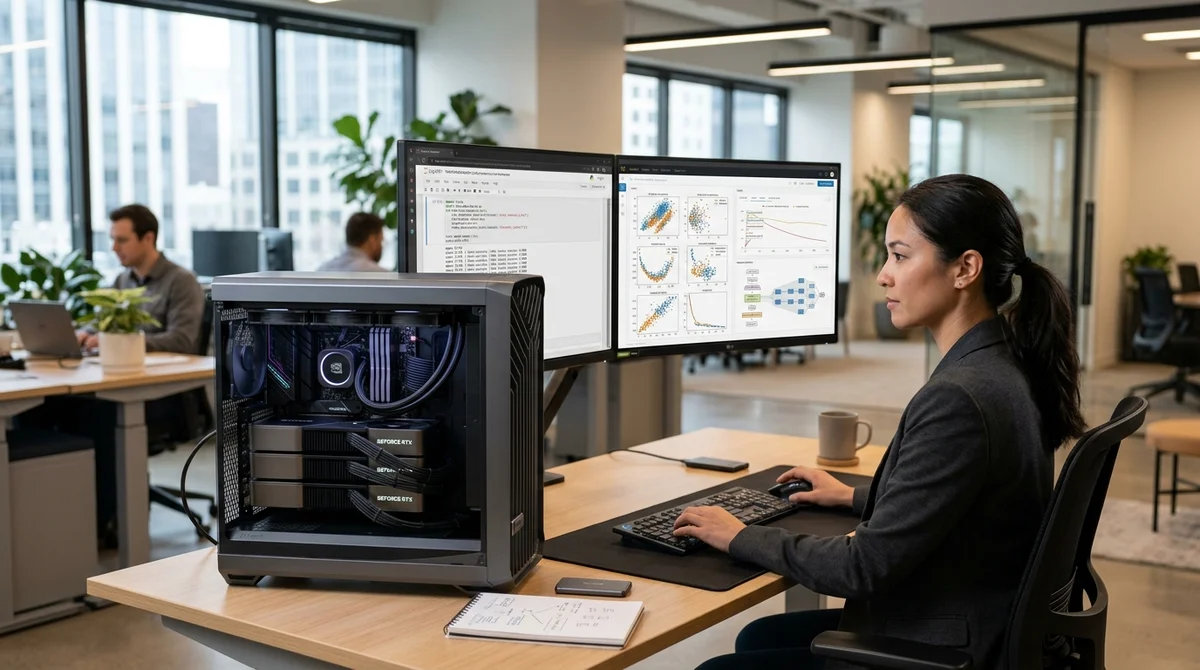

In a sponsored piece for IEEE Spectrum, PNY promotes the NVIDIA RTX PRO 6000 Blackwell Workstation Edition as a local alternative to the cloud and data centers for data science work. The central claim: some heavy AI and analytics pipelines can be sped up by tens of times right at the desk.
Why CPUs Fall Short
The story rests on three bottlenecks familiar to most data science teams. First, data preparation: cleaning, joining tables, filling gaps and building features often eat up most of the time before a model is even trained. Second, scale: data volumes grow faster than desktop CPU systems can digest them, so teams sometimes cut their samples and lose result quality. Third, hardware: access to accelerators in the cloud and in data centers is expensive and, in places, limited.
Against that backdrop, NVIDIA and PNY propose moving part of the workload back to local workstations. The idea is simple: if an analyst or ML engineer has a multi-GPU machine under the desk, they depend less on queues in shared infrastructure, test hypotheses faster and keep sensitive data in-house. For corporate teams, this is presented as a compromise between speed, privacy and cost control.
What Blackwell Promises
The emphasis is on speeding up the whole pipeline, from pandas operations to model training. According to NVIDIA, the cuDF library from the CUDA-X stack can accelerate Python pipelines without code rewrites, and combining it with PyData and XGBoost should noticeably cut the time spent on exploratory analysis and training. The platform is also designed for multi-user scenarios, advanced visualization and collaboration through NVIDIA AI Workbench, so the same project can run on a local machine, in the cloud and in a data center.
- up to four RTX PRO 6000 Blackwell Max-Q GPUs in a single workstation
- pandas acceleration through cuDF with no code changes, up to 50x by the company's claim
- join operation: almost 5 minutes on CPU versus 14 seconds on GPU
- group by: almost 4 minutes on CPU versus 4 seconds on GPU
- XGBoost training that used to take weeks, which the company promises to shrink to minutes
"the most powerful desktop GPU ever built"
The marketing tone is blunt: this is how PNY describes the RTX PRO 6000 Blackwell in the accompanying video. It is a strong claim, but the piece itself contains no independent tests or comparisons with alternatives in an identical configuration. So treat the numbers as a vendor reference point: they show the class of tasks where a GPU does deliver a gain, but they are no substitute for a full benchmark on your own stack and data.
A Bet on Local Computing
A separate argument is economics and security. When part of a pipeline moves from the cloud to a workstation, a company pays less for compute rental and storage, and sensitive datasets stay inside the perimeter. For industries with on-premise processing requirements, this matters more than raw performance. A local machine also reduces dependence on GPU scarcity in data centers: you less often have to wait for a training slot or negotiate a separate budget.
PNY also stresses the enterprise side: integration with existing IT infrastructure, NVIDIA ConnectX networking, deployment tools and high uptime. The message is clear: the RTX PRO 6000 Blackwell is sold not as an "enthusiast card" but as a building block for corporate AI development. That applies especially to teams that need fast iterations on large datasets but are not ready to move fully to the cloud or to constantly compete for the resources of a shared cluster.
What It Means
The AI hardware market is shifting from universal promises toward a concrete scenario: giving a data science team data-center-level performance right at the workplace. If the claimed speedups hold up on real workloads, such workstations could become an intermediate layer between an analyst's laptop and an expensive GPU cluster. But they should be bought after testing on your own pipelines, not on the strength of an advertising benchmark.
- Nov 1, 2026Local models lose to Opus and Codex: 0.21 on a MacBook versus 1.00 for Codex
- Nov 1, 2026Habr author fine-tunes YOLOv8l on dental X-rays and pushes mAP50 to 0.642
- Nov 1, 2026Voice bots built on LLMs turn to Jev, a fast classifier, for decisions in 200–500 ms
- Nov 1, 2026MoneyGate safety layer blocked all 42 fraudulent requests to local AI models
Key Questions Answered
Why CPUs Fall Short?
The story rests on three bottlenecks familiar to most data science teams. First, data preparation: cleaning, joining tables, filling gaps and building features often eat up most of the time before a model is even trained. Second, scale: data volumes grow faster than desktop CPU systems can digest them, so teams sometimes cut their samples and lose result quality. Third, hardware: access to accelerators in the cloud and in data centers is expensive and, in places, limited. Against that backdrop, NVIDIA and PNY propose moving part of the workload back to local workstations. T
What Blackwell Promises?
The emphasis is on speeding up the whole pipeline, from pandas operations to model training. According to NVIDIA, the cuDF library from the CUDA-X stack can accelerate Python pipelines without code rewrites, and combining it with PyData and XGBoost should noticeably cut the time spent on exploratory analysis and training. The platform is also designed for multi-user scenarios, advanced visualization and collaboration through NVIDIA AI Workbench, so the same project can run on a local machine, in the cloud and in a data center. up to four RTX PRO 6000 Blackwell Max-Q GPUs in
What are the key details on A Bet on Local Computing?
A separate argument is economics and security. When part of a pipeline moves from the cloud to a workstation, a company pays less for compute rental and storage, and sensitive datasets stay inside the perimeter. For industries with on-premise processing requirements, this matters more than raw performance. A local machine also reduces dependence on GPU scarcity in data centers: you less often have to wait for a training slot or negotiate a separate budget. PNY also stresses the enterprise side: integration with existing IT infrastructure, NVIDIA ConnectX networking, deploym
Test Frontier LLMs & Autonomous Agents in One Workspace
Run Claude Opus 5.5, GPT-6, Gemini 3.1, and DeepSeek side-by-side in Nomad AI (nomadnet.ai) — unified model routing, deep research, and multimodal workflows under one subscription.
The AI world, distilled — once a week
Seven stories that actually mattered, hand-picked. No noise, no reposts, no press releases.
Done! Check your inbox for a confirmation.