Elon Musk prepares his own chip factory: Tesla and SpaceX launch TeraFab project
Elon Musk is taking the computing race to a new level: Tesla and SpaceX want to manufacture chips themselves for robots, AI systems, and space data centers. The plan is to build a factory in Austin where logic, memory, and packaging will be under one roof. Against this backdrop, British Nscale has already reached a $14.6 billion valuation and is strengthening its board of directors.
AI-processed from Bloomberg Tech; edited by Hamidun News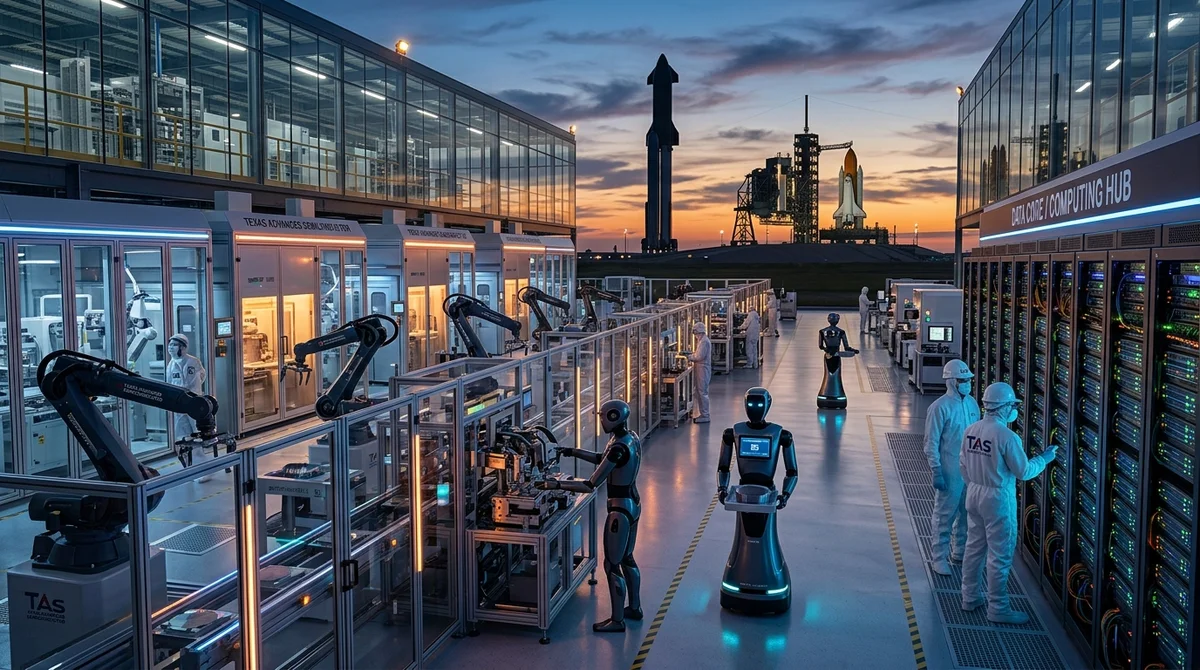
Elon Musk wants Tesla and SpaceX to stop depending on external suppliers and produce critical chips themselves. This is not just about cars, but also robots, AI infrastructure, and even orbital data centers.
Own Chip Factory
The project brings together two key Musk companies: Tesla and SpaceX. They are to jointly launch an advanced chip manufacturing facility in Austin, because in Musk's view, the current semiconductor market is scaling too slowly for his needs. He needs processors not for one product line, but for several directions at once: robotics, model training and inference, and computing systems that SpaceX ties to its space plans.
The key feature of the idea is an attempt to assemble almost the entire chain under one roof. The project discussion covered logic, GPUs and CPUs, memory and packaging. For the industry, this is an atypical move: normally these stages are split among different players, because the technologies, materials, and economics of the processes differ significantly.
That's why this approach is unusual not just in scale, but in the very bet on maximum vertical integration.
"Either we build TeraFab, or we won't have chips.
We need chips — so we're building TeraFab."
Betting on Scale
The scale of the project is almost demonstrative. Starting point — approximately 100 thousand wafers per month, with the long-term goal of reaching 1 million per month. This no longer looks like an internal factory for the narrow needs of one company. Rather, it's an attempt to build its own industrial circuit for AI, robotics and space. At this scale, the main question comes down not to a beautiful presentation, but to money, timelines, and the ability to quickly assemble the necessary engineering expertise.
- Starting goal — about 100 thousand wafers per month
- Long-term goal — 1 million wafers per month
- Plan to consolidate logic, memory and packaging under one facility
- One of the main use cases — chips for space data centers
A separate layer of this story is the connection to orbital computing. The project assigns significant importance to space data centers, which SpaceX has long positioned as the next big market for AI compute power. Public presentations showed concepts of satellite computing platforms. If Starship truly becomes cheaper and closer to full reusability, the economics of launching such systems could change noticeably. For now, this looks very ambitious, but the logic is clear: control not just models and servers, but the entire stack — from chip to orbit.
Race for Infrastructure
In parallel, another front is accelerating — AI infrastructure funding. British Nscale attracted $2 billion in a Series C round in March and was valued at $14.6 billion.
Sheryl Sandberg joined the board, along with Susan Decker and Nick Clegg. For the European market, this is an important signal: big money is flowing not just into models and applications, but into companies that build computational infrastructure, data centers, GPU clusters and services on top of them. If Musk's strategy is built around own production, Nscale's bet is on speed of rolling out infrastructure across different regions and on heavyweight board management.
Both cases show the same market fork: in AI there is less and less room for lightweight intermediaries and more and more value for those who control scarce resources — energy, facilities, accelerator supplies and production chains.
What This Means
The AI market is rapidly shifting from a race for models to a race for physical infrastructure. If Musk's plan works, Tesla and SpaceX will try to turn the chip shortage into their competitive advantage, and Nscale's success shows that investors are ready to pay huge money precisely for control over computational power.
Want to stop reading about AI and start using it?
AI News is a curated feed of AI/tech news. Hamidun Academy teaches you to use AI systematically in your work.
The AI world, distilled — once a week
Seven stories that actually mattered, hand-picked. No noise, no reposts, no press releases.
Done! Check your inbox for a confirmation.