API, MCP and MCP Gateways: Distinguishing Interfaces and Protocols for AI Systems
API and MCP often sound like synonyms, yet in practice they address different needs. API enables communication between applications and services, while MCP allows AI models to understand tools, data, and actions in a unified format. Above this layer sits MCP Gateway: it centralizes access, security, and model connectivity to existing corporate systems.
AI-processed from AI News; edited by Hamidun News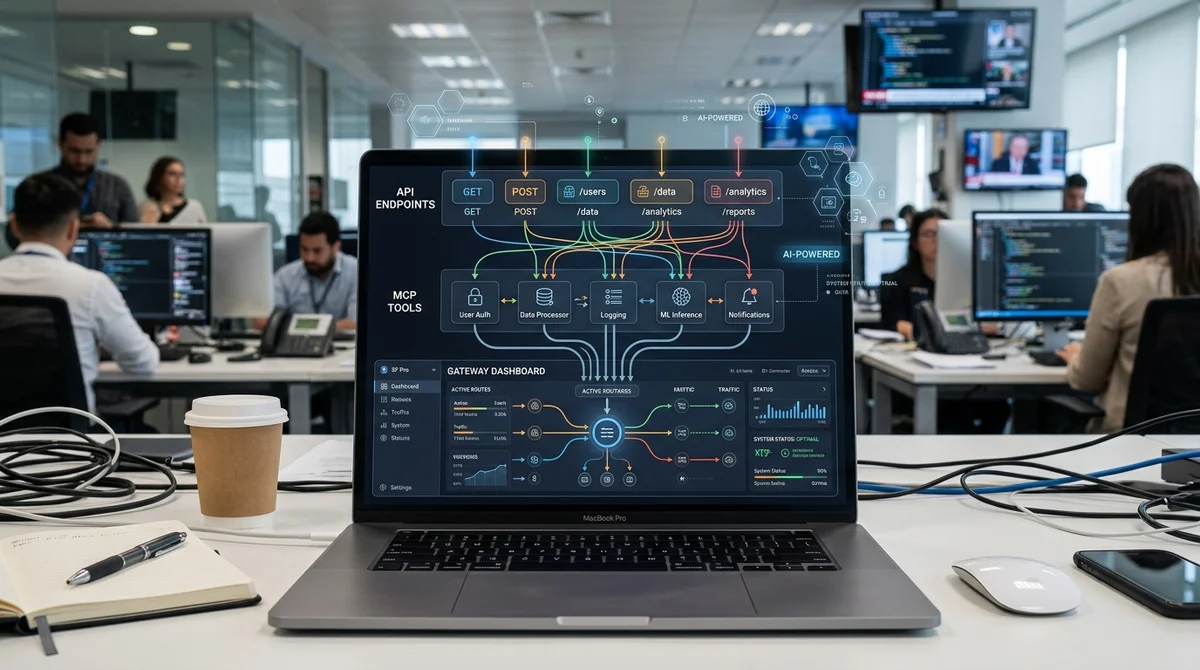
API and MCP are often used as interchangeable terms, especially in conversations about AI agents, corporate data, and automation. But there is an important difference between them: API connects software systems, while MCP defines a way for a model to work with tools, resources, and actions in a manner it understands.
Why They're Confused
The confusion arises because both API and MCP help systems exchange information. At a basic level, this is indeed true: in both cases, there is a formal description of how one party can request data or perform an action with another. But APIs have historically been created for developers and regular applications. It is a contract between services: what methods exist, what parameters need to be passed, how responses are structured, how authorization works, and what to do when an error occurs.
MCP solves a different problem. It does not replace the internal logic of a service and does not cancel out the API, but rather adds a layer through which an AI client or model receives a standardized description of available capabilities. In other words, instead of a set of disparate integrations, a model sees understandable tools and resources in a single format. Therefore, the presence of an API does not mean that an AI agent will be able to reliably and safely use that service without additional adaptation.
Where the Line is Drawn
To put it simply, APIs are created for programs, while MCP is for interaction between programs and models. A regular application can rigidly know the address of the required endpoint, the request format, and the list of mandatory parameters. A model cannot work this way: it needs to first understand what tools are available, what each one does, and what arguments are acceptable. MCP provides exactly this descriptive layer, so that an AI system does not have to guess from documentation or rely on fragile custom integrations.
- API describes specific methods and contracts of a particular service.
- MCP describes tools, resources, and actions in a form understandable to a model.
- API usually requires manual integration tailored to each product and its documentation.
- MCP allows a single AI client to work with different sources using more unified rules.
- In many cases, the MCP server internally still calls ordinary APIs.
From this follows an important conclusion: this is not about competitors, but about different levels of architecture. API remains the foundation, because it is through it that real services provide data, execute commands, and return results. MCP is needed where a model appears on top of these services and requires a safe, predictable, and standardized way to select tools. For developers, this means less disposable code, and for users, more stable operation of AI assistants.
Why a Gateway is Needed
When there are many tools, another layer appears—an MCP Gateway. Its task is not to connect each model directly to dozens of heterogeneous systems, but to consolidate access at a single point. Such a gateway can act as an intermediary between AI clients, MCP servers, and the company's existing APIs. As a result, the team does not rewrite all corporate services from scratch, but gradually wraps them in a compatible format and manages access centrally.
The practical value of a gateway lies in management and security. Through it, it is easier to configure authentication, logging, restrictions, request routing, and access rules for different teams or scenarios. But the gateway itself does not solve everything automatically. If tool descriptions are poorly made, permissions are given too broadly, or old APIs behave unstably, the AI layer will inherit the same problems. Therefore, a good gateway is not just a connector, but a control point for the quality of the entire integration.
What This Means
For the market, this is a signal that AI integrations are transitioning from disparate experiments to a more coherent architecture. APIs are not going anywhere: they will remain the foundation of service interaction. But MCP becomes a convenient overlay that makes these capabilities understandable to models, and MCP Gateway helps connect them to real business systems without completely revisiting the existing stack.
Want to stop reading about AI and start using it?
AI News is a curated feed of AI/tech news. Hamidun Academy teaches you to use AI systematically in your work.
The AI world, distilled — once a week
Seven stories that actually mattered, hand-picked. No noise, no reposts, no press releases.
Done! Check your inbox for a confirmation.