Figure AI Founder Launches Hark — AI-Device Startup with Product Family
Brett Adcock, founder of Figure AI, is launching Hark — a new startup in the AI-device category. According to him, the company is building not a single device, but an entire family of products. This is an important signal for the market: the next wave of competition is moving from applications to hardware, where not the loudest prototype will win, but a convenient everyday use case for people.
AI-processed from Bloomberg Tech; edited by Hamidun News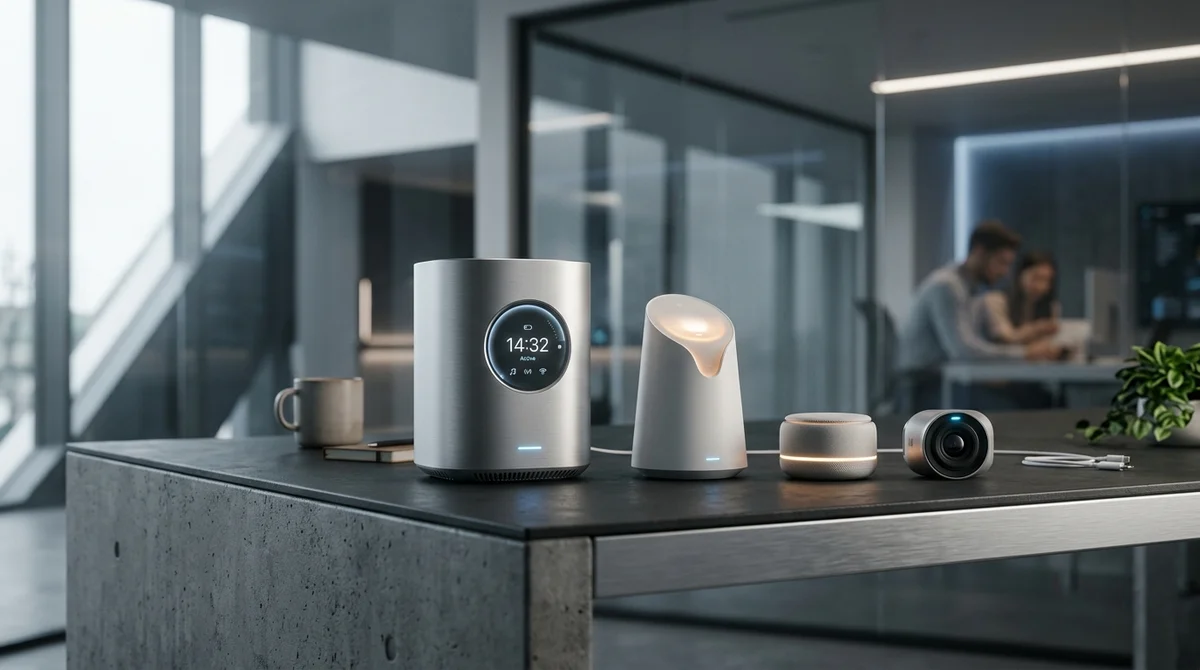
Brett Adcock, founder of Figure AI, launches new startup Hark and targets it at the AI-devices market. According to him, the company is working not on a single gadget, but immediately on a family of products, which shows: the competition for "AI-powered hardware" is only gaining momentum.
Adcock's New Project
Adcock is already known as an entrepreneur who builds companies at the intersection of software, robotics, and grand ambitions. Now he's opening another front: Hark enters the category of AI-powered devices, where startups are trying to find the next mass format after mobile applications and chatbots. Importantly, this is not a one-off attempt to release one striking device, but a broader product strategy designed for several scenarios and a long development cycle.
The phrase about a "family of products" sounds like an intention to think in ecosystem terms right from the start. This is not just a matter of design or hardware—it immediately changes the scale of the concept. Such an approach typically means a common software platform, common use cases, and the ability to quickly test multiple form factors without betting everything on a single gadget.
For a young market, this is a pragmatic move: demand is still forming, and it's difficult to guess the winner in advance, especially when user habits are only being established.
Why Make a Lineup
The idea of a family of devices is important in itself. Most of the AI market still lives within browsers, smartphones, and corporate software, but manufacturers are increasingly looking for ways to embed models into physical products. A separate device can offer a different level of interaction: constant access, sensors, voice, camera, local actions, and the feeling that the user is communicating not with an app, but with an autonomous system. This is exactly why such projects attract so much attention. Such an approach has several obvious advantages:
- You can cover different scenarios—from home and office to mobile use.
- It's easier to build an ecosystem where devices complement each other rather than compete.
- The company gets more space to experiment with pricing, subscriptions, and accessories.
- Risk is distributed across multiple products rather than concentrated in a single launch.
For Hark this makes particular sense because the AI-gadgets market is still far from maturity. Users haven't yet decided if they need a separate assistant outside their phone, and investors and teams continue to debate what matters more—a new interface, autonomy, or deep integration with familiar services. Against this backdrop, betting on a portfolio of devices looks like an attempt not to guess, but to occupy multiple positions within a single company at once and understand faster where real value emerges.
What We Know Now
Details are limited so far. Hark has only indicated its direction and has not revealed specific device categories, launch timelines, or technical specifications of future products. But even at this stage, the news is important because of Adcock's prominence. When the founder of Figure AI moves into an adjacent, rapidly growing category, the market perceives this as a signal: betting on AI-devices already looks not like an experiment on the periphery, but like a full-fledged new vertical that investors and competitors will watch closely.
The company is working on a "family of products".
This also raises expectations for how such startups will differ from each other. Promises about a "smart device" alone are no longer enough: you need a clear scenario in which the device is actually faster, more convenient, or cheaper than a smartphone or laptop. Otherwise, users will ask why they need another screen, another subscription, and another entry point to the same AI service, if the main task is already solved by familiar tools without extra friction.
For Hark, the key question will be not just the hardware itself, but how smoothly the company connects it to models, voice, memory, and the user's daily tasks. The winner won't be whoever shows a beautiful prototype first, but whoever creates a sustainable habit of daily use. It's at this stage that whether a category has a real market or just the interest of early investors and audience curiosity is usually tested.
What This Means
The emergence of Hark shows that the next wave of AI competition is shifting from pure software to devices and ecosystems. If seasoned and prolific founders start building not one gadget but entire lineups, the market is preparing not for a one-time novelty, but for a long struggle for a new consumer interface.
Want to stop reading about AI and start using it?
AI News is a curated feed of AI/tech news. Hamidun Academy teaches you to use AI systematically in your work.
The AI world, distilled — once a week
Seven stories that actually mattered, hand-picked. No noise, no reposts, no press releases.
Done! Check your inbox for a confirmation.