Microsoft States It's Building Its Own Safeguards for AI, Brad Smith Says
Microsoft is strengthening its rhetoric around safe AI. At a CERA Week panel in Houston, company president Brad Smith said the corporation is implementing its own safeguards for AI. He did not reveal details about specific mechanisms, but the emphasis itself is telling: major vendors are already selling not just model power, but manageability, control, and predictability of their use.
AI-processed from Bloomberg Tech; edited by Hamidun News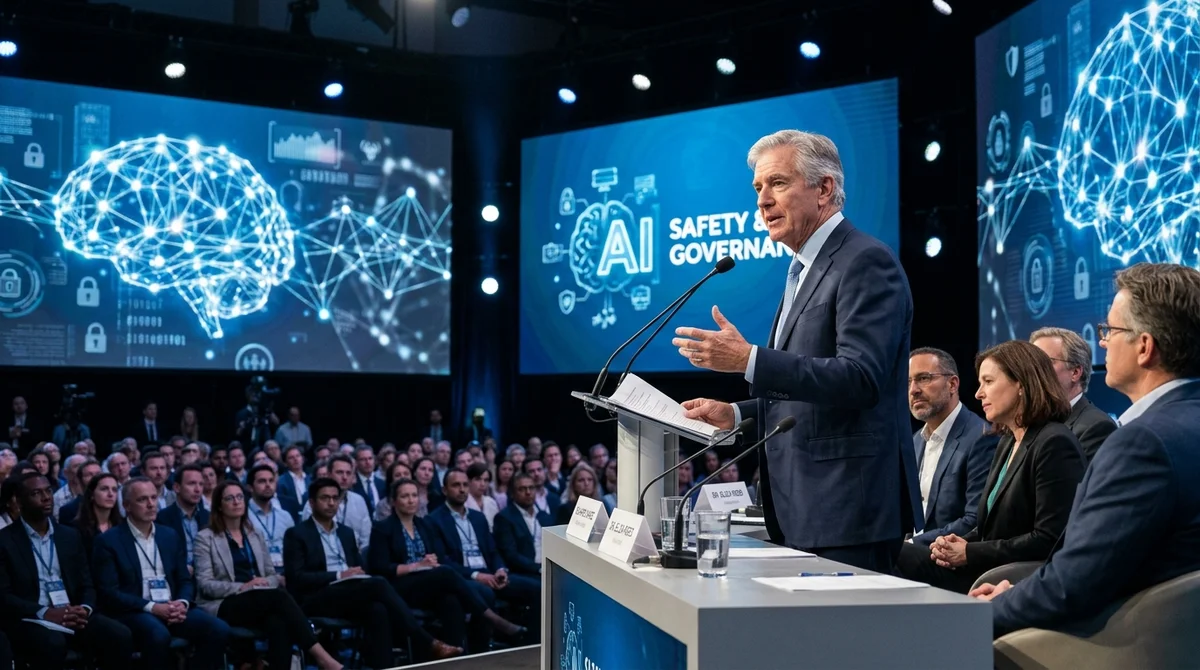
Microsoft publicly bets on safe AI implementation. At CERA Week in Houston, the company's president Brad Smith announced that the corporation is building its own protective guardrails around artificial intelligence systems.
Statement in Houston
During a panel discussion, Smith outlined an important thesis for Microsoft: the company is not going to reduce the question of AI safety to external regulation alone and is simultaneously building internal frameworks for technology use. This sounds like both a political and product statement at once. Microsoft has long been selling AI not as an experiment for enthusiasts, but as infrastructure for developers and businesses, so the conversation about guardrails for it is already directly linked to customer trust.
"We are setting up our own protective guardrails around AI,"
Smith said.
The brief description of the presentation does not reveal what specific tools, processes, or policies he meant. But the wording itself is telling: Microsoft wants the conversation about artificial intelligence to revolve not only around model power, release speed, and new features, but also around provider responsibility. For the corporate market, this is often just as important an argument as generation quality or context window size. In other words, the company is emphasizing: the question is no longer whether to use AI, but who is capable of putting it under controlled management.
What's Behind Guardrails
Each company interprets the term guardrails in its own way, but usually it's not about a single safety button, but about a set of technical and organizational measures. If we translate this into practical language, customers expect such frameworks to deliver quite concrete things:
- filtering dangerous or prohibited content
- restricting model access to sensitive data and critical actions
- logging, monitoring, and the ability to analyze controversial responses
- testing models for vulnerabilities, restriction bypasses, and undesirable scenarios
This also usually involves access control separation, transparent settings for administrators, and mechanisms that allow a human to stop or correct the system's operation. In other words, guardrails are not a decorative layer, but part of the implementation architecture. Without it, AI remains an impressive demonstration, but poorly suited for processes where accountability, repeatability, and a trace you can later follow to understand why the system acted that way matter.
When Microsoft brings this topic into public rhetoric, it is essentially selling not just the AI itself, but the manageability of its behavior. For companies that want to embed models into documents, support, analytics, or internal tools, this is a principal point. They need not an abstract "smart system," but a service whose behavior can be limited, verified, and explained within a workflow.
Why the Emphasis Intensified
As generative AI moves out of demonstration mode and into real business scenarios, the cost of error rises sharply. If a model made a mistake in an entertainment chatbot, that's unfortunate. If it draws conclusions from a company's internal data, helps write code, responds to customers, or participates in decision-making, the security question instantly becomes operational.
This is precisely why the largest platforms are increasingly talking not only about model capabilities, but also about the limits of their application. For Microsoft, this topic is especially sensitive because the company simultaneously serves as a supplier of cloud infrastructure, a developer platform, and AI-based solutions for corporations. Smith's statement is addressed to several audiences at once: regulators, corporate clients, and teams responsible for implementing AI in sensitive industries.
And the context of CERA Week itself is important here: at venues related to energy, industry, and major infrastructure, new technologies are expected above all to be predictable, controllable, and auditable.
What This Means
Brad Smith's statement shows how the entire AI market is changing: competitive advantage is no longer only about model power, but also about the supplier's ability to prove that it can be safely integrated into real processes. For Microsoft, this is a way to strengthen trust in its AI products, and for the market, it's another signal that the era of "let's launch first, figure it out later" is gradually coming to an end.
Want to stop reading about AI and start using it?
AI News is a curated feed of AI/tech news. Hamidun Academy teaches you to use AI systematically in your work.
The AI world, distilled — once a week
Seven stories that actually mattered, hand-picked. No noise, no reposts, no press releases.
Done! Check your inbox for a confirmation.