Microsoft Says It Is Building Its Own AI Guardrails, Brad Smith Says
Microsoft is turning up its rhetoric on safe AI. On a CERA Week panel in Houston, company president Brad Smith said the corporation is putting its own guardrails around AI. He did not disclose details of the specific mechanisms, but the emphasis itself is telling: major vendors now sell not only model power but also manageability, control and predictability of use.
AI-processed from Bloomberg Tech; edited by Hamidun News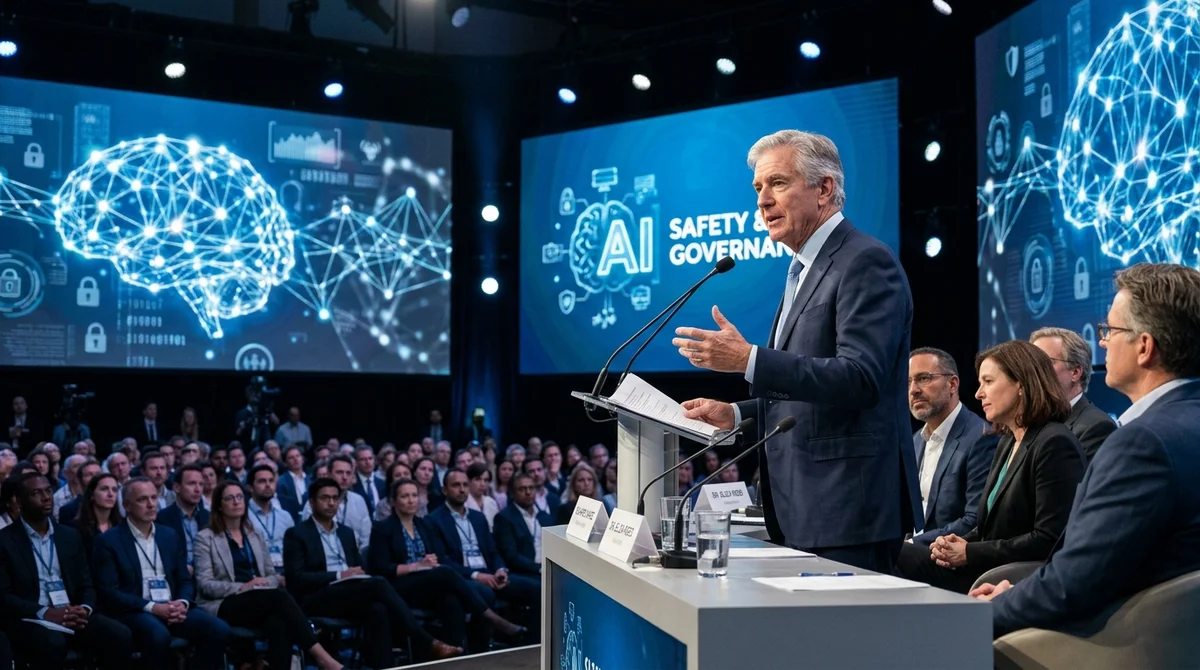
Microsoft is publicly betting on the theme of safe AI deployment. At CERA Week in Houston, company president Brad Smith said the corporation is building its own protective restrictions around artificial intelligence systems.
The statement in Houston
During a panel discussion, Smith laid out a thesis that matters to Microsoft: the company does not intend to reduce AI safety to external regulation alone, and is building internal frameworks for using the technology in parallel. It sounds like a political and a product statement at once. Microsoft has long sold AI not as an experiment for enthusiasts but as infrastructure for developers and businesses, so talk of guardrails is directly tied to customer trust.
"We are setting our own guardrails around AI," Smith said.
The brief summary of the talk does not say which tools, processes or policies he had in mind. But the wording itself is telling: Microsoft wants the conversation about artificial intelligence to revolve not only around model power, release speed and new features, but also around the vendor's responsibility. For the enterprise market, that is often an argument as important as generation quality or context window size. In other words, the company is stressing that the question is no longer whether to use AI, but who can bring it under manageable control.
What lies behind guardrails
Every company interprets the term guardrails in its own way, but it usually refers not to a single safety switch but to a set of technical and organizational measures. In practical terms, customers expect fairly concrete things from such frameworks:
- filtering of dangerous or prohibited content
- limits on the model's access to sensitive data and critical actions
- logging, monitoring and the ability to review disputed answers
- testing models for vulnerabilities, restriction bypasses and unwanted scenarios
They usually also include separation of access rights, transparent settings for administrators, and mechanisms that let a human stop or adjust the system's work. In other words, guardrails are not a decorative add-on but part of the deployment architecture. Without them, AI remains an impressive demo but is poorly suited to processes where accountability, repeatability and an audit trail matter, a trail that lets you later reconstruct why the system acted as it did.
When Microsoft takes this topic into its public rhetoric, it is in effect selling not only the AI itself but also control over its behavior. For companies that want to embed models in documents, support, analytics or internal tools, this is a critical point. They need not an abstract "smart system" but a service whose behavior can be restricted, verified and explained within the workflow.
Why the emphasis has grown
As generative AI moves out of demo mode and into real business scenarios, the cost of error rises sharply. If a model errs in an entertainment chatbot, it is unpleasant. If it draws conclusions from a company's internal data, helps write code, answers customers or takes part in decisions, the safety question immediately becomes operational. That is why the largest platforms increasingly talk not only about model capabilities but also about the limits of their application.
For Microsoft the topic is especially sensitive, because the company is at once a provider of cloud infrastructure, a developer platform and AI-based solutions for corporations. Smith's statement addresses several audiences at once: regulators, enterprise customers and the teams responsible for deploying AI in sensitive industries. The CERA Week context matters here too: at venues tied to energy, industry and large-scale infrastructure, people expect new technology above all to be predictable, controllable and auditable.
What it means
Brad Smith's statement shows how the whole AI market is changing: the competitive advantage is no longer only model power but also a vendor's ability to prove that the model can be safely built into real processes. For Microsoft, it is a way to strengthen trust in its AI products; for the market, it is one more signal that the era of "launch first, figure it out later" is gradually ending.
- Nov 2, 2026Anthropic needs to grow revenue 32% a year to cover $850 billion in contracts
- Nov 2, 2026Microsoft releases 4B model Mage-VL-Cowork, which solves 66.0% of OSWorld-Verified tasks
- Nov 1, 2026Google's StreamVibe video agent beats other models by 10.7% on response timing and quality
- Oct 30, 2026Mistral opens Large 4 weights: strong at code, but Chinese models score 32 to its 26
Key Questions Answered
What are the key details on The statement in Houston?
During a panel discussion, Smith laid out a thesis that matters to Microsoft: the company does not intend to reduce AI safety to external regulation alone, and is building internal frameworks for using the technology in parallel. It sounds like a political and a product statement at once. Microsoft has long sold AI not as an experiment for enthusiasts but as infrastructure for developers and businesses, so talk of guardrails is directly tied to customer trust. "We are setting our own guardrails around AI," Smith said. The brief summary of the talk does not say which tools,
What lies behind guardrails?
Every company interprets the term guardrails in its own way, but it usually refers not to a single safety switch but to a set of technical and organizational measures. In practical terms, customers expect fairly concrete things from such frameworks: filtering of dangerous or prohibited content limits on the model's access to sensitive data and critical actions logging, monitoring and the ability to review disputed answers testing models for vulnerabilities, restriction bypasses and unwanted scenarios They usually also include separation of access rights, transparent setting
Why the emphasis has grown?
As generative AI moves out of demo mode and into real business scenarios, the cost of error rises sharply. If a model errs in an entertainment chatbot, it is unpleasant. If it draws conclusions from a company's internal data, helps write code, answers customers or takes part in decisions, the safety question immediately becomes operational. That is why the largest platforms increasingly talk not only about model capabilities but also about the limits of their application. For Microsoft the topic is especially sensitive, because the company is at once a provider of cloud inf
Test Frontier LLMs & Autonomous Agents in One Workspace
Run Claude Opus 5.5, GPT-6, Gemini 3.1, and DeepSeek side-by-side in Nomad AI (nomadnet.ai) — unified model routing, deep research, and multimodal workflows under one subscription.
The AI world, distilled — once a week
Seven stories that actually mattered, hand-picked. No noise, no reposts, no press releases.
Done! Check your inbox for a confirmation.