Anthropic sues the Pentagon after Claude is banned for the US military and its contractors
Anthropic has taken the Pentagon to federal court. The company wants a judge to temporarily freeze a ban that bars the US military and its contractors from using Claude. The dispute began after Anthropic refused to allow its model to be used for domestic mass surveillance and fully autonomous lethal systems. Anthropic is also challenging a broader administration order directing all government agencies to stop using its tools.
AI-processed from Guardian; edited by Hamidun News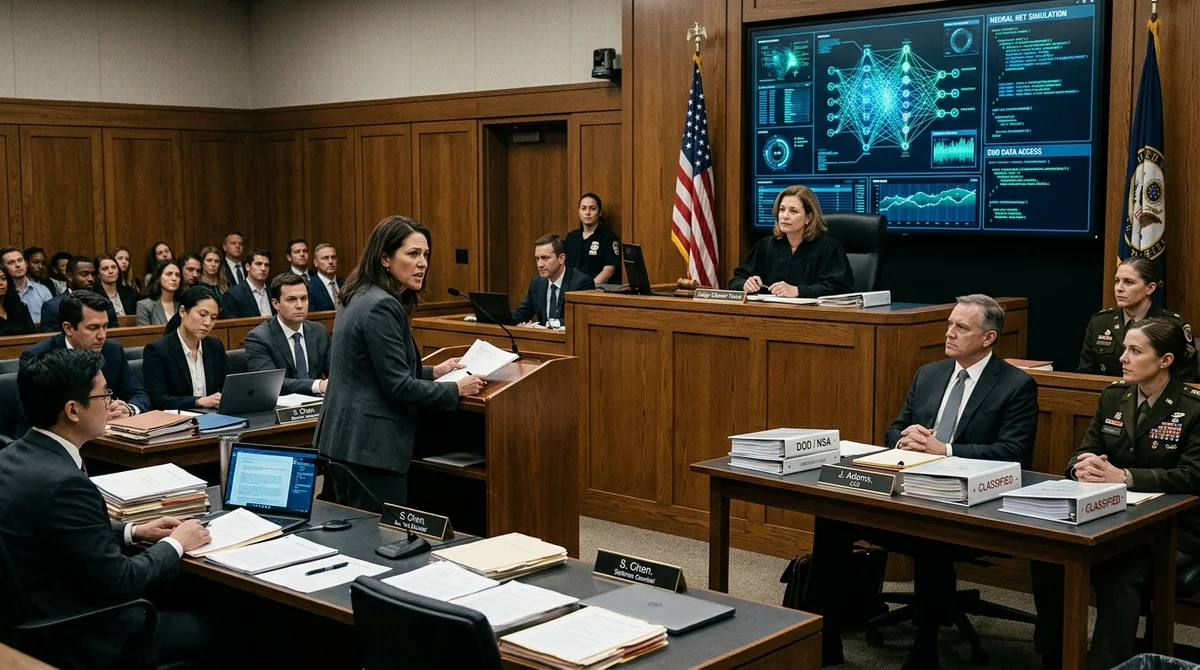
Anthropic has gone to federal court to stop a Pentagon ban on Claude for the US military and defense contractors. The case has become a public flashpoint between a commercial AI company and a government that wants to deploy models more widely in sensitive security work.
How the conflict started
Judge Rita Lin heard the case on Tuesday in the US District Court for the Northern District of California. Anthropic is asking the court to temporarily freeze a Department of Defense decision that barred the military and its contractors from using the company's technology. This is not a final ruling on the case. It is a first attempt to quickly halt the ban's effects while the main lawsuit is heard on the merits. The stakes are high for Anthropic because the restrictions are already affecting its access to government work and defense contracts.
The conflict escalated after Anthropic refused to allow Claude to be used for two categories of tasks: domestic mass surveillance and fully autonomous lethal systems. According to the lawsuit, Donald Trump's administration then ordered a halt to the use of Anthropic's tools not only in the military but across other federal agencies as well. The company argues that the government punished it not for any technical risks in its product, but for refusing to drop its own ethical limits on how the model can be used.
What Anthropic wants
The lawsuit targets a decision made after Defense Secretary Pete Hegseth declared Anthropic a "supply chain risk." The company calls that label unfounded and legally vulnerable. It is asking the court to temporarily block the designation so that military bodies and contractors are not forced to drop Claude immediately, before the case is fully heard.
Anthropic says the designation was imposed without a clear explanation and that its consequences take effect immediately: access to procurement and pilot programs may disappear before the court rules on the merits.
- suspend the ban for the military and contractors
- challenge the "supply chain risk" designation
- limit direct losses on contracts and revenue
- protect its right to restrict dangerous uses of its models
Anthropic warns that without swift intervention from the court, the damage could reach hundreds of millions of dollars and hurt its reputation as a government supplier. For the developer, this is also about precedent: if the government can pressure AI companies through procurement and defense mechanisms, any publicly stated limits on model use could quickly turn from safety policy into business risk. By the company's reasoning, this would hit not only current deals but also future negotiations with agencies, which tend to avoid controversial vendors.
Why the dispute matters
The case matters well beyond a single contract. Until now, many AI companies have tried to do two things at once: sell technology to the government while drawing red lines around uses they consider unacceptable. The Anthropic case shows how fragile that balance can be when the customer is the world's largest defense establishment. If the court does not side with the company, even temporarily, the whole market will get the message: refusing military or surveillance work can cost you access to government money.
The dispute also raises a broader question: who ultimately sets the limits on how general-purpose models are used — the developer, or the government paying for deployment? For Washington, this is a matter of national security and control over suppliers. For the industry, it is a test of whether "responsible AI" means anything if refusing to work on autonomous weapons effectively gets a company pushed out of the largest government programs.
What it means
The court fight between Anthropic and the Pentagon turns AI ethics limits from PR promises into a high-stakes legal dispute. The outcome will determine whether model developers can actually prohibit the most dangerous uses, or whether government customers will end up dictating the rules over any internal principles. If temporary relief is denied, pressure on vendors that impose safety restrictions will only grow, and the case will serve as a warning to other developers.
- Nov 1, 2026Local models lose to Opus and Codex: 0.21 on a MacBook versus 1.00 for Codex
- Nov 1, 2026Kimi scores 96.2% on a 1C database analytics test and emerges as a fallback if Claude access is blocked
- Nov 1, 2026OpenAI Rewrites GPT Behavior Rules: Five Values and a Chain of Command
- Nov 1, 2026Google admits AI Mode cuts search revenue, shares fall 15%
Key Questions Answered
How the conflict started?
Judge Rita Lin heard the case on Tuesday in the US District Court for the Northern District of California. Anthropic is asking the court to temporarily freeze a Department of Defense decision that barred the military and its contractors from using the company's technology. This is not a final ruling on the case. It is a first attempt to quickly halt the ban's effects while the main lawsuit is heard on the merits. The stakes are high for Anthropic because the restrictions are already affecting its access to government work and defense contracts. The conflict escalated after
What Anthropic wants?
The lawsuit targets a decision made after Defense Secretary Pete Hegseth declared Anthropic a "supply chain risk." The company calls that label unfounded and legally vulnerable. It is asking the court to temporarily block the designation so that military bodies and contractors are not forced to drop Claude immediately, before the case is fully heard. Anthropic says the designation was imposed without a clear explanation and that its consequences take effect immediately: access to procurement and pilot programs may disappear before the court rules on the merits. suspend the
Why the dispute matters?
The case matters well beyond a single contract. Until now, many AI companies have tried to do two things at once: sell technology to the government while drawing red lines around uses they consider unacceptable. The Anthropic case shows how fragile that balance can be when the customer is the world's largest defense establishment. If the court does not side with the company, even temporarily, the whole market will get the message: refusing military or surveillance work can cost you access to government money. The dispute also raises a broader question: who ultimately sets t
Test Frontier LLMs & Autonomous Agents in One Workspace
Run Claude Opus 5.5, GPT-6, Gemini 3.1, and DeepSeek side-by-side in Nomad AI (nomadnet.ai) — unified model routing, deep research, and multimodal workflows under one subscription.
The AI world, distilled — once a week
Seven stories that actually mattered, hand-picked. No noise, no reposts, no press releases.
Done! Check your inbox for a confirmation.