Epoch Biodesign Raises $12M to Scale AI-Powered Nylon Recycling
London-based Epoch Biodesign has raised $12 million to demonstrate that its AI-developed enzymes can recycle nylon 6,6 at industrial scale. The company…
AI-processed from TNW; edited by Hamidun News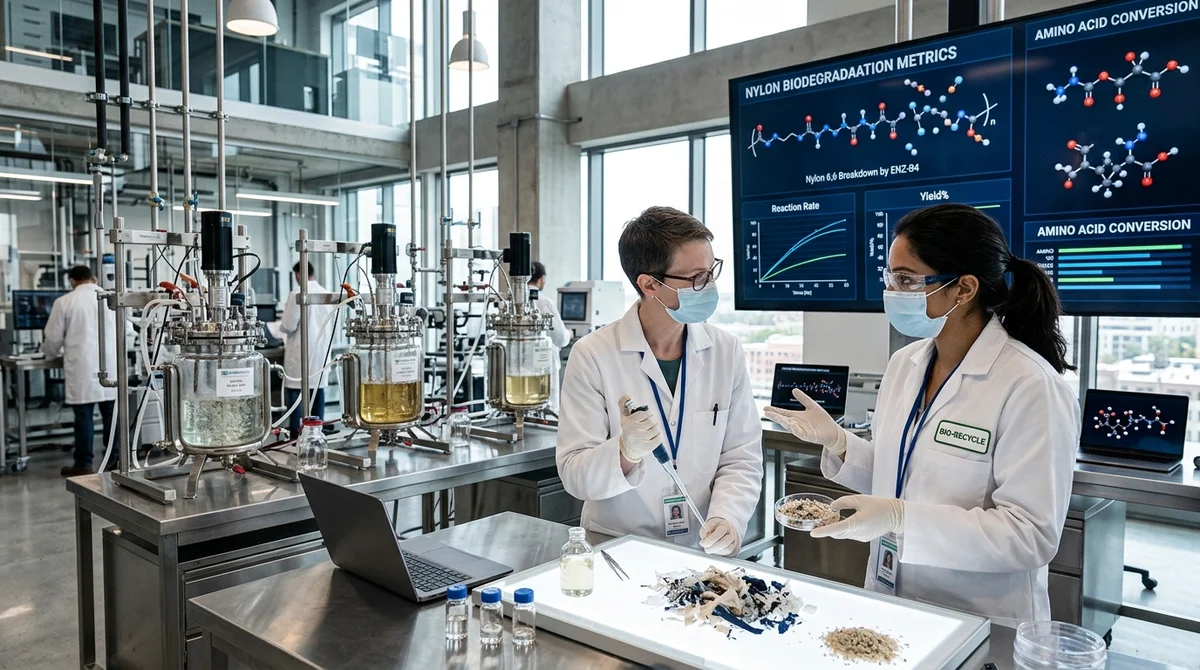
Epoch Biodesign raised $12M to prove that its AI-designed enzymes can be used for industrial recycling of nylon 6,6. For the market, this is not just another climate startup, but an attempt to turn one of the most complex plastic streams into reusable raw material without new oil.
How the technology works
The London-based company develops enzymes that break down nylon 6,6 waste back into its original monomers. This is a material found in very diverse products: from leggings and sportswear to carpets and car airbags. In the classical supply chain, such plastic is typically either incinerated or sent for low-grade recycling.
Epoch Biodesign's approach aims for a more valuable scheme: to return the material to nearly its original chemical state, so that new nylon can be made from it again. The key idea is not to devalue waste, but to restore its chemical value. According to the company, the process can recover more than 90% of the original raw material.
This is an important figure, because the economics of recycling depends not only on ecology but also on the yield of usable product. If the technology truly maintains this level not in a laboratory test tube but on a large-scale raw material stream, it can reduce the need for primary petrochemical feedstock. This is what makes the project interesting not only for the climate agenda but also for material manufacturers looking for a way to stabilize supplies and reduce dependence on fluctuations in raw material markets.
Why the funding round is needed
The new $12M round is needed by the company to prove: the technology works not only as a scientific demonstration but as a scalable industrial process. In biotech and climate technologies, this is the most challenging stage. Good results on a small scale still do not mean that enzymes will work as effectively with contaminated, heterogeneous and logistically expensive waste coming from the real market.
Based on the stated goals of the round, Epoch Biodesign needs to simultaneously solve several tasks: confirm stable monomer yield at large volumes; adapt the process to different types of nylon 6,6 waste; demonstrate economics independent of primary feedstock; prepare the foundation for working with industrial partners. Total capital raised has already exceeded $50M, and this shows that investors see in the technology not a niche story but a potential platform for an entire class of materials. Nylon 6,6 has long been considered one of the most useful synthetic materials: it is strong, heat-resistant and widely used in textiles and industry.
But precisely because of its usefulness, it has accumulated in huge volumes, and it is still difficult to recycle it well. If Epoch Biodesign can prove industrial efficiency, the company will land in an important market point where AI, bioengineering and circular economy converge. Here AI acts not as an interface or chatbot but as a tool for designing molecular systems with specific economic effect.
For the industry, this is a notable signal: the next big AI use case may come not from software but from production chains, where algorithms help create new processes, materials and utilization methods. If the model works, similar approaches will start being tested on other complex polymers.
What this means
For the AI market, this news is important because it shows a more mature scenario for artificial intelligence application: not content generation but enzyme creation with measurable industrial results. If Epoch Biodesign confirms scalability, this will strengthen interest in startups using AI for chemistry, materials science and recycling, where value is determined not by demo but by output, cost and process stability.
Want to stop reading about AI and start using it?
AI News is a curated feed of AI/tech news. Hamidun Academy teaches you to use AI systematically in your work.