Kuaishou Grows Revenue as Generative AI Monetization and the Kling Platform Take Off
Kuaishou has shown that generative AI is no longer a showcase for the company but a working business. Revenue rose to 39.6 billion yuan in the fourth quarter of 2025, and its AI advertising tools and the Kling platform made a noticeable contribution to that growth. Online marketing, e-commerce, and customer spending on AIGC creatives all grew, and adjusted profit also posted double-digit gains.
AI-processed from Bloomberg Tech; edited by Hamidun News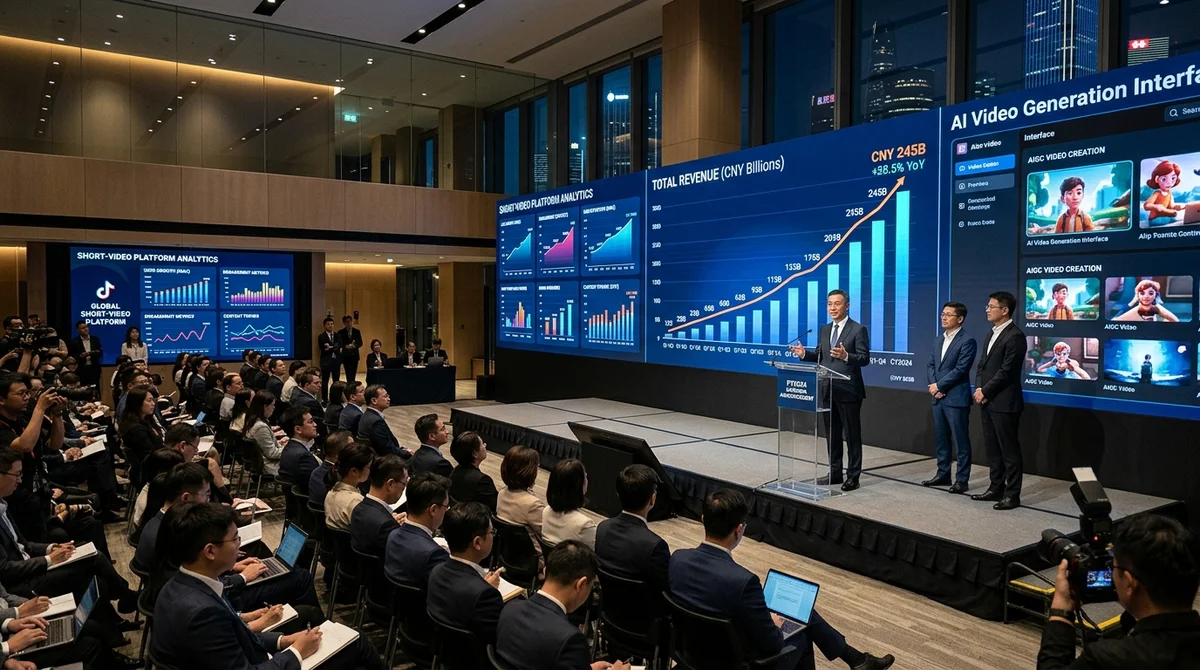
Kuaishou says that scaling its in-house generative AI tools is already having a noticeable impact on the business. In the fourth quarter of 2025, the Chinese short-video platform's revenue rose to 39.6 billion yuan, and the company cites AI product monetization as one of the main drivers.
Growth on AI
According to the company, quarterly revenue grew about 12% year over year to 39.6 billion yuan. Adjusted net profit rose 16%, beating analyst expectations. For full-year 2025, Kuaishou posted 142.8 billion yuan in revenue and 20.6 billion yuan in adjusted profit. The app averaged 410.2 million daily active users over the year.
This is an important signal for the market: the company no longer talks about AI as a long-term bet but is already showing its contribution to current financial results. The effect is especially visible in advertising. Online marketing revenue grew 14.5% in the fourth quarter to 23.6 billion yuan, while other services, which includes e-commerce and Kling AI, grew 28% to 6.3 billion yuan.
Kuaishou specifically noted that generative recommendation models and intelligent bidding models delivered about 5% growth in internal ad revenue. Customer spending on ad creatives made with AIGC reached 4 billion yuan in the quarter alone.
What Kling sells
Kling AI, Kuaishou's flagship video generation platform, gets its own spotlight. The company sped up new model releases throughout 2025, and in February 2026 it introduced the Kling 3.0 lineup with multimodal input and output: text, images, audio, and video combined in a single workflow. Before that, Kuaishou released Kling O1 and Kling 2.6, which focused on a unified generation-and-editing engine and on generating video and audio simultaneously.
- Kling AI revenue in the fourth quarter of 2025 came to 340 million yuan
- In December 2025, the service's monthly revenue exceeded 20 million dollars
- That corresponds to an annualized revenue run rate of about 240 million dollars
- The platform is already used in marketing, e-commerce, film, animation, and gaming
For Kuaishou, this matters more than slick demos. The company is showing that Kling is starting to sell not just to enthusiasts but to professional customers: brands, studios, merchants, and creative teams.
Kuaishou also highlighted strong demand for its motion control feature, which transfers movement from uploaded clips or a motion library. The tool helped push the product beyond a narrow circle of professional creators and draw in a broader mainstream audience.
AI inside the ecosystem
Monetization isn't limited to a standalone Kling subscription or API. Kuaishou is building AI into ad auctions, recommendations, search, and in-app commerce.
In e-commerce, the company upgraded its OneSearch search architecture, which lifted search order volume in the shopping section by almost 3% in the fourth quarter. Total e-commerce GMV for the period grew 12.9% year over year to 521.8 billion yuan. Meanwhile, the OneRec recommendation models and other AI systems took on a bigger role in short videos, livestreams, and storefront scenarios.
The company also uses AI for internal efficiency. Its in-house tool CodeFlicker has become an everyday tool for developers, and more than 40% of new code at Kuaishou is already generated with it. The platform also upgraded its content understanding and tagging system to analyze videos and livestreams more precisely, retain audiences better, and improve recommendations.
CEO Cheng Yixiao directly tied these investments to the company's future.
Our AI capabilities have become a key engine of
Kuaishou's long-term growth.
What it means
Kuaishou's story shows an AI platform moving into the post-hype stage: from impressive demos to clear revenue in advertising, commerce, and creator tools. For the market, it is one of the clearest examples that the winners in AI video won't only be the developers of strong models, but also the companies that know how to embed them in an already working commercial ecosystem.
- Nov 1, 2026Pika Labs releases open video model H3 Flex: 6 steps instead of 50
- Nov 1, 2026Google taught its StreamVibe video agent to decide when to step in on its own: +10.7%
- Oct 31, 2026AI cartoon series: a 24-second episode built ten ways, the best cost 162 credits
- Oct 31, 2026Anthropic: Fold Subagents Back Into a Single Loop — One Customer's Tasks Ran Twice as Fast
Key Questions Answered
What are the key details on Growth on AI?
According to the company, quarterly revenue grew about 12% year over year to 39.6 billion yuan. Adjusted net profit rose 16%, beating analyst expectations. For full-year 2025, Kuaishou posted 142.8 billion yuan in revenue and 20.6 billion yuan in adjusted profit. The app averaged 410.2 million daily active users over the year. This is an important signal for the market: the company no longer talks about AI as a long-term bet but is already showing its contribution to current financial results. The effect is especially visible in advertising. Online marketing revenue grew 14
What Kling sells?
Kling AI, Kuaishou's flagship video generation platform, gets its own spotlight. The company sped up new model releases throughout 2025, and in February 2026 it introduced the Kling 3.0 lineup with multimodal input and output: text, images, audio, and video combined in a single workflow. Before that, Kuaishou released Kling O1 and Kling 2.6, which focused on a unified generation-and-editing engine and on generating video and audio simultaneously. Kling AI revenue in the fourth quarter of 2025 came to 340 million yuan In December 2025, the service's monthly revenue exceeded
What are the key details on AI inside the ecosystem?
Monetization isn't limited to a standalone Kling subscription or API. Kuaishou is building AI into ad auctions, recommendations, search, and in-app commerce. In e-commerce, the company upgraded its OneSearch search architecture, which lifted search order volume in the shopping section by almost 3% in the fourth quarter. Total e-commerce GMV for the period grew 12.9% year over year to 521.8 billion yuan. Meanwhile, the OneRec recommendation models and other AI systems took on a bigger role in short videos, livestreams, and storefront scenarios. The company also uses AI for i
Ship AI Faster with Founders, Engineers & Weekly Architecture Reviews
Inside Vibe Club (hamidun.com/club) — weekly live masterminds with Zhemal Khamidun, Tech Radar, full LMS access, and 370+ production Claude Code skills.
The AI world, distilled — once a week
Seven stories that actually mattered, hand-picked. No noise, no reposts, no press releases.
Done! Check your inbox for a confirmation.