RusHydro to spend nearly 100 million rubles on Nvidia H100 servers for AI workloads
RusHydro, through its IT subsidiary, is buying servers built on Nvidia H100 GPUs for nearly 100 million rubles. These GPUs are typically used to train and run AI models, analyze large datasets and handle computer vision. For a major energy company, this is no longer just interest in the AI hype. It is an investment in its own computing infrastructure for real internal tasks.
AI-processed from CNews AI; edited by Hamidun News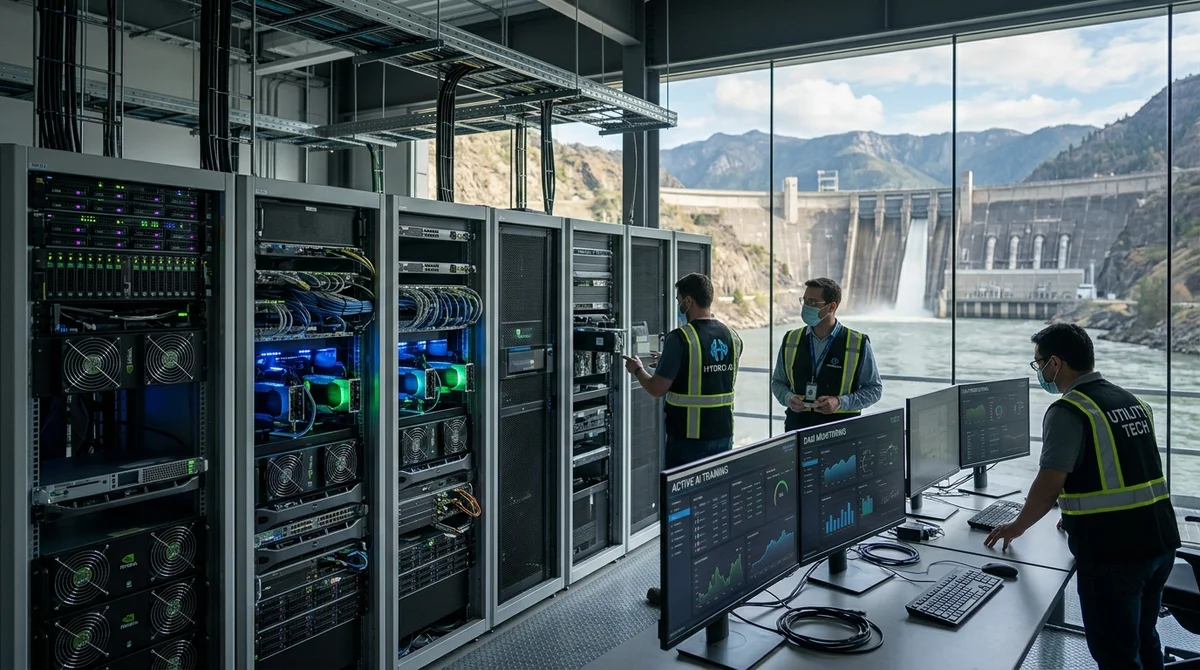
RusHydro, through its IT subsidiary, is buying servers built on Nvidia H100 GPUs for nearly 100 million rubles. For the Russian energy sector this is a notable step: it is not just a hardware refresh, but a bet on in-house computing infrastructure for artificial intelligence.
What exactly is being bought
The news is simple: the IT arm of Russia's largest hydropower generating company is ordering servers with Nvidia H100 graphics accelerators. These GPUs are typically used where heavy computing is needed: training and running AI models, processing large datasets, computer vision and complex analytics. Even without details on the configuration, it is clear these are not office machines or standard corporate servers, but high-end specialized hardware built for heavy workloads.
The purchase is worth nearly 100 million rubles. By global AI infrastructure standards that is not a record budget, but for a single corporate purchase in Russia's industrial sector it is a sizable figure. That is especially true given that the H100 remains one of the most sought-after accelerators for resource-intensive tasks.
The very fact that such hardware is appearing inside a major energy company suggests it treats AI as a practical tool rather than a slide-deck experiment. Most likely this is not a giant computing cluster but a starter setup, or a limited-scale infrastructure for specific internal tasks. Even so, the format matters: the company gets to test and deploy AI scenarios on its own hardware, not only through cloud services or contractors. For industries with critical infrastructure this is often a matter of principle, because control over computing and data is especially sensitive there.
Why energy needs this
Energy companies work with huge volumes of data: sensor readings, equipment operating modes, load schedules, repair cycles, weather factors and production reports. Once a business has its own GPU capacity, it can do more than buy ready-made AI services. It can run internal models adapted to its own processes and security requirements. That is a different level of maturity from isolated pilots or external experiments.
There are quite practical use cases for such infrastructure, and they can pay off not through polished demos but through less downtime, faster diagnostics and time saved for engineering teams. These are tasks where data processing speed matters, along with the ability to fine-tune models on internal context and integrate with existing corporate systems. That is why such purchases interest not only the IT market but the whole industrial sector. For business, this is a direct path to applied AI adoption.
- load and demand forecasting
- predictive equipment diagnostics
- analysis of images and video from facilities
- automation of work with technical documents
- corporate AI assistants for employees
In RusHydro's case the industrial context matters most. For energy companies, AI is not only text generation or chatbots. Far more important are scenarios where a model helps cut downtime, spot deviations in system behavior faster, plan repairs more accurately and speed up internal analytics. Running computations inside the company also gives more control over data and reduces dependence on external platforms.
In addition, in-house GPU servers make it safer to work with sensitive information. For an industrial enterprise this can be critical: some data is better not sent to external services, even when those are more convenient. Local infrastructure makes it possible to build closed AI environments, integrate models with internal systems and configure access to meet corporate requirements. For companies with distributed infrastructure and many technological facilities, this is particularly important.
Why the bet stands out
The choice of Nvidia H100 is telling in itself. These accelerators are associated with the top tier of AI computing and appear more often in projects where performance and scaling matter. So the news looks less like a cosmetic server-room upgrade and more like buying infrastructure with headroom for serious tasks. In this class of hardware, buyers usually plan not for one demo case but for a range of future uses. For the corporate market, this is a very visible marker of how mature the intentions are.
Who is making the purchase also matters. When the one investing in AI infrastructure is a major player from a traditional industry rather than a dedicated IT company, it usually signals a change of approach: the technology is moving from pilots to capital systems. For the market, it is a signal that demand for accelerators and specialized servers now comes not only from model developers, banks or internet companies, but also from industry. That widens the circle of customers for expensive AI hardware.
Another important point is the planning horizon. Equipment like this is rarely bought for a one-off demonstration. Usually there are plans behind it for a series of internal use cases, from analytics and document-workflow automation to equipment condition monitoring and support for engineering teams. Even if some of these scenarios are still at the hypothesis-testing stage, the infrastructure itself lays the groundwork for quickly scaling the ones that succeed. This is an investment in the next stage of digitalization, not a purchase made for the sake of a report.
What it means
The purchase of Nvidia H100 servers for RusHydro's structure shows that Russian industrial companies are starting to build their own AI base inside the business. If such projects reach real production scenarios, AI in energy will become a working tool for forecasting, diagnostics and infrastructure management rather than an innovation showcase. And the more often such purchases move from headlines to working cases, the faster the whole approach of large industries to adopting AI will change.
- Nov 1, 2026Local models lose to Opus and Codex: 0.21 on a MacBook versus 1.00 for Codex
- Nov 1, 2026Habr author fine-tunes YOLOv8l on dental X-rays and pushes mAP50 to 0.642
- Nov 1, 2026Voice bots built on LLMs turn to Jev, a fast classifier, for decisions in 200–500 ms
- Nov 1, 2026MoneyGate safety layer blocked all 42 fraudulent requests to local AI models
Key Questions Answered
What exactly is being bought?
The news is simple: the IT arm of Russia's largest hydropower generating company is ordering servers with Nvidia H100 graphics accelerators. These GPUs are typically used where heavy computing is needed: training and running AI models, processing large datasets, computer vision and complex analytics. Even without details on the configuration, it is clear these are not office machines or standard corporate servers, but high-end specialized hardware built for heavy workloads. The purchase is worth nearly 100 million rubles. By global AI infrastructure standards that is not a
Why energy needs this?
Energy companies work with huge volumes of data: sensor readings, equipment operating modes, load schedules, repair cycles, weather factors and production reports. Once a business has its own GPU capacity, it can do more than buy ready-made AI services. It can run internal models adapted to its own processes and security requirements. That is a different level of maturity from isolated pilots or external experiments. There are quite practical use cases for such infrastructure, and they can pay off not through polished demos but through less downtime, faster diagnostics and
Why the bet stands out?
The choice of Nvidia H100 is telling in itself. These accelerators are associated with the top tier of AI computing and appear more often in projects where performance and scaling matter. So the news looks less like a cosmetic server-room upgrade and more like buying infrastructure with headroom for serious tasks. In this class of hardware, buyers usually plan not for one demo case but for a range of future uses. For the corporate market, this is a very visible marker of how mature the intentions are. Who is making the purchase also matters. When the one investing in AI inf
Test Frontier LLMs & Autonomous Agents in One Workspace
Run Claude Opus 5.5, GPT-6, Gemini 3.1, and DeepSeek side-by-side in Nomad AI (nomadnet.ai) — unified model routing, deep research, and multimodal workflows under one subscription.
The AI world, distilled — once a week
Seven stories that actually mattered, hand-picked. No noise, no reposts, no press releases.
Done! Check your inbox for a confirmation.