Researchers: Deepfakes of Trump and Fake Military Women Have Become Propaganda Weapons
Political deepfakes are turning into an industry of their own. Creators no longer just fake well-known people; they invent entire AI characters. These personas already draw millions of views on social media, funnel traffic to paid platforms and work as propaganda even when viewers know the image is not real. Researchers say platforms still label this content far too weakly and are slow to build defenses.
AI-processed from Guardian; edited by Hamidun News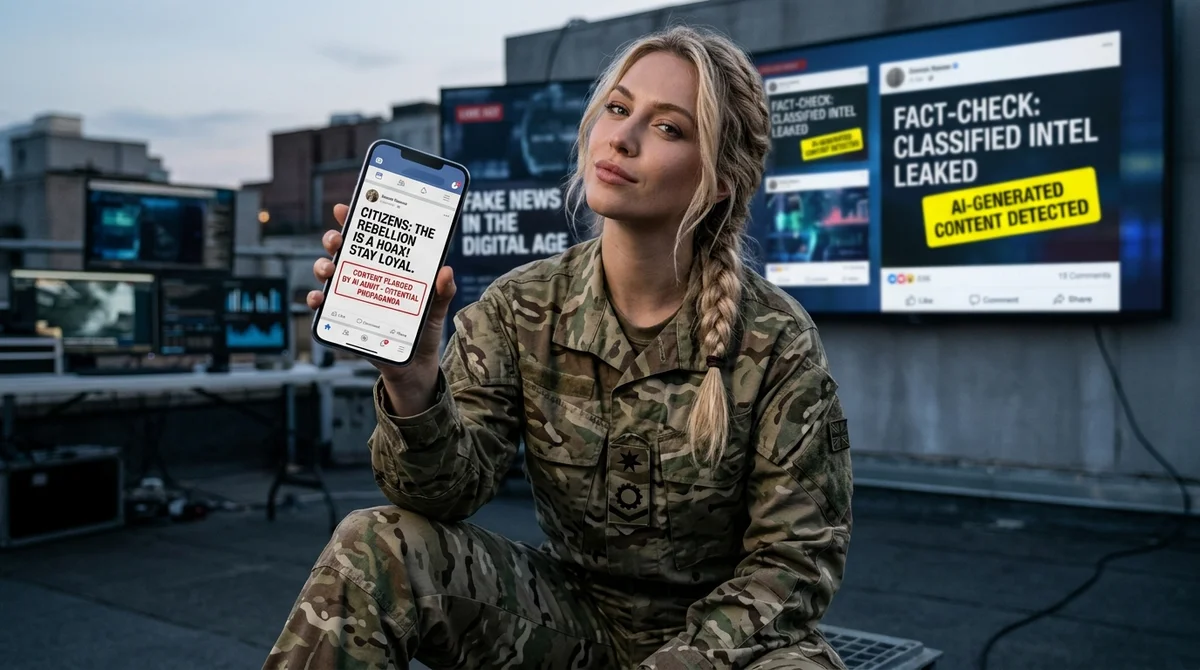
Political deepfakes are quickly ceasing to be mere memes or parodies. Researchers warn that synthetic characters created with generative AI already make money, build audiences and serve as a convenient form of propaganda, even when viewers suspect they are looking at a fake.
The scale of the new wave
The Governance and Responsible AI Lab (Grail) records a sharp rise in this kind of content. Since the start of 2025, researchers have counted more than 1,000 English-language social media posts with fake images and videos about politicians, newsworthy events and controversial topics. By comparison, Grail's database collected 1,344 similar cases over the previous eight years combined. The jump is attributed not only to the popularity of the topic but also to generative models making a plausible scene almost instant to produce.
The main change is not that there are more fakes of famous people. Creators increasingly invent entirely nonexistent characters and place them in politically charged settings: barracks, police stations, conflict zones, rallies. This is no longer just swapping a politician's face in a clip. It is the construction of a whole "reality" in which the viewer gets not a fact but an image that conveniently matches their beliefs. That is the new strength of deepfakes: they do not have to be accurate, only plausible-looking.
Money and beliefs
One of the most prominent examples is the AI character Jessica Foster, a blonde woman in a US military uniform who appeared on Instagram in December 2025. Posts showing her on a bed in a barracks, in an office with her feet on the desk, and next to Donald Trump on an airfield in high heels drew a huge audience. The account had more than a million followers, and traffic was then directed to OnlyFans, where users were sold supposed photos of her. The synthetic image thus worked both as a political visual symbol and as a commercial product.
Similar cases are already appearing in several formats:
- fake "Iranian soldiers" in clips designed to go viral during wartime
- an AI police officer on TikTok with more than 26,000 followers, posting messages supporting a hard-line deportation policy
- at least 18 deepfakes published by Donald Trump and the White House since 2024
- anti-Trump deepfakes, which California Governor Gavin Newsom has also started using
Researchers separately stress an unpleasant effect: such content can persuade even when viewers notice oddities. Wrong insignia, absurd scenes, mismatched details and an overly glossy visual style do not necessarily blunt the impact. If an image supports a person's existing opinion, it works as emotional confirmation. In this logic, a deepfake is not meant to prove a fact but to strengthen a feeling: "this looks true, so it must be."
Labels and defenses
Defenses currently rely mainly on content provenance standards and automatic labels. The Coalition for Content Provenance and Authenticity promotes an approach in which cryptographically signed metadata is embedded in an image or video: where the file was created, whether it was edited with AI tools and what happened to it afterward. The idea is simple: if a platform can read this information, it can warn the user before synthetic content spreads across feeds.
So far this works poorly. In an experiment by a journalist at The Indicator, 200 AI images and videos were uploaded to major platforms to test how they apply labels. Even the best results, from LinkedIn and Pinterest, covered only about 67% of the material. Instagram flagged just 15 of 105 fake images.
Researchers also warn about the next stage: AI swarms, in which networks of synthetic accounts could coordinate autonomously, embed themselves in communities and imitate public consensus without the familiar "troll factories" staffed by real people.
What this means
The political risk is no longer limited to the question of whether people will believe a fake literally. What matters far more is whether it reinforces a desired emotion, an image of an enemy or a sense of being right. While platforms label AI content slowly and monetization of such characters works fast, deepfakes will increasingly be used not only for entertainment but also for persuasion, radicalization and sales.
*Meta has been designated an extremist organization and is banned in Russia.
- Nov 1, 2026Pika Labs releases open video model H3 Flex: 6 steps instead of 50
- Nov 1, 2026Google's StreamVibe video agent beats other models by 10.7% on response timing and quality
- Oct 31, 2026AI cartoon series: a 24-second episode built ten ways, the best cost 162 credits
- Oct 31, 2026Anthropic: Fold Subagents Back Into a Single Loop — One Customer's Tasks Ran Twice as Fast
Key Questions Answered
What are the key details on The scale of the new wave?
The Governance and Responsible AI Lab (Grail) records a sharp rise in this kind of content. Since the start of 2025, researchers have counted more than 1,000 English-language social media posts with fake images and videos about politicians, newsworthy events and controversial topics. By comparison, Grail's database collected 1,344 similar cases over the previous eight years combined. The jump is attributed not only to the popularity of the topic but also to generative models making a plausible scene almost instant to produce. The main change is not that there are more fakes
What are the key details on Money and beliefs?
One of the most prominent examples is the AI character Jessica Foster, a blonde woman in a US military uniform who appeared on Instagram in December 2025. Posts showing her on a bed in a barracks, in an office with her feet on the desk, and next to Donald Trump on an airfield in high heels drew a huge audience. The account had more than a million followers, and traffic was then directed to OnlyFans, where users were sold supposed photos of her. The synthetic image thus worked both as a political visual symbol and as a commercial product. Similar cases are already appearing
What are the key details on Labels and defenses?
Defenses currently rely mainly on content provenance standards and automatic labels. The Coalition for Content Provenance and Authenticity promotes an approach in which cryptographically signed metadata is embedded in an image or video: where the file was created, whether it was edited with AI tools and what happened to it afterward. The idea is simple: if a platform can read this information, it can warn the user before synthetic content spreads across feeds. So far this works poorly. In an experiment by a journalist at The Indicator, 200 AI images and videos were uploaded
Test Frontier LLMs & Autonomous Agents in One Workspace
Run Claude Opus 5.5, GPT-6, Gemini 3.1, and DeepSeek side-by-side in Nomad AI (nomadnet.ai) — unified model routing, deep research, and multimodal workflows under one subscription.
The AI world, distilled — once a week
Seven stories that actually mattered, hand-picked. No noise, no reposts, no press releases.
Done! Check your inbox for a confirmation.