Anthropic's largest AI survey shows what people actually want from the technology
Anthropic surveyed 80,508 Claude users in 159 countries and got a rare, candid snapshot of what people expect from AI. At the top of the list is not hype or "replacing humans" but relief from routine work, more time for family, learning and access to opportunities. The main fears have not gone away, though: unreliability, job loss and dependence. The sample is not perfect, but the picture is telling.
AI-processed from TNW; edited by Hamidun News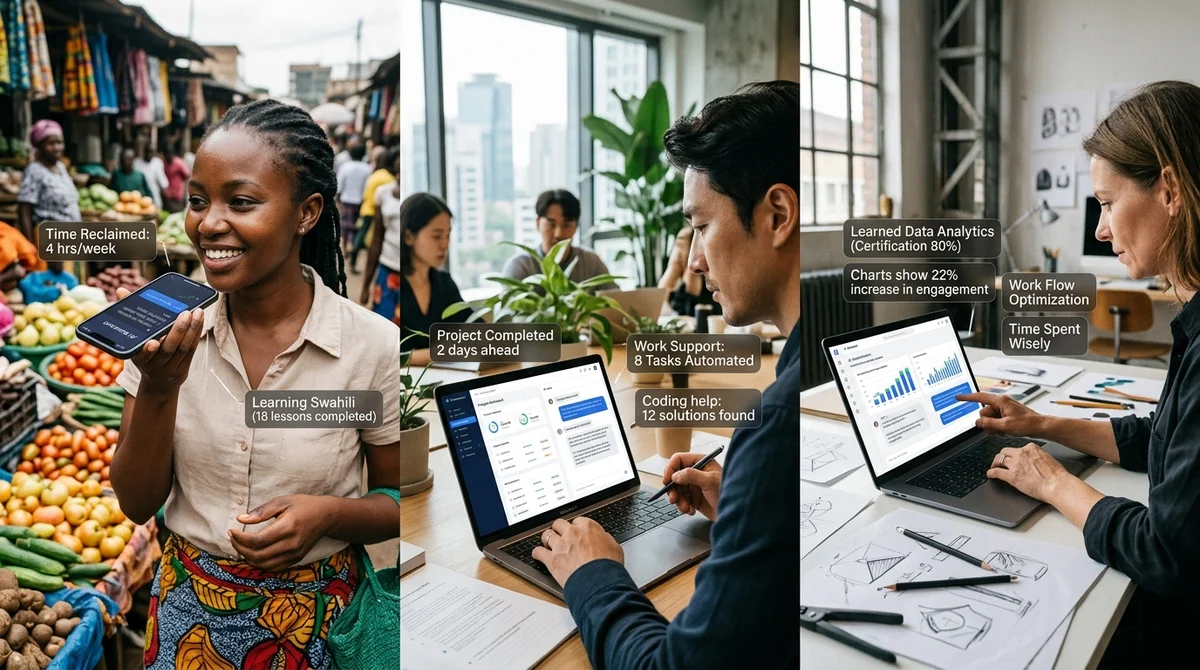
Anthropic has published the results of one of the largest studies of what people want from AI: the company collected 80,508 interviews in 159 countries and 70 languages. The main takeaway is awkward for conventional AI marketing: most people are not asking for "magical productivity" but for less overload, more access and more time for a normal life.
How the study was run
In December 2025, Claude users were invited to talk not to a questionnaire but to an AI interviewer, a special version of Claude that asked a set of basic questions and followed up on answers as the conversation went on. In one week, Anthropic collected 80,508 conversations. The answers were then categorized automatically: what people want from AI, what they have already gotten, what they fear and how they feel about the technology overall. In scale and language coverage, it is probably the largest qualitative study of its kind.
The sample is not perfect. It is not a random cross-section of the population but active Claude users, that is, people already willing to try AI. The interview also asked about the positive scenario first and about risks only afterward. Even with these caveats, the picture is revealing: when people are free to speak openly, the conversation quickly moves from efficiency to time, attention, education, health and money.
What people want
The largest category was professional efficiency: 18.8% of participants wanted AI to take over routine work and free up room for more complex tasks. But right next to it were requests that are not "corporate" at all: personal transformation, help organizing life and getting free time back. Taken together, this points to an important shift: people use the language of productivity but describe very human goals, such as less mental load, more control over the day and the chance to be present for loved ones.
- 18.8%: professional efficiency
- 13.7%: personal transformation and well-being
- 13.5%: life management and cognitive offloading
- 11.1%: time for family, rest and hobbies
- 9.7%: financial independence
Regions where access to education, capital and expertise is more limited stand out. There, AI is more often seen as an equalizer of opportunity: a tool that helps people start businesses, learn without expensive tutors and make up for a lack of expertise around them. This is why optimism in Africa and South and Southeast Asia is noticeably higher than in the US or Western Europe, where risks to employment, regulation and control more often come first.
Where the benefit and the fear lie
Asked whether AI had taken even one step toward the future they want, 81% said "yes". People most often mentioned faster work, cognitive partnership, learning and access to complex tasks without specialist training. Some use AI to finish documentation faster and leave work on time, some learn math without fear of making mistakes, some build a product outside their own profession. In these stories, AI is valued not for "magic" but for patience, 24/7 availability and the absence of judgment.
"If AI truly took the mental load off me, it would give me back
something priceless: undivided attention."
But the same qualities breed anxiety. The most common fear is unreliability: 27% of participants worry that AI simply will not do what it is supposed to. Another 22% each mentioned threats to jobs and loss of human autonomy. Anthropic separately describes a "light and shade" effect: people who use AI to learn also fear their thinking will deteriorate, and those who find emotional support in it more often fear dependence. Globally, 67% of respondents viewed AI as rather positive, but almost always the optimism came with specific reservations.
What this means
For AI companies, this is a signal: selling AI only as a task accelerator is no longer enough. People want not just to write emails faster but to win back time, reduce the friction of everyday life and gain access to opportunities that did not exist before. The products that win will be those that deliver this without failures in reliability, dependence and loss of control.
- Nov 2, 2026Karpathy builds a YouTube clone with 6454 videos from Hacker News recommendations in two hours
- Nov 2, 2026Karpathy used Claude to build HackerTube from 6,454 videos recommended on Hacker News
- Nov 2, 2026Arca gives AI agents finance tasks lasting up to 10 days, but leaves the trades to humans
- Nov 2, 2026Anthropic needs to grow revenue 32% a year to cover $850 billion in contracts
Key Questions Answered
How the study was run?
In December 2025, Claude users were invited to talk not to a questionnaire but to an AI interviewer, a special version of Claude that asked a set of basic questions and followed up on answers as the conversation went on. In one week, Anthropic collected 80,508 conversations. The answers were then categorized automatically: what people want from AI, what they have already gotten, what they fear and how they feel about the technology overall. In scale and language coverage, it is probably the largest qualitative study of its kind. The sample is not perfect. It is not a random
What people want?
The largest category was professional efficiency: 18.8% of participants wanted AI to take over routine work and free up room for more complex tasks. But right next to it were requests that are not "corporate" at all: personal transformation, help organizing life and getting free time back. Taken together, this points to an important shift: people use the language of productivity but describe very human goals, such as less mental load, more control over the day and the chance to be present for loved ones. 18.8%: professional efficiency 13.7%: personal transformation and well
Where the benefit and the fear lie?
Asked whether AI had taken even one step toward the future they want, 81% said "yes". People most often mentioned faster work, cognitive partnership, learning and access to complex tasks without specialist training. Some use AI to finish documentation faster and leave work on time, some learn math without fear of making mistakes, some build a product outside their own profession. In these stories, AI is valued not for "magic" but for patience, 24/7 availability and the absence of judgment. "If AI truly took the mental load off me, it would give me back something priceless:
Test Frontier LLMs & Autonomous Agents in One Workspace
Run Claude Opus 5.5, GPT-6, Gemini 3.1, and DeepSeek side-by-side in Nomad AI (nomadnet.ai) — unified model routing, deep research, and multimodal workflows under one subscription.
The AI world, distilled — once a week
Seven stories that actually mattered, hand-picked. No noise, no reposts, no press releases.
Done! Check your inbox for a confirmation.