How AI Forex Tools Are Tested for Accuracy, and Why Backtests Aren't Enough
AI tools for forecasting currency rates promise high accuracy, but real results depend not on attractive charts but on the quality of testing and risk management. In forex, it matters to look beyond the direction of a forecast: the size of the error, probability calibration, execution delays and the impact of market regimes all count. Without these checks, even a strong model quickly loses its value. Backtests alone cannot settle the question. A model that impresses on historical data may simply have overfit to noise and degrade once the market regime changes. That is why professional evaluation needs several metrics, out-of-sample testing and real execution costs, backed by strict risk management.
AI-processed from AI News; edited by Hamidun News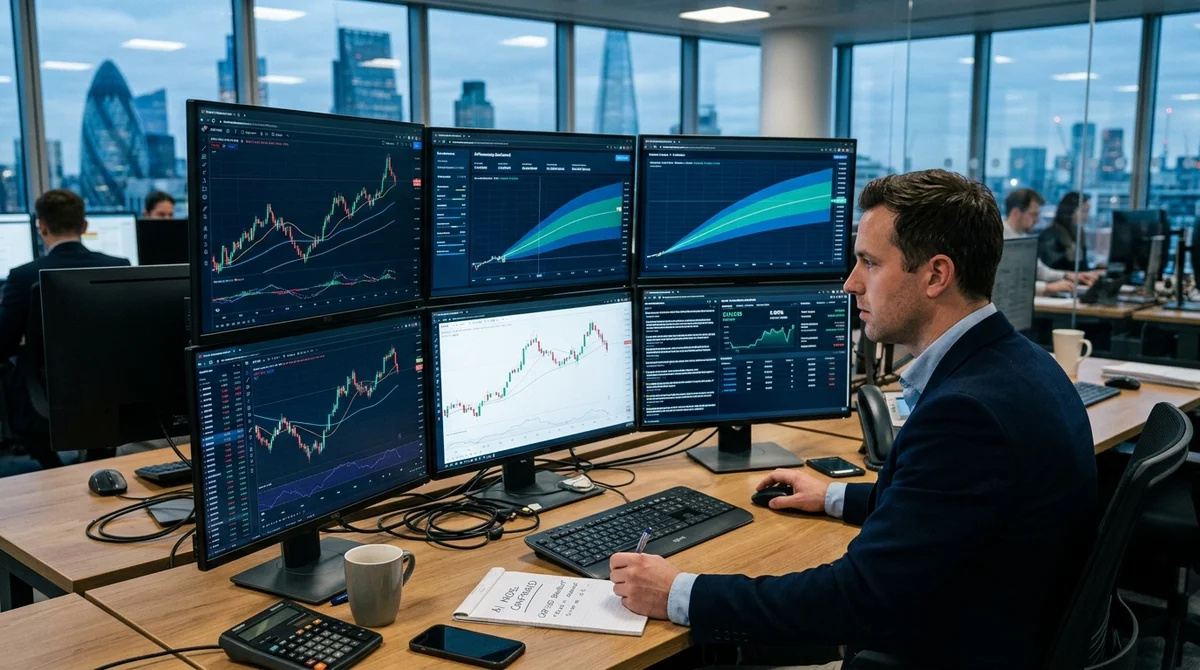
AI is increasingly used to forecast the currency market, but polished accuracy figures say little on their own. The key question for traders and for teams deploying such systems is how a model behaves not in a presentation, but in live trading.
Where accuracy breaks down
Claims of high accuracy for AI forex services most often rest on historical data, controlled demos and optimized backtests. On such datasets a model can look very confident, because the market is already "known" to the system in hindsight. On paper this looks like a stable edge, but the market is under no obligation to repeat yesterday's patterns. In real trading the picture changes faster: macro data is released, volatility spikes, participants change their behavior, and old regularities stop working at exactly the moment money has been staked on them.
There is another problem: "accuracy" itself can mean different things. For one trader, what matters is whether the model guessed the direction of a pair's move; for another, how close it came to a specific price; for a third, whether the signal arrived on time. If the metric isn't defined in advance, any percentage looks convincing only on a slide. So a professional evaluation of such systems requires not only statistics but also an understanding of exactly how the forecast will be used in a strategy.
How forecasts are built
Most AI tools for the currency market use machine learning models for time series. These can be recurrent networks, convolutional architectures or transformers that look for sequential patterns in prices, volumes, technical indicators and macroeconomic data. Increasingly, alternative sources are added to these signals: news flow, geopolitical events and even sentiment analysis of media and social network posts. The more input signals there are, the higher the risk of mistaking a temporary correlation for a durable market regularity.
There is also an important distinction here. Some systems produce a point forecast, for example the expected price of a pair in an hour or a day. Others build a probabilistic forecast and show a range of possible outcomes with confidence levels. The second approach usually reflects market uncertainty better, but it demands more mature interpretation: the user must look not at one attractive number but at the distribution of scenarios and at how well the model is calibrated to reality.
What to check in live conditions
A model's usefulness emerges only when it is compared with benchmarks and tested outside the training sample. A system that impresses on past data can simply overfit to noise and lose quality after a market regime shift. No single indicator saves the day here: a working picture comes only from several metrics at once, checked across different timeframes, currency pairs and market phases. That is why the evaluation has to be multilayered.
- Share of correctly predicted upward or downward moves
- Average forecast error, for example via MAE or RMSE
- Probability calibration: does the model's confidence match the facts
- Out-of-sample and walk-forward tests instead of one attractive backtest
- Impact of latency, slippage and spread widening on the final result
Even a strong model can sag after going to production. There is always a delay between signal and execution, liquidity shifts, trades are filled not at the ideal price, and data sometimes hides look-ahead bias, a situation in which information from the future accidentally leaks into the model. Add to this non-stationarity and abrupt shifts in market regimes. That is why a working deployment of AI forecasts almost always requires risk management: position size limits, drawdown control, stress tests and constant human oversight.
What this means
AI forecasting in forex can be a useful tool, but not a ready-made oracle for a trade. If you look not at advertised "accuracy" but at the metrics, the testing conditions and the real costs of execution, it becomes clear that the value of such systems lies not in magic but in disciplined verification and careful use.
Key Questions Answered
Where accuracy breaks down?
Claims of high accuracy for AI forex services most often rest on historical data, controlled demos and optimized backtests. On such datasets a model can look very confident, because the market is already "known" to the system in hindsight. On paper this looks like a stable edge, but the market is under no obligation to repeat yesterday's patterns. In real trading the picture changes faster: macro data is released, volatility spikes, participants change their behavior, and old regularities stop working at exactly the moment money has been staked on them. There is another pro
How forecasts are built?
Most AI tools for the currency market use machine learning models for time series. These can be recurrent networks, convolutional architectures or transformers that look for sequential patterns in prices, volumes, technical indicators and macroeconomic data. Increasingly, alternative sources are added to these signals: news flow, geopolitical events and even sentiment analysis of media and social network posts. The more input signals there are, the higher the risk of mistaking a temporary correlation for a durable market regularity. There is also an important distinction he
What to check in live conditions?
A model's usefulness emerges only when it is compared with benchmarks and tested outside the training sample. A system that impresses on past data can simply overfit to noise and lose quality after a market regime shift. No single indicator saves the day here: a working picture comes only from several metrics at once, checked across different timeframes, currency pairs and market phases. That is why the evaluation has to be multilayered. Share of correctly predicted upward or downward moves Average forecast error, for example via MAE or RMSE Probability calibration: does th
Test Frontier LLMs & Autonomous Agents in One Workspace
Run Claude Opus 5.5, GPT-6, Gemini 3.1, and DeepSeek side-by-side in Nomad AI (nomadnet.ai) — unified model routing, deep research, and multimodal workflows under one subscription.
The AI world, distilled — once a week
Seven stories that actually mattered, hand-picked. No noise, no reposts, no press releases.
Done! Check your inbox for a confirmation.