Goldman Sachs cuts off Hong Kong staff from Anthropic's Claude
Goldman Sachs has cut off its Hong Kong employees from Anthropic's Claude, an AI tool that speeds up code writing. The bank has not publicly disclosed the reasons for the decision. The episode shows that even strong AI products face more than a model-quality test inside banks: they also have to clear compliance, security and regional rules.
AI-processed from Bloomberg Tech; edited by Hamidun News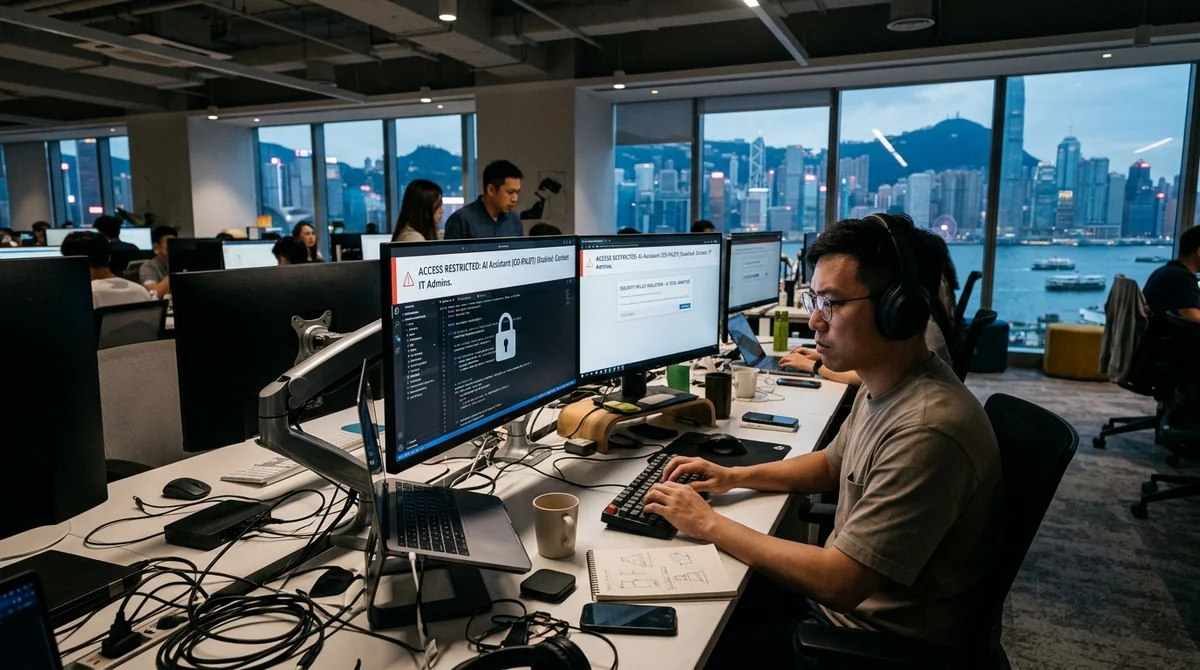
Goldman Sachs has cut off its Hong Kong employees from Anthropic's Claude, an AI tool that helps write software code faster. According to Bloomberg, the restriction is already in effect, but the bank has not publicly explained why.
What happened in Hong Kong
This is not Goldman Sachs abandoning generative AI altogether, but a targeted restriction in one of its key Asian offices. Bloomberg, citing a source familiar with the situation, reports that employees in Hong Kong can no longer use Claude. It is still unclear whether the decision affects other divisions of the bank, whether the measure is temporary, and whether it is tied to an internal review, a security policy or local data-handling requirements.
The regional nature of the restriction matters as much as the shutdown itself. At large international banks, access to internal and external digital services is often configured not uniformly but by country, legal entity and team function. So even a narrow change in a single office can mean either a local adjustment of the rules or a broader rethink of how AI tools are admitted into engineering workflows across a global organization.
What may have played a role
The article does not name a reason, so any explanation here is only a cautious inference from context. For large banks, tools like Claude are not just chatbots but a potential access point to internal code, documentation, workflows and client data. If employees use AI to speed up development, a bank typically assesses separately which pieces of code can be sent to an external service, where requests are stored, how auditing is set up and who is responsible for compliance with local rules.
- sending internal code fragments and configurations to an external service
- regional restrictions on data processing and storage
- a review of AI pilot programs after an internal audit
- different sets of permitted tools for different offices and teams
The report describes Claude as an agent that speeds up software development. For a bank this is a useful but sensitive use case: the assistant can suggest code fragments, explain the logic of systems and help with refactoring, but any gain in speed has to be weighed against compliance risks and the risk of intellectual property leaks. This is especially true for international organizations, where the same platform has to pass review in several jurisdictions at once.
A signal for the market
The Hong Kong story matters beyond a single bank. Financial institutions are actively testing generative AI, but banks run into security, regulatory and governance requirements more often than most. Any tool that helps write code automatically falls under stricter controls than an ordinary corporate chat. That is because it involves not just text but access to the logic of internal systems, libraries, engineering practices and potentially data tied to the business's critical infrastructure.
It is also a telling episode for Anthropic. Even if the restriction covers only one region, it is a reminder that winning in the enterprise segment depends on more than model quality. Deployment terms, data routing, log transparency, admin-control flexibility and willingness to adapt to local rules matter just as much. In enterprise AI, buyers pay not for an impressive demo but for predictability, control and the ability to pass an internal risk review.
What this means
The Goldman Sachs news shows that the enterprise AI market is entering a phase of tougher filtering. For large companies it is no longer enough for a tool to be simply strong: it must fit regional policies, compliance and the access-management model. For vendors this means one thing: enterprise sales are increasingly decided not in the interface but in the security department.
- Nov 2, 2026Karpathy builds a YouTube clone with 6454 videos from Hacker News recommendations in two hours
- Nov 2, 2026Karpathy used Claude to build HackerTube from 6,454 videos recommended on Hacker News
- Nov 2, 2026Arca gives AI agents finance tasks lasting up to 10 days, but leaves the trades to humans
- Nov 2, 2026Anthropic needs to grow revenue 32% a year to cover $850 billion in contracts
Key Questions Answered
What happened in Hong Kong?
This is not Goldman Sachs abandoning generative AI altogether, but a targeted restriction in one of its key Asian offices. Bloomberg, citing a source familiar with the situation, reports that employees in Hong Kong can no longer use Claude. It is still unclear whether the decision affects other divisions of the bank, whether the measure is temporary, and whether it is tied to an internal review, a security policy or local data-handling requirements. The regional nature of the restriction matters as much as the shutdown itself. At large international banks, access to interna
What may have played a role?
The article does not name a reason, so any explanation here is only a cautious inference from context. For large banks, tools like Claude are not just chatbots but a potential access point to internal code, documentation, workflows and client data. If employees use AI to speed up development, a bank typically assesses separately which pieces of code can be sent to an external service, where requests are stored, how auditing is set up and who is responsible for compliance with local rules. sending internal code fragments and configurations to an external service regional res
What are the key details on A signal for the market?
The Hong Kong story matters beyond a single bank. Financial institutions are actively testing generative AI, but banks run into security, regulatory and governance requirements more often than most. Any tool that helps write code automatically falls under stricter controls than an ordinary corporate chat. That is because it involves not just text but access to the logic of internal systems, libraries, engineering practices and potentially data tied to the business's critical infrastructure. It is also a telling episode for Anthropic. Even if the restriction covers only one
Test Frontier LLMs & Autonomous Agents in One Workspace
Run Claude Opus 5.5, GPT-6, Gemini 3.1, and DeepSeek side-by-side in Nomad AI (nomadnet.ai) — unified model routing, deep research, and multimodal workflows under one subscription.
The AI world, distilled — once a week
Seven stories that actually mattered, hand-picked. No noise, no reposts, no press releases.
Done! Check your inbox for a confirmation.