Apple to add AI photo-editing tools in iOS 27, iPadOS 27 and macOS 27
Apple is preparing a notable update to the built-in photo editor in iOS 27, iPadOS 27 and macOS 27. The company wants to add AI tools for editing images on iPhone, iPad and Mac. If the plans are confirmed, users will get system-level features for removing unwanted objects, reducing blur and extending the frame, with no third-party apps required. It is a direct response to what Google Pixel and Samsung Galaxy already offer.
AI-processed from 3DNews AI; edited by Hamidun News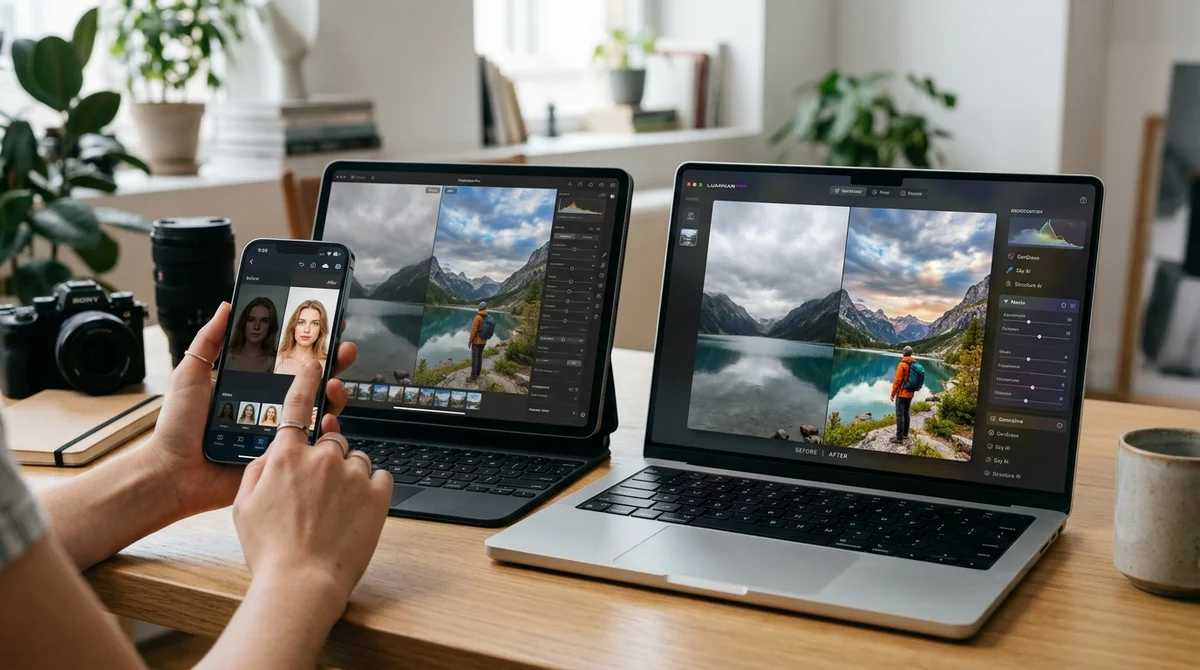
Apple is preparing a major update to the built-in photo editor on iPhone, iPad and Mac. According to Bloomberg, the fall releases of iOS 27, iPadOS 27 and macOS 27 will include AI tools meant to strengthen the Apple Intelligence package and narrow the gap with Android rivals.
What is being updated
This is not about a third-party app, but about system-level image-editing features that people use every day, right on their devices. Apple wants to significantly expand the built-in toolset on iPhone, iPad and Mac by adding artificial intelligence capabilities.
The approach matters for the company: the more useful AI scenarios work out of the box, the easier it is to keep users inside its own ecosystem, and the fewer reasons they have to look for alternatives in third-party apps. For Apple, it is also a chance to show that Apple Intelligence is not just a set of experimental features for text and the assistant, but a practical layer on top of everyday tasks.
Photo editing is one of the most easily understood mass-market scenarios: nobody needs to explain why they want AI when they can remove an unwanted object, fix a bad shot or get a picture ready to post in a couple of taps.
Why Apple is playing catch-up
In mobile photography, Android manufacturers raised the bar long ago. Google has been pushing AI photo editing for several years: object removal, blur reduction, frame extension and other semi-automatic enhancements have become a familiar part of the experience on Pixel and across the Android ecosystem. Samsung has its own tools for Galaxy smartphones, and for many users they have long since gone from a marketing add-on to a real everyday feature.
Against that backdrop, Apple looks more like the one catching up. The company has traditionally been strong in cameras, image processing and hardware-software integration, but built-in generative tools in the photo editor have so far not been as clear an advantage for it. So the new features in iOS 27, iPadOS 27 and macOS 27 matter not only as a gallery update but as a signal: Apple can no longer postpone AI features in a category where users are already used to instant results.
What features to expect
Apple has not yet disclosed the exact list of capabilities. But if the company really wants to close the gap with Google and Samsung, users will expect not abstract promises but a set of clear tools that save time and do not require separate apps. These are primarily the scenarios that have already become the market standard and directly affect the quality of a shot after it is taken.
- Removing unwanted objects from photos
- Reducing blur and noise
- Extending the frame beyond the original
- Quick local retouching without a manual mask
- Unified tools across iPhone, iPad and Mac
If Apple implements these scenarios carefully and quickly, the gain will go beyond editing quality to the whole logic of the ecosystem. A user will be able to start an edit on a smartphone, continue on a tablet and finish on a Mac without leaving for third-party services. That matters especially now, when the battle between ecosystems is no longer only about device performance, but also about how smart the basic everyday functions turn out to be.
What it means
Apple is finally bringing Apple Intelligence to one of the most mainstream user scenarios: photo editing. If the fall versions of iOS 27, iPadOS 27 and macOS 27 really deliver strong built-in AI tools, competition between Apple, Google and Samsung will shift from standalone flagship features to an everyday experience users notice after every shot they take.
- Nov 1, 2026Local models lose to Opus and Codex: 0.21 on a MacBook versus 1.00 for Codex
- Oct 29, 2026Claude Code Edits Video From a Transcript: How the video-use Skill With 30 000 Stars Works
- Oct 29, 2026Stanford AI tool verifies part of Signal's code in half a day for under $500, versus five months of expert work
- Oct 29, 2026Liquid AI releases LFM3: six multimodal 2B models with a 256K context window
Key Questions Answered
What is being updated?
This is not about a third-party app, but about system-level image-editing features that people use every day, right on their devices. Apple wants to significantly expand the built-in toolset on iPhone, iPad and Mac by adding artificial intelligence capabilities. The approach matters for the company: the more useful AI scenarios work out of the box, the easier it is to keep users inside its own ecosystem, and the fewer reasons they have to look for alternatives in third-party apps. For Apple, it is also a chance to show that Apple Intelligence is not just a set of experiment
Why Apple is playing catch-up?
In mobile photography, Android manufacturers raised the bar long ago. Google has been pushing AI photo editing for several years: object removal, blur reduction, frame extension and other semi-automatic enhancements have become a familiar part of the experience on Pixel and across the Android ecosystem. Samsung has its own tools for Galaxy smartphones, and for many users they have long since gone from a marketing add-on to a real everyday feature. Against that backdrop, Apple looks more like the one catching up. The company has traditionally been strong in cameras, image pr
What features to expect?
Apple has not yet disclosed the exact list of capabilities. But if the company really wants to close the gap with Google and Samsung, users will expect not abstract promises but a set of clear tools that save time and do not require separate apps. These are primarily the scenarios that have already become the market standard and directly affect the quality of a shot after it is taken. Removing unwanted objects from photos Reducing blur and noise Extending the frame beyond the original Quick local retouching without a manual mask Unified tools across iPhone, iPad and Mac If
Test Frontier LLMs & Autonomous Agents in One Workspace
Run Claude Opus 5.5, GPT-6, Gemini 3.1, and DeepSeek side-by-side in Nomad AI (nomadnet.ai) — unified model routing, deep research, and multimodal workflows under one subscription.
The AI world, distilled — once a week
Seven stories that actually mattered, hand-picked. No noise, no reposts, no press releases.
Done! Check your inbox for a confirmation.