Bernie Sanders urges US and China to rein in AI's 'train without brakes' together
On April 29, Bernie Sanders hosted a panel with Chinese scholars on Capitol Hill and urged the US and China to negotiate AI rules modeled on international agreements. He warned of disinformation, loss of privacy, social isolation among teenagers and rising unemployment, and compared the current AI race to a "train without brakes." The idea drew criticism from some conservatives, who do not trust Beijing.
AI-processed from Guardian; edited by Hamidun News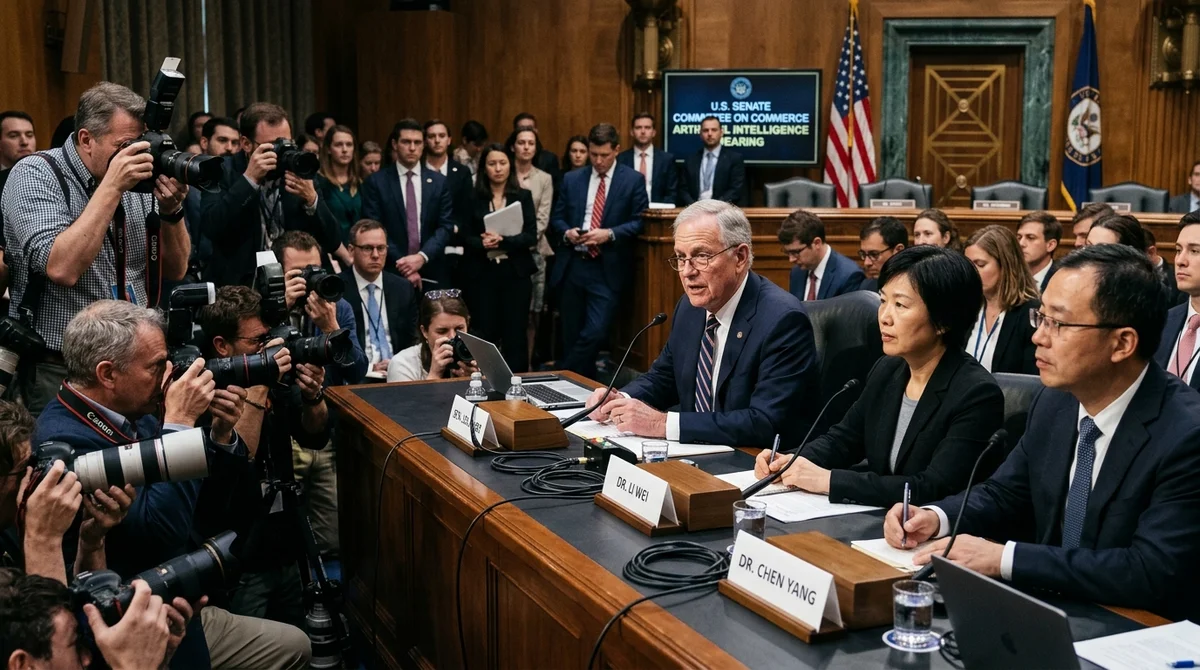
On April 29, 2026, Senator Bernie Sanders hosted a panel on the risks of artificial intelligence on Capitol Hill and called for international rules of the game. His central argument: the race between the US and China to build more powerful systems cannot be left to run on its own, or the consequences will hit the labor market, privacy and social stability.
The panel in Congress
Sanders invited two Chinese specialists in AI regulation: Xue Lan of Tsinghua University and Zeng Yi of the Beijing Institute of AI Safety and Governance. For American politics, this is an unusual format. Rather than talking only about technological leadership, the senator emphasized shared rules and said that without dialogue between the largest powers, regulation will not work. In his logic, if countries compete only on development speed, every new precaution will look like a concession to a rival.
Sanders likened the approach he wants to Cold War-era international agreements and in effect proposed carrying that logic over to AI. He argues that Congress is already far behind in grasping the scale of change that automation and robotics bring. This is not a new position for the senator: on March 25, 2026, he and Alexandria Ocasio-Cortez introduced a bill for a moratorium on building new AI data centers until the US has strict federal safety guarantees.
The risks he sees
The core of Sanders' remarks is not an abstract fear of the technology but a set of concrete threats that, in his view, are already beginning to materialize as AI is adopted at scale. At the panel he said separately that business and investors are scaling models faster than politicians can grasp the consequences.
- disinformation and amplified manipulation in the public sphere
- loss of privacy and deeper collection of user data
- social isolation of teenagers who depend on chatbots
- rising unemployment if companies begin replacing people with automated labor en masse
- the risk of superintelligent systems emerging outside their developers' control
"The richest and most powerful people in the world are building a train without brakes,"
Sanders said, describing the current AI race.
For him, the problem lies not only in the models themselves but in the pace at which corporations deploy them. The senator warns of a scenario in which decisions affecting the economy and democratic institutions are made by a handful of big Big Tech players, while society gets the consequences after the fact.
One of the Chinese panelists, Xue Lan, backed the idea of coordination and said it is hard to imagine a world in which the most powerful tools are concentrated in a few countries and companies while the rest of the world is left on the margins of the AI economy.
Why it sparked a dispute
The mere appearance of Chinese academics on Capitol Hill irritated some American conservatives. The criticism targeted not so much regulation itself as cooperation with China as a geopolitical rival. Conservative analyst Michael Sobolik wrote that child safety, community impact and job displacement need to be discussed, but doing so in partnership with Chinese participants in such discussions is a bad idea.
Against this backdrop, US Treasury Secretary Scott Bessent pushed a harder line: in his version, America should set the global AI safety standard itself, without letting other countries define the rules.
This is the main fault line in the current debate. One camp holds that regulation is possible only through international agreements among centers of power. The other holds that such agreements would weaken the US in the technology race and hand competitors a political advantage.
What it means
The Sanders panel shows that the argument over AI is quickly moving beyond talk of new products and becoming a question of geopolitics, employment and control over infrastructure. If international rules take hold on Washington's agenda, the next stage of the debate will no longer be about whether AI needs oversight, but about who will write the rules: the US alone or several countries together.
- Oct 31, 2026Author puts his script before an AI jury: the verdict cost 850 thousand tokens
- Oct 29, 2026OvisOCR3: an 0.8B-parameter model that reads documents better than specialized systems
- Oct 29, 2026Tencent releases Youtu-Parsing-Omni: one model parses documents, audio and video
- Oct 28, 2026Liquid AI releases LFM2.5-24B-A2B: an agent model with 2B active parameters
Key Questions Answered
What are the key details on The panel in Congress?
Sanders invited two Chinese specialists in AI regulation: Xue Lan of Tsinghua University and Zeng Yi of the Beijing Institute of AI Safety and Governance. For American politics, this is an unusual format. Rather than talking only about technological leadership, the senator emphasized shared rules and said that without dialogue between the largest powers, regulation will not work. In his logic, if countries compete only on development speed, every new precaution will look like a concession to a rival. Sanders likened the approach he wants to Cold War-era international agreem
What are the key details on The risks he sees?
The core of Sanders' remarks is not an abstract fear of the technology but a set of concrete threats that, in his view, are already beginning to materialize as AI is adopted at scale. At the panel he said separately that business and investors are scaling models faster than politicians can grasp the consequences. disinformation and amplified manipulation in the public sphere loss of privacy and deeper collection of user data social isolation of teenagers who depend on chatbots rising unemployment if companies begin replacing people with automated labor en masse the risk of
Why it sparked a dispute?
The mere appearance of Chinese academics on Capitol Hill irritated some American conservatives. The criticism targeted not so much regulation itself as cooperation with China as a geopolitical rival. Conservative analyst Michael Sobolik wrote that child safety, community impact and job displacement need to be discussed, but doing so in partnership with Chinese participants in such discussions is a bad idea. Against this backdrop, US Treasury Secretary Scott Bessent pushed a harder line: in his version, America should set the global AI safety standard itself, without letting
Test Frontier LLMs & Autonomous Agents in One Workspace
Run Claude Opus 5.5, GPT-6, Gemini 3.1, and DeepSeek side-by-side in Nomad AI (nomadnet.ai) — unified model routing, deep research, and multimodal workflows under one subscription.
The AI world, distilled — once a week
Seven stories that actually mattered, hand-picked. No noise, no reposts, no press releases.
Done! Check your inbox for a confirmation.