Federal Treasury Launches AI Monitoring of National Project Construction Sites Using QMonitoring
Federal Treasury has implemented AI services to monitor construction projects funded from the federal budget. The QMonitoring platform analyzes video from…
AI-processed from Habr AI; edited by Hamidun News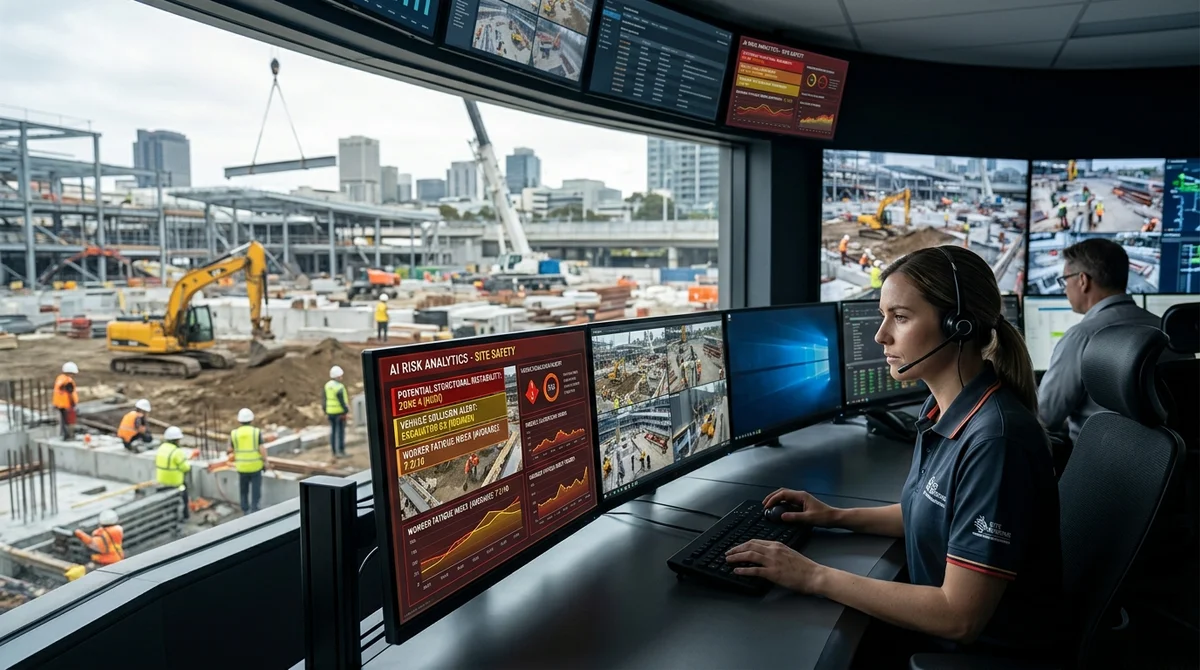
The Federal Treasury has transferred part of construction control to AI: for capital construction projects built at the expense of the federal budget, they launched automatic risk analysis. The basis for this was the Russian platform QMonitoring, which processes video from cameras at construction sites across the country 24/7.
How the System Works
The new monitoring framework is built around continuous video surveillance and automatic analytics. Cameras at facilities transmit a stream to the QMonitoring platform, and algorithms in real-time search for signs of deviations that previously had to be tracked manually through site visits, photo reports, and interim summaries. For the customer, this is an attempt to move from reactive control, when a problem is noticed only after a schedule break, to earlier risk detection.
Moreover, this is not about a single pilot region, but a distributed network of sites where a unified evaluation logic allows facilities to be compared with each other. The system works not as an archive of recordings, but as a tool for operational oversight. It doesn't just save video, but interprets what is happening on the site and forms signals for management decisions.
Each day, AI prepares reports and notifications according to the methodology of the Analytical Center under the Government of the Russian Federation. This means that data from cameras is converted into a structure suitable for assessing timelines, pace, and probable failures at facilities.
What Risks It Looks For
Based on the project description, the platform focuses not on abstract "smart construction," but on quite practical indicators. AI tracks how much the construction is actually progressing, whether there are enough people and equipment, whether events are occurring on the site that could quickly move the facility into a red zone. In practice, this could mean the risk of schedule failure, cost increases, or poor utilization of already allocated funds. These are exactly the signals important for early intervention.
- number of workers at the facility
- work being performed and its actual character
- emergency incidents at the site
- efficiency of heavy equipment utilization
- facilities that fall into the risk zone
Such a set of metrics is useful because it unites the execution picture in one window. If there are few people on the site, equipment is idle, and actual work does not match the plan, the system can detect this before the problem is reflected in official reporting. The Treasury believes that this approach will help to timely identify deviations in schedules, pace, and volume of work, and then take measures in advance to reduce construction risks and not inflate the budget.
"Digitalization of control is a necessary condition for improving the
speed, transparency, and quality of management of budget funds."
A financial effect is also separately emphasized. When control becomes continuous rather than episodic, the customer has more opportunities to notice inefficiency at an early stage: from idle resources to signs of work delays. For projects financed from the budget, this is especially important because even small shifts across multiple sites quickly turn into a systemic problem. At the same time, dependence on rare selective inspections that often lag is reduced.
What Will Be Added Next
At the first stage of implementation, the platform is already used for risk assessment, but its functionality is planned to expand. In upcoming updates, developers want to add monitoring of construction volumes, analysis of object storey numbers, and new data sources for assessing linear objects—for example, roads and bridges. This is an important expansion: such projects are harder to assess from a single camera or one type of signal, so the system will need a richer set of indicators.
The Treasury also stated that when analyzing risks, primary attention is given to social sector facilities. The logic is clear: schools, hospitals, sports and other public facilities are more sensitive to schedule failures and quickly come into public attention. If the pilot and subsequent implementation phases show stable results, such a format of digital control could become standard for a significant portion of state construction projects.
For departments, this is also a way to set priorities where the cost of delay is highest.
What This Means
Government construction control is gradually transforming from a paper and selective procedure into stream analytics based on video. For the market, this is a signal that AI in infrastructure projects is increasingly used not for presentations, but for a concrete task—to notice failures earlier, manage risks, and more closely monitor the effectiveness of budget spending. If the system shows sustained effect, similar approaches will be scaled to other types of budget projects in the future.
Want to stop reading about AI and start using it?
AI News is a curated feed of AI/tech news. Hamidun Academy teaches you to use AI systematically in your work.