OpenAI hits key US AI compute target years ahead of schedule, speeds up data centers
OpenAI has closed an important US AI compute target ahead of schedule. For the company, this is more than infrastructure news: a cushion of compute directly affects how quickly it can ship new models, how stable its services stay and how fast it can expand data centers. If the capacity is indeed locked in early, OpenAI gains a markedly stronger position in the race for scale, speed and the ability to serve growing demand.
AI-processed from Bloomberg Tech; edited by Hamidun News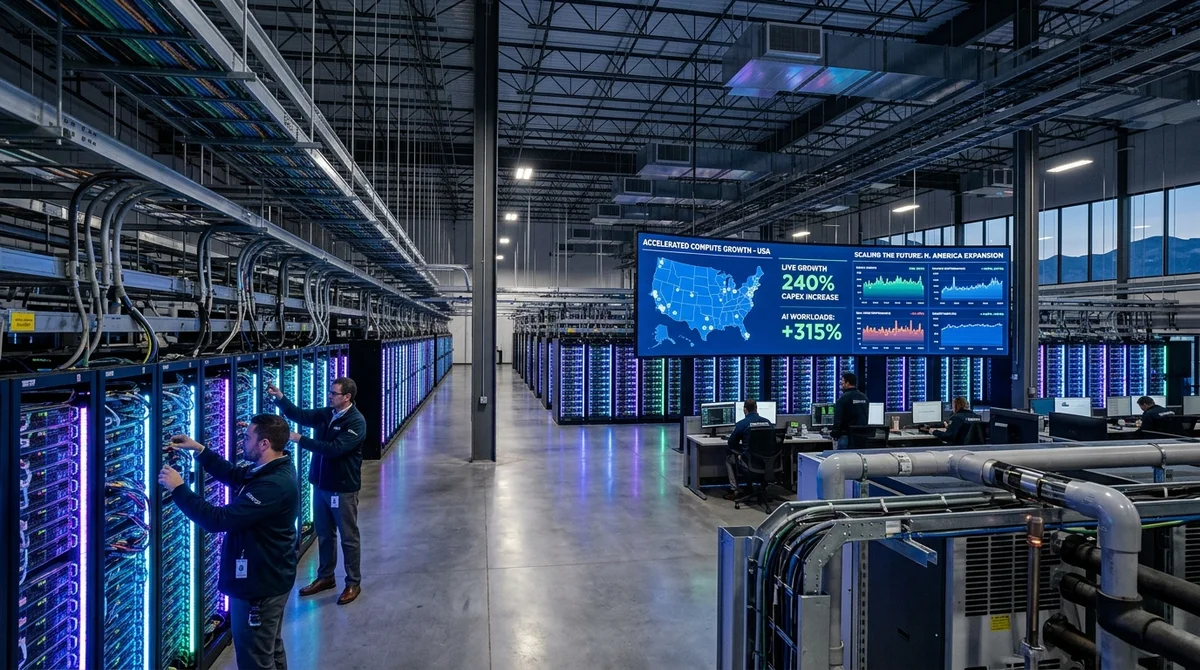
OpenAI has hit a key milestone for securing AI compute capacity in the US ahead of schedule. This removes one of the company's main infrastructure constraints and speeds up its plans to expand its network of data centers.
What was secured
According to Bloomberg Tech, the company reached an important goal for reserving AI capacity in the American market several years earlier than its own schedule. For OpenAI this is not a formality or a pretty KPI: it concerns access to the compute base without which it is impossible to reliably train new models, scale services already in operation and withstand growing user load. At this stage, time saved turns into a real competitive advantage, because demand for compute in the industry is growing faster than players can bring new capacity online.
When people talk about AI compute, they usually mean more than just chips. It also includes racks, networking, cooling, power supply, sites and the contracts that keep clusters running. At this level the market has long since run into scarcity: demand for accelerators and electricity is growing faster than new infrastructure is being built. So reaching the goal early gives OpenAI not an abstract edge but a firmer operational foundation for its next launches. That matters especially for a company whose products need resources both for training models and for handling a large daily stream of requests.
Why it matters
For OpenAI, compute capacity directly sets the pace of product releases. The more infrastructure is available, the fewer internal queues there are between training, testing and launching new features. This is especially important now that the generative AI market competes not only on model quality but also on the speed of updates, API reliability and cost of operation for businesses. In other words, spare capacity becomes part of product strategy, not just a backend question. When compute runs short, a company has to choose what matters most right now: training the next model, serving current users or holding a reserve for new releases.
Closing such a milestone early also strengthens plans for US data center development. If the key block of capacity is already secured, it is easier for the company to move on: sign new agreements, plan larger installations and distribute load across sites. For the ecosystem around OpenAI this is also a positive signal: partners, enterprise customers and developers get more confidence that demand growth will not hit a hard infrastructure ceiling. This reduces nervousness around future launches and makes planning several cycles ahead easier.
- more resources for training the next models
- lower risk of capacity shortages as traffic grows
- more room to launch new products
- a stronger position in negotiations over future data centers
The news does not mean infrastructure problems are over. Expanding data centers remains a capital-intensive and slow task: construction, network connectivity, cooling and power consumption all have to be synchronized. The focus on the US matters too: for OpenAI it is a question of supply chain control, access to electricity and more predictable planning. Still, the fact that the goal was reached early shows the company is getting through the industry's most painful stretch faster than many expected. And that affects not only OpenAI's internal plans but the balance of power across the whole AI infrastructure market.
What it means
The AI race increasingly comes down to infrastructure, not just model quality. If OpenAI has indeed closed its key US compute target early, that strengthens its position in the next phase of the market: the winners will be those who can not only build strong AI but quickly supply it with hardware, energy and scale. For users and businesses this is a good sign: services built on OpenAI have a better chance of growing without a constant state of scarcity and painful limits on the pace of development.
- Nov 1, 2026Local models lose to Opus and Codex: 0.21 on a MacBook versus 1.00 for Codex
- Nov 1, 2026Kimi scores 96.2% on a 1C database analytics test and emerges as a fallback if Claude access is blocked
- Nov 1, 2026OpenAI Rewrites GPT Behavior Rules: Five Values and a Chain of Command
- Nov 1, 2026Google admits AI Mode cuts search revenue, shares fall 15%
Key Questions Answered
What was secured?
According to Bloomberg Tech, the company reached an important goal for reserving AI capacity in the American market several years earlier than its own schedule. For OpenAI this is not a formality or a pretty KPI: it concerns access to the compute base without which it is impossible to reliably train new models, scale services already in operation and withstand growing user load. At this stage, time saved turns into a real competitive advantage, because demand for compute in the industry is growing faster than players can bring new capacity online. When people talk about AI
Why it matters?
For OpenAI, compute capacity directly sets the pace of product releases. The more infrastructure is available, the fewer internal queues there are between training, testing and launching new features. This is especially important now that the generative AI market competes not only on model quality but also on the speed of updates, API reliability and cost of operation for businesses. In other words, spare capacity becomes part of product strategy, not just a backend question. When compute runs short, a company has to choose what matters most right now: training the next mod
What it means?
The AI race increasingly comes down to infrastructure, not just model quality. If OpenAI has indeed closed its key US compute target early, that strengthens its position in the next phase of the market: the winners will be those who can not only build strong AI but quickly supply it with hardware, energy and scale. For users and businesses this is a good sign: services built on OpenAI have a better chance of growing without a constant state of scarcity and painful limits on the pace of development.
Test Frontier LLMs & Autonomous Agents in One Workspace
Run Claude Opus 5.5, GPT-6, Gemini 3.1, and DeepSeek side-by-side in Nomad AI (nomadnet.ai) — unified model routing, deep research, and multimodal workflows under one subscription.
The AI world, distilled — once a week
Seven stories that actually mattered, hand-picked. No noise, no reposts, no press releases.
Done! Check your inbox for a confirmation.