Mphasis CEO Nitin Rakesh explains how the company is rethinking its business around AI
Nitin Rakesh, CEO of Mphasis, appeared on Bloomberg: The Asia Trade to outline the company's AI strategy. In his words, AI investment is not an extra line item in the budget but a rebuild of the entire operating model. Mphasis is betting on deep specialization in the financial sector rather than chasing scale.
AI-processed from Bloomberg Tech; edited by Hamidun News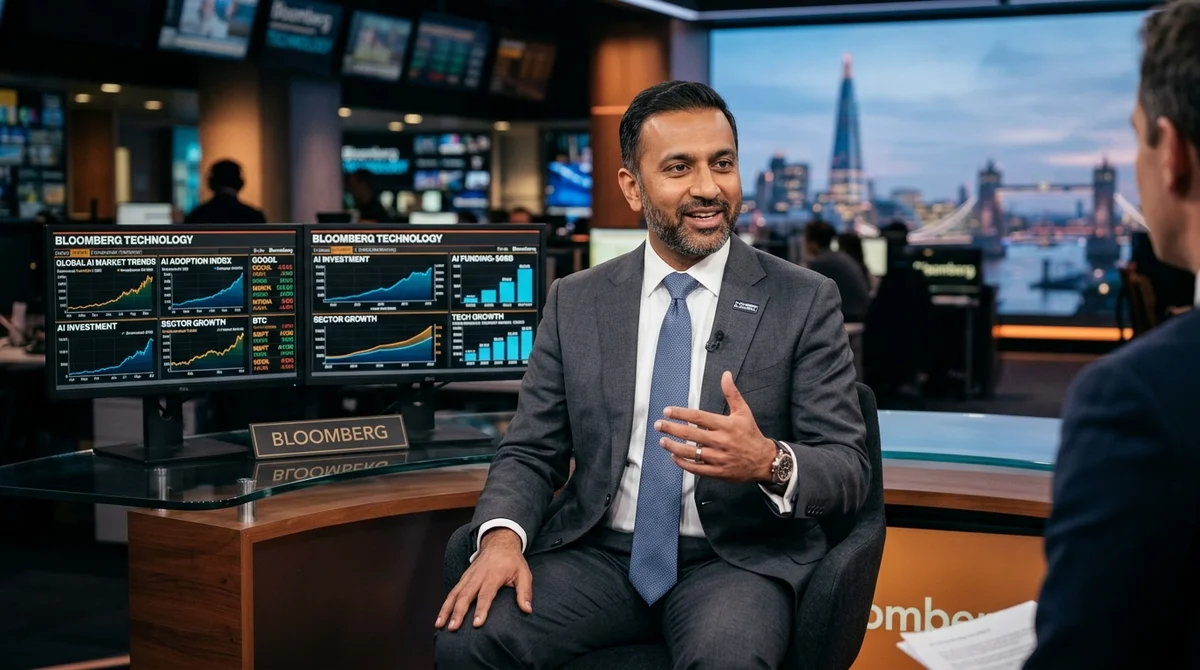
Nitin Rakesh, CEO of Indian IT company Mphasis, appeared on Bloomberg: The Asia Trade to review the company's business strategy and its priorities for AI development.
A position in an overheated market
Mphasis is a mid-sized player in Indian IT outsourcing, specializing in the financial sector, insurance and logistics. Unlike Infosys, TCS or Wipro, the company deliberately keeps an industry focus rather than reaching for scale. In an era of mass AI investment, this positioning works in Mphasis's favor: deep expertise in banking and insurance lets it build solutions that large generalists deliver more slowly and less precisely.
AI as a rebuild, not an expense
Rakesh views AI investment not as a separate budget line but as a rethinking of how an IT service is built. In his reading, AI changes the economics of outsourcing at a fundamental level:
- Lower development costs through AI assistants and test automation
- Faster time-to-market for client solutions
- A shift from "pay for time" to contracts tied to measurable results
- Retraining engineers as AI operators and product analysts
- New generative AI services for clients in banks and insurance companies
Mid-sized companies have to make this transition faster than large ones, because they lack the resources to wait until the market finally settles.
The Asian vector
Bloomberg: The Asia Trade was not a random choice of venue. Southeast Asia is becoming a priority market for Indian IT companies: financial institutions in the region are looking for digital transformation partners who understand local regulation and can work with product logic rather than purely executor logic. Mphasis already operates in Singapore, Australia and Japan. Rakesh sees Asian markets as points of leading growth, as the American and European enterprise segments approach saturation.
Talent in the age of automation
The impact of AI on employment in IT outsourcing remains a sharp question: the Indian industry employs several million people. Rakesh's position is pragmatic: Mphasis does not plan mass layoffs, but the structure of roles is changing. Routine work goes to algorithms, and people move up a level: managing models, advising clients and shaping AI strategy for the customer.
What this means
Mphasis is an instructive case for the entire Indian IT industry: it shows how a mid-sized company can avoid losing out in the AI era by betting on depth instead of scale. For corporate clients, it points to the emergence of a new class of technology partner: not just task executors but co-authors of transformation.
- Oct 31, 2026Author puts his script before an AI jury: the verdict cost 850 thousand tokens
- Oct 29, 2026OvisOCR3: an 0.8B-parameter model that reads documents better than specialized systems
- Oct 29, 2026Tencent releases Youtu-Parsing-Omni: one model parses documents, audio and video
- Oct 28, 2026Liquid AI releases LFM2.5-24B-A2B: an agent model with 2B active parameters
Key Questions Answered
What are the key details on A position in an overheated market?
Mphasis is a mid-sized player in Indian IT outsourcing, specializing in the financial sector, insurance and logistics. Unlike Infosys, TCS or Wipro, the company deliberately keeps an industry focus rather than reaching for scale. In an era of mass AI investment, this positioning works in Mphasis's favor: deep expertise in banking and insurance lets it build solutions that large generalists deliver more slowly and less precisely.
What are the key details on AI as a rebuild, not an expense?
Rakesh views AI investment not as a separate budget line but as a rethinking of how an IT service is built. In his reading, AI changes the economics of outsourcing at a fundamental level: Lower development costs through AI assistants and test automation Faster time-to-market for client solutions A shift from "pay for time" to contracts tied to measurable results Retraining engineers as AI operators and product analysts New generative AI services for clients in banks and insurance companies Mid-sized companies have to make this transition faster than large ones, because they
What are the key details on The Asian vector?
Bloomberg: The Asia Trade was not a random choice of venue. Southeast Asia is becoming a priority market for Indian IT companies: financial institutions in the region are looking for digital transformation partners who understand local regulation and can work with product logic rather than purely executor logic. Mphasis already operates in Singapore, Australia and Japan. Rakesh sees Asian markets as points of leading growth, as the American and European enterprise segments approach saturation.
Ship AI Faster with Founders, Engineers & Weekly Architecture Reviews
Inside Vibe Club (hamidun.com/club) — weekly live masterminds with Zhemal Khamidun, Tech Radar, full LMS access, and 370+ production Claude Code skills.
The AI world, distilled — once a week
Seven stories that actually mattered, hand-picked. No noise, no reposts, no press releases.
Done! Check your inbox for a confirmation.