Eka robots sort nuggets and screw in light bulbs — a ChatGPT moment for physical AI is coming
Eka robots are handling tasks that recently seemed impossible for machines: sorting chicken nuggets on conveyor lines, screwing in light bulbs, carefully moving fragile eggs. Their movements eerily resemble human ones. Wired poses the industry's central question: does this dexterity represent true physical intelligence—or merely well-trained movement statistics that will break down on unfamiliar tasks?
AI-processed from Wired; edited by Hamidun News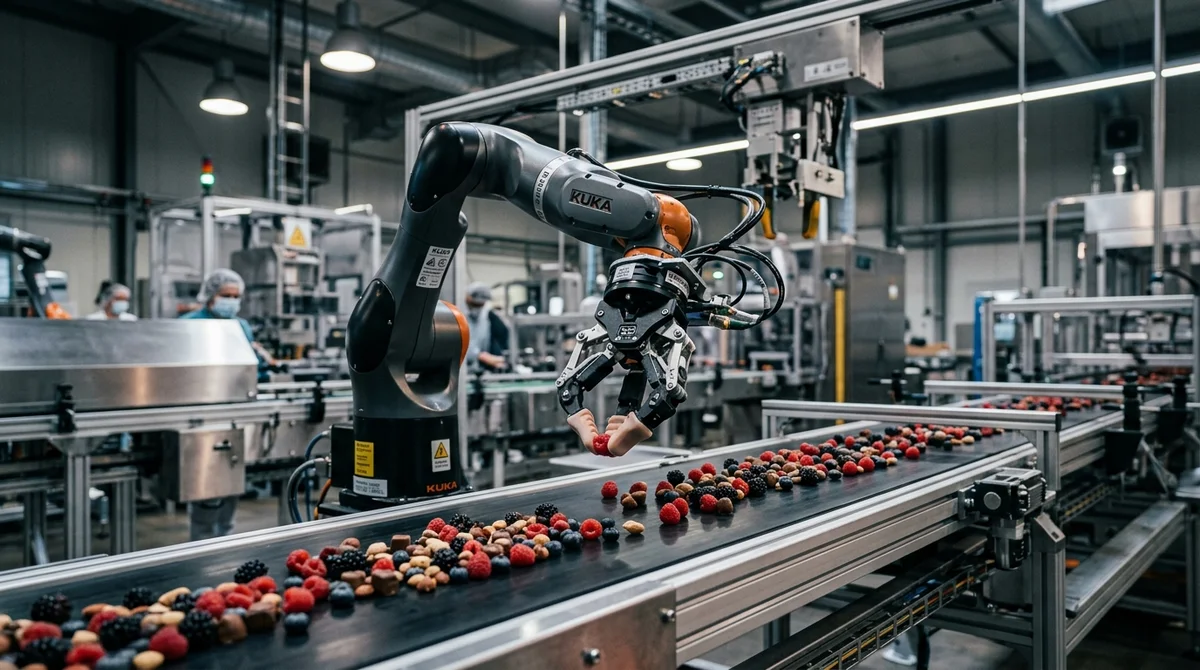
Eka has created robots that screw in lightbulbs, sort chicken nuggets, and move fragile objects — their movements are eerily reminiscent of human ones. Wired asks: does this dexterity represent true physical intelligence or merely well-trained movement imitation?
What Eka Robots Can Do
Eka's developments differ from standard industrial manipulators that have worked for decades in the automotive industry on strictly predefined trajectories. Eka's robot grippers are not simple "claws" but multi-jointed hands with tactile sensors at the fingertips. Instead of hard-coded trajectories, the systems are trained on video datasets of human labor and fine-tuned through simulation. This allows them to adapt to objects of different shapes and weights without pre-programmed coordinates. Here's what the same robot accomplishes in real-world conditions:
- Sorts chicken nuggets on a conveyor belt by shape and position
- Screws in lightbulbs into sockets at various angles
- Transfers fragile eggs without damaging the shell
- Handles unfamiliar objects without point-specific recalibration
- Works in unstructured environments — where earlier robots required perfect order
The key distinction from the previous generation is the ability to handle variability. Not "execute movement A at point B," but "figure out how to handle this object the way a human would."
ChatGPT-Moment or Skillful Imitation?
Wired raises an uncomfortable question: how much do these robots' movements reflect genuine understanding of space versus precise reproduction of patterns from training data? For language models, the "parrot problem" — a model that mimics understanding without actually comprehending anything — has never been fully resolved. With physical robots, the question is sharper: an error on a production line costs more than a hallucination in text.
Eka and competitors — Apptronik, Figure AI, Physical Intelligence (π), 1X Technologies — are betting that foundation models for movement are already good enough for commercial deployment. But researchers disagree. Some believe the boundary between "physical intelligence" and "very good movement statistics" has no practical significance if the robot consistently completes the task. Others warn: it's in edge cases that imitation breaks down.
"The question isn't whether a robot can screw in a lightbulb.
The question is what it will do when the lightbulb is a different diameter," — explains a robotics researcher.
Why the Threshold Is Now
Cheaper actuators, available depth cameras, large datasets of human movements, and transformer architecture for physical AI — all converged simultaneously. The distance between lab prototype and working robot has shrunk faster than the industry expected. Eka is already testing their systems on real production lines in the food industry. The parallel with language models is direct: ChatGPT launched in November 2022, and over the next 18 months the industry reconsidered what could actually be automated. Physical robots may stand at a similar threshold. If so, decisions about which manual tasks to automate won't be made in 10 years, but in 2-3.
What This Means
If Eka and competitors are right, the next few years will be transformative for manual labor in manufacturing and logistics. The question is no longer "will robots replace human hands," but "in which tasks will this happen first."
Need AI working inside your business — not just in your newsfeed?
I build production AI for companies — custom CRM, internal tools, autonomous agents, workflow automation. Owned by you, shaped to your process, no per-seat tax. Built by Zhemal Khamidun, CPO of AlpinaGPT (AI platform, 6,000+ users).
The AI world, distilled — once a week
Seven stories that actually mattered, hand-picked. No noise, no reposts, no press releases.
Done! Check your inbox for a confirmation.