Product Graph and agent memory: why AI can't save a product that lacks structured knowledge
The author examines the main weakness of AI-first product teams: knowledge about decisions, research and constraints is scattered across people and documents. In that environment, AI agents don't cure chaos; they speed it up. The proposed way out is Product Graph, an approach in which tasks are linked to insights, requirements, decisions and outcomes. Agents help maintain this memory rather than simply closing tickets.
AI-processed from Habr AI; edited by Hamidun News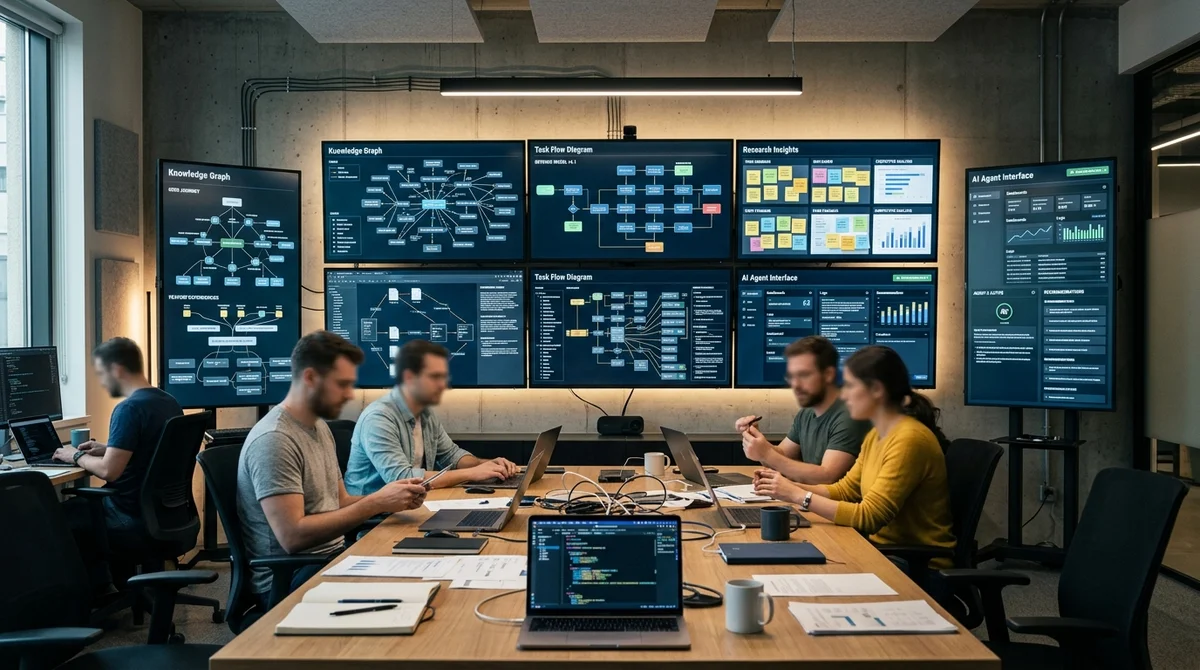
AI agents can already write code, update tickets and assemble PRs, but that doesn't solve the basic problem of most product teams: the memory of the product is still stored in pieces. As long as decisions, research and constraints are scattered across meetings, chats and employees' heads, automation will speed up confusion, not understanding.
Where context gets lost
As a product grows, companies almost inevitably split it among separate teams. Each gets its own backlog, its own metrics and its own part of the user journey. From the outside, this looks rational: fewer dependencies, more autonomy, faster local decisions.
But autonomy brings fragmentation of knowledge. One team remembers why onboarding was changed, another knows which constraints exist in billing, a third knows that users don't understand the current access-rights model. As a result, the coherent picture of the product breaks into local versions of reality.
The problem isn't just poor documentation. Even if a team carefully maintains PRDs, research notes and decision records, they remain a set of separate artifacts. Notion, Confluence, Jira and Google Docs store fragments well, but do almost nothing to help see the links between them. A document records a fact, but doesn't create understanding on its own.
So companies often fall into a repeating cycle: they re-argue old questions, repeat research that has already been done and make decisions without accounting for earlier constraints.
Why agents don't save the day
Against this backdrop, the temptation to hand part of the work to agents looks logical. A model can read a task, open a repository, propose code, update a ticket and generate a convincing result in minutes.
But the agent works inside the same information environment as the team. If past decisions are not recorded anywhere, it won't take them into account. If an important study is buried in an old presentation, the agent won't know about it. If the strategy exists only in a manager's head, the agent will optimize execution, not meaning.
AI doesn't necessarily reduce chaos.
Sometimes it just increases its throughput.
This is where the author introduces the idea of meta-work. It isn't bureaucracy for bureaucracy's sake, but a layer of actions that turns scattered events into a knowledge system. Someone has to connect new research to an old insight, record which data a requirement is based on, and show where two teams are already moving in different directions. For agents, this may even be a more useful role than writing code from scratch: not replacing product work, but maintaining collective memory and bringing back into context everything the team manages to forget.
Why a Product Graph is needed
As an alternative to the familiar task-first approach, the author proposes Product Graph. It is not a new task tracker but a model in which the main object is not a card on a board but connected knowledge. In such a system, a task matters not on its own but as a link in a chain: signal source, insight, decision, requirement, implementation and result. If the chain isn't broken, the team can at any moment trace back from a release to the reason the work appeared in the first place.
This approach rests on several practical principles:
- every task must have a clear source: a user signal, a metric, research or a strategic bet
- a decision must exist as a separate object, with alternatives, arguments and conditions for revisiting it
- new results must return to the system and refine old conclusions, not vanish after release
- contradictions between strategy, UX, research and technical constraints must become visible as early as possible
If Product Graph really works, the agent receives not just a ticket but a map of causes and consequences. It can then do more than execute: it can check coherence, surface forgotten research, find conflicting assumptions, remind the team of unresolved hypotheses and help it learn from its own results. In this model, AI is not a machine for closing tasks but a participant in product memory.
What this means
The article's main point is simple: AI is useful where a team already has a knowledge structure to which automation can be attached. Without that structure, the speed of agents merely scales the old problem faster: organizational amnesia.
So the next step for AI-first teams is not only to deploy agents, but to build a system in which decisions, research, requirements and results are linked to one another.
- Nov 2, 2026DeepSeek open-sources Super-agent prototype: p95 task completion time of 15.7 minutes vs. 29.5
- Nov 2, 2026Bun creator uses Claude Code to port 750K lines from Zig to Rust in 11 days
- Nov 2, 2026Microsoft releases 4B model Mage-VL-Cowork, which solves 66.0% of OSWorld-Verified tasks
- Nov 2, 2026Meta's Muse assistant keeps dossiers on loved ones and gets root on Ubuntu by default
Key Questions Answered
Where context gets lost?
As a product grows, companies almost inevitably split it among separate teams. Each gets its own backlog, its own metrics and its own part of the user journey. From the outside, this looks rational: fewer dependencies, more autonomy, faster local decisions. But autonomy brings fragmentation of knowledge. One team remembers why onboarding was changed, another knows which constraints exist in billing, a third knows that users don't understand the current access-rights model. As a result, the coherent picture of the product breaks into local versions of reality. The problem is
Why agents don't save the day?
Against this backdrop, the temptation to hand part of the work to agents looks logical. A model can read a task, open a repository, propose code, update a ticket and generate a convincing result in minutes. But the agent works inside the same information environment as the team. If past decisions are not recorded anywhere, it won't take them into account. If an important study is buried in an old presentation, the agent won't know about it. If the strategy exists only in a manager's head, the agent will optimize execution, not meaning. AI doesn't necessarily reduce chaos. S
Why a Product Graph is needed?
As an alternative to the familiar task-first approach, the author proposes Product Graph. It is not a new task tracker but a model in which the main object is not a card on a board but connected knowledge. In such a system, a task matters not on its own but as a link in a chain: signal source, insight, decision, requirement, implementation and result. If the chain isn't broken, the team can at any moment trace back from a release to the reason the work appeared in the first place. This approach rests on several practical principles: every task must have a clear source: a us
Test Frontier LLMs & Autonomous Agents in One Workspace
Run Claude Opus 5.5, GPT-6, Gemini 3.1, and DeepSeek side-by-side in Nomad AI (nomadnet.ai) — unified model routing, deep research, and multimodal workflows under one subscription.
The AI world, distilled — once a week
Seven stories that actually mattered, hand-picked. No noise, no reposts, no press releases.
Done! Check your inbox for a confirmation.