OpenAI is preparing interactive ChatGPT ads that talk back to users
OpenAI is accelerating ChatGPT's advertising model. After launching ads for free users in the US, the company is bringing in Smartly to make them interactive: when a user clicks, the ad can continue the conversation right inside the chat. At the same time, OpenAI is expanding its ad-tech team and preparing self-serve tools for businesses. It promises not to show such blocks next to health and politics topics, or to users under 18.
AI-processed from TNW; edited by Hamidun News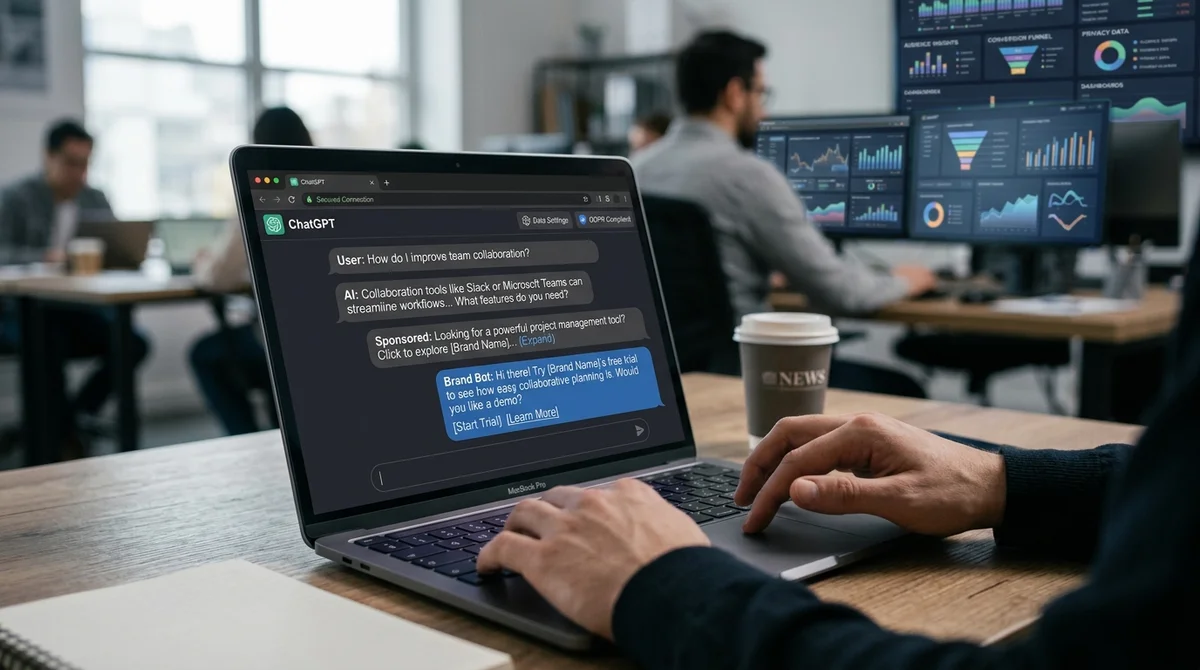
OpenAI is taking advertising in ChatGPT to the next level: instead of ordinary sponsored cards, the company is preparing formats that can respond to the user right inside the conversation. To do this, it is bringing in outside ad-tech partners while building a full-fledged advertising team.
How advertising will change
Today, ads in ChatGPT for free users in the US look relatively simple: after a query about a product or a trip, the service can show a labeled sponsored block under the main answer. The next step is noticeably more ambitious. OpenAI is working with Smartly, a Finnish advertising automation platform, on formats where the ad doesn't just sit next to the answer but continues the conversation.
A user will be able to tap the ad block and move into a separate mini-dialogue inside ChatGPT, where the brand will offer more precise options, clarify preferences and tailor its recommendation to the context. In effect, OpenAI wants to build advertising into the same mechanic people come to ChatGPT for in the first place: the conversational interface.
This is an important shift. Where ads used to look like a familiar insert from search or a marketplace, they are now starting to imitate the behavior of the assistant itself. According to the description of the partnership, Smartly will help not only with creatives but also with performance optimization, meaning it will change targeting and ad content depending on how users interact with the new format.
How OpenAI is building its ad tech
The move to interactive advertising does not look like a cautious experiment. OpenAI is quickly assembling a full commercial infrastructure around ChatGPT. Besides Smartly, the company has already brought on Criteo as its first formal ad-tech partner, which from 2 March connects about 17,000 advertisers to ChatGPT's ad inventory. OpenAI has also discussed scaling up sales further with The Trade Desk. In late March, the company hired David Dugan, a former Meta* executive, to lead a new global advertising solutions group.
- On 9 February 2026, OpenAI turned on ads in ChatGPT for free users in the US.
- By the end of March, the pilot had reached $100 million in annualized revenue, attracted more than 600 advertisers and covered less than a fifth of the eligible audience.
- ChatGPT already has more than 800 million weekly active users, but only about 5% pay for a subscription.
- OpenAI plans to open self-serve tools for advertisers in April, removing the current $200,000 entry threshold.
- The initial launch ran at a CPM of about $60, and Criteo claims that traffic from large language models converts 1.5 times better than other channels.
The signal to the market is simple: OpenAI is no longer testing whether to put ads in the product at all. The company already assumes that advertising will become a noticeable part of revenue from the free audience. It has told investors that ChatGPT's consumer revenue could exceed $17 billion in 2026. If the self-serve model really works, not only large brands but also small and medium-sized businesses will be able to join the platform.
At the same time, OpenAI is preparing to expand the pilots beyond the US, to Canada, Australia and New Zealand, and then to other markets.
Where the risks lie
The main question is not whether ChatGPT will show more ads, but how far ads will be able to use the context of the conversation. OpenAI says conversations are not shared with advertisers, and that brands receive only aggregated metrics such as impressions and clicks. The company also states that it does not show ads next to topics of health, mental health and politics, and that users under 18 do not see such ads at all.
On paper, this looks like a reasonable set of restrictions, but this is exactly where the most painful dispute begins. Critics point out that ChatGPT holds an unusually sensitive layer of user data: people discuss purchases, work, anxiety, relationships and personal plans with the bot. After a click on an ad, purchase data may flow back to OpenAI, and the updated privacy policy allows contact-sync features that may involve processing a phone number.
Against this backdrop, Anthropic is already using Claude's ad-free positioning as a competitive advantage and plays directly on the contrast with OpenAI.
"The company is building an economic engine whose incentives will eventually override its own rules," is how former
OpenAI researcher Zoe Hitzig described this turn.
What this means
For the advertising market, ChatGPT is becoming not just another placement channel but a new type of interface, where an ad can talk to the user almost on equal terms with the assistant. For OpenAI, it is a chance to monetize hundreds of millions of free users faster.
But if the line between a helpful answer and a commercial dialogue starts to blur, the company risks ChatGPT's most valuable asset: trust in its suggestions and recommendations.
*Meta has been designated an extremist organization and is banned in Russia.
- Nov 2, 2026Meta's Muse assistant keeps dossiers on loved ones and gets root on Ubuntu by default
- Nov 1, 2026Local models lose to Opus and Codex: 0.21 on a MacBook versus 1.00 for Codex
- Nov 1, 2026Kimi scores 96.2% on a 1C database analytics test and emerges as a fallback if Claude access is blocked
- Nov 1, 2026OpenAI Rewrites GPT Behavior Rules: Five Values and a Chain of Command
Key Questions Answered
How advertising will change?
Today, ads in ChatGPT for free users in the US look relatively simple: after a query about a product or a trip, the service can show a labeled sponsored block under the main answer. The next step is noticeably more ambitious. OpenAI is working with Smartly, a Finnish advertising automation platform, on formats where the ad doesn't just sit next to the answer but continues the conversation. A user will be able to tap the ad block and move into a separate mini-dialogue inside ChatGPT, where the brand will offer more precise options, clarify preferences and tailor its recommen
How OpenAI is building its ad tech?
The move to interactive advertising does not look like a cautious experiment. OpenAI is quickly assembling a full commercial infrastructure around ChatGPT. Besides Smartly, the company has already brought on Criteo as its first formal ad-tech partner, which from 2 March connects about 17,000 advertisers to ChatGPT's ad inventory. OpenAI has also discussed scaling up sales further with The Trade Desk. In late March, the company hired David Dugan, a former Meta executive, to lead a new global advertising solutions group. On 9 February 2026, OpenAI turned on ads in ChatGPT for
Where the risks lie?
The main question is not whether ChatGPT will show more ads, but how far ads will be able to use the context of the conversation. OpenAI says conversations are not shared with advertisers, and that brands receive only aggregated metrics such as impressions and clicks. The company also states that it does not show ads next to topics of health, mental health and politics, and that users under 18 do not see such ads at all. On paper, this looks like a reasonable set of restrictions, but this is exactly where the most painful dispute begins. Critics point out that ChatGPT holds
Test Frontier LLMs & Autonomous Agents in One Workspace
Run Claude Opus 5.5, GPT-6, Gemini 3.1, and DeepSeek side-by-side in Nomad AI (nomadnet.ai) — unified model routing, deep research, and multimodal workflows under one subscription.
The AI world, distilled — once a week
Seven stories that actually mattered, hand-picked. No noise, no reposts, no press releases.
Done! Check your inbox for a confirmation.