Secondary-Market Interest in OpenAI Shares Is Fading as Investors Move to Anthropic
OpenAI shares on the secondary market have cooled noticeably. In some cases, selling them has become nearly impossible without a price concession. Investors are switching quickly to Anthropic, which is an important signal for the entire private AI sector. This is not a collapse of OpenAI but a change in mood: the market no longer buys every leader indiscriminately and is increasingly picking a single favorite.
AI-processed from Bloomberg Tech; edited by Hamidun News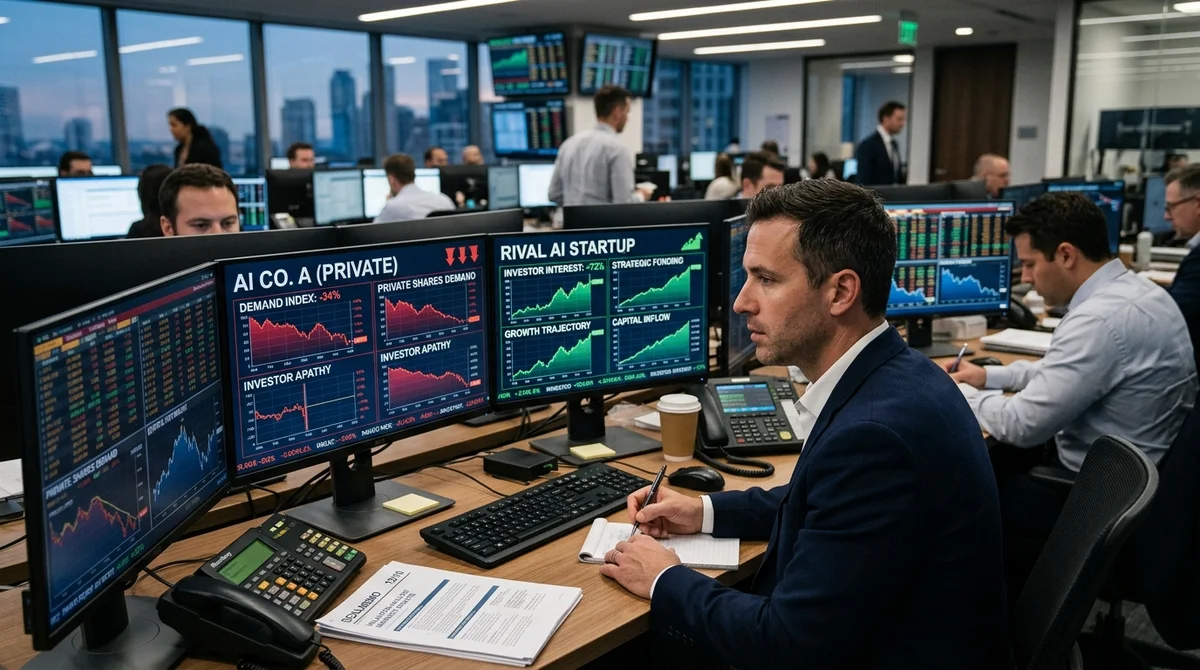
Interest in OpenAI shares on the secondary market has weakened noticeably: some investors no longer want to hold these securities, and selling them has become harder. Meanwhile, capital is flowing quickly to Anthropic, which the market increasingly sees as the "hotter" bet in the race among AI companies.
What happened
On the secondary market, where existing shareholders of private companies trade their stakes, OpenAI paper has begun to lose its appeal. The story is not simply one of waning enthusiasm: in some cases, these shares are almost impossible to offload quickly without a price concession. For the private capital market, this is a sensitive signal: even around the largest AI companies, demand is no longer taken for granted, and investors have become noticeably more selective.
It also matters that the secondary market often shows sentiment earlier than official funding rounds. A new investment in a startup can come with a strong PR effect and a limited pool of participants, whereas resales between current and new holders usually better reflect the market's real willingness to pay right now. When buyers start to hesitate, ask for a discount or walk away from deals altogether, it means liquid demand is cooling, not just that the news agenda has changed.
Why the focus is shifting
The main beneficiary of this turn is Anthropic. Investors who not long ago were ready to buy up practically any stake in the leading AI players now compare companies far more strictly and switch faster to whichever looks most promising at the moment. In the private tech sector this is standard logic: capital goes where the sense of future growth is stronger, where the negotiating position is better and where there is a greater chance of being at the center of the next wave of demand.
- fewer buyers willing to take OpenAI stakes
- higher likelihood of a discount on sale
- more attention on Anthropic paper
- market sentiment is being repriced faster
This does not necessarily mean OpenAI has a fundamentally weak business or that the company has lost strategic importance. Rather, the market is starting to separate "the biggest player" from "the most desirable paper right now." For private AI companies, that is a crucial difference. When a sector is overheated, money goes into almost all the leaders at once. When a market matures, investors stop buying the whole category and pick a specific winner, while the rest, even with a strong brand, face tougher terms.
How to read this
For employees, early investors and funds, the secondary market is not an abstract indicator but a practical liquidity tool. If a security is in demand, it is easier to sell without lengthy negotiations or a noticeable markdown. If interest falls, holders end up trapped: the asset is formally expensive, but turning it into cash becomes much harder. That is why the cooling of demand for OpenAI matters in itself, even if the company remains one of the centers of the AI market.
The story shows something else too: the race among the big AI labs now affects not only products and enterprise contracts but also the capital structure around them. Perceived technological leadership immediately feeds into share valuations, and valuations feed into the terms for employees, secondary deals and future rounds. The more the market believes Anthropic is better at monetizing the current moment, the more actively demand shifts there. For OpenAI this is not a verdict, but it is a clear reminder: flagship status no longer guarantees an automatic queue of buyers.
What this means
The market for private AI companies is entering a phase where one big name is no longer enough: capital is sorting leaders ever more aggressively by current momentum. For founders, employees and investors, the signal is to look not only at model releases but also at where there is real demand for shares and liquidity today.
- Nov 2, 2026Meta's Muse assistant keeps dossiers on loved ones and gets root on Ubuntu by default
- Nov 1, 2026Local models lose to Opus and Codex: 0.21 on a MacBook versus 1.00 for Codex
- Nov 1, 2026Kimi scores 96.2% on a 1C database analytics test and emerges as a fallback if Claude access is blocked
- Nov 1, 2026OpenAI Rewrites GPT Behavior Rules: Five Values and a Chain of Command
Key Questions Answered
What happened?
On the secondary market, where existing shareholders of private companies trade their stakes, OpenAI paper has begun to lose its appeal. The story is not simply one of waning enthusiasm: in some cases, these shares are almost impossible to offload quickly without a price concession. For the private capital market, this is a sensitive signal: even around the largest AI companies, demand is no longer taken for granted, and investors have become noticeably more selective. It also matters that the secondary market often shows sentiment earlier than official funding rounds. A ne
Why the focus is shifting?
The main beneficiary of this turn is Anthropic. Investors who not long ago were ready to buy up practically any stake in the leading AI players now compare companies far more strictly and switch faster to whichever looks most promising at the moment. In the private tech sector this is standard logic: capital goes where the sense of future growth is stronger, where the negotiating position is better and where there is a greater chance of being at the center of the next wave of demand. fewer buyers willing to take OpenAI stakes higher likelihood of a discount on sale more att
How to read this?
For employees, early investors and funds, the secondary market is not an abstract indicator but a practical liquidity tool. If a security is in demand, it is easier to sell without lengthy negotiations or a noticeable markdown. If interest falls, holders end up trapped: the asset is formally expensive, but turning it into cash becomes much harder. That is why the cooling of demand for OpenAI matters in itself, even if the company remains one of the centers of the AI market. The story shows something else too: the race among the big AI labs now affects not only products and
Ship AI Faster with Founders, Engineers & Weekly Architecture Reviews
Inside Vibe Club (hamidun.com/club) — weekly live masterminds with Zhemal Khamidun, Tech Radar, full LMS access, and 370+ production Claude Code skills.
The AI world, distilled — once a week
Seven stories that actually mattered, hand-picked. No noise, no reposts, no press releases.
Done! Check your inbox for a confirmation.