Kakao Mobility Reveals Level 4 Autonomous Driving Roadmap and Physical AI Strategy
Kakao Mobility announced it will develop Level 4 autonomous driving technologies in-house as part of its physical AI strategy. The roadmap includes proprietary ML models, fault-tolerant vehicle architecture, validation through simulations and real-world rides, and a 24/7 control center. The company is already leveraging robotaxi service data from Seoul's Gangnam district and preparing an open ecosystem for partners.
AI-processed from AI News; edited by Hamidun News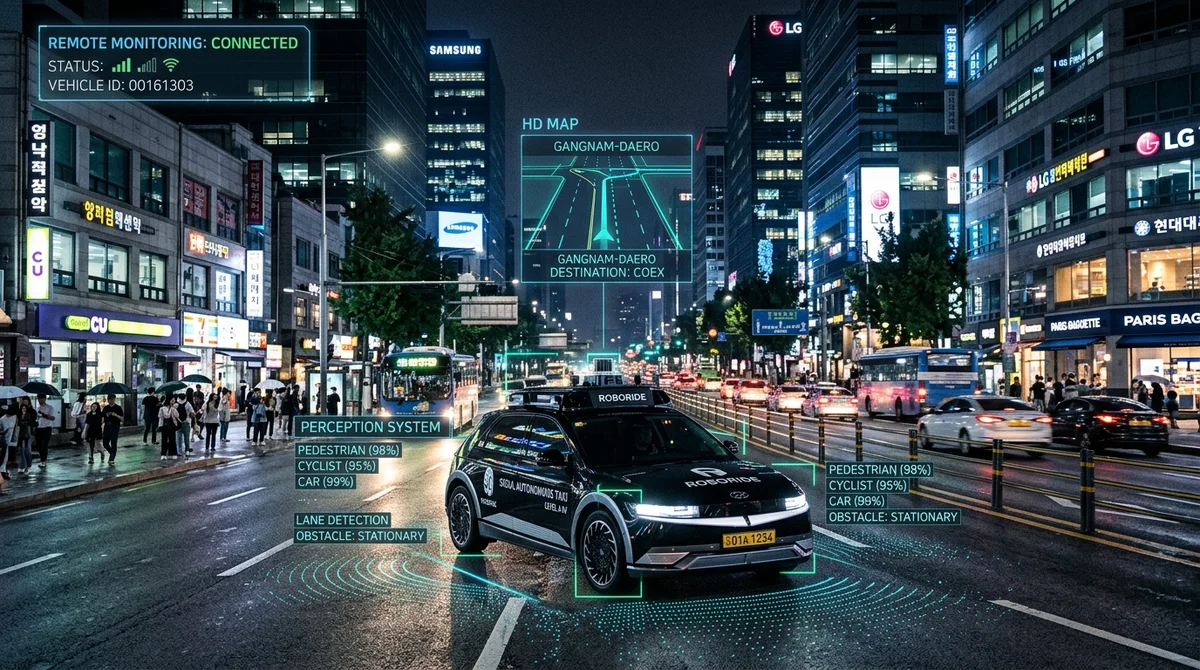
Kakao Mobility has revealed its roadmap to bring autonomous driving to Level 4 within the company and embed it into its own mobility platform. The focus is not only on self-driving cars as separate vehicles, but on a complete stack of physical AI: from models and validation to dispatch, maps, and remote control.
Level 4 Roadmap
The company shared its plans at the World IT Show 2026 conference at COEX in Seoul. The presentation was delivered by Vice President and head of the Physical AI division Kim Jin-gyu. According to Yonhap, the exhibition involved 460 companies and organizations from 17 countries. The main idea is straightforward: Kakao Mobility wants to build autonomous services not as an isolated R&D project, but as part of its existing urban transportation platform. Level 4 here refers to a mode in which a vehicle can drive without human participation within a defined service area, and a passenger does not need to monitor the road or be ready to immediately take control.
The roadmap relies on three technological blocks. The first is proprietary machine learning models for environmental perception, decision-making, and motion control without a driver. The second is vehicle architecture with redundancy of critical systems, so that critical functions continue to work even if one component fails. The third is a validation platform that combines virtual simulations and real-world trip data. Such a loop is needed not only for testing, but also for continuous improvement of service quality before scaling.
"Beyond vision — to action: AI drives reality."
Safety and Control
A separate layer of the strategy comprises observation and safety tools during the ride itself. Kakao Mobility is creating an integrated safety management platform for autonomous vehicles. One of its elements is the Autonomous Vehicle Visualizer, a 3D interface that shows in real time the vehicle's field of view and what it recognizes around itself. For a passenger, this is a way to understand the context in which the self-driving car operates: what objects it sees, how it interprets the road situation, and why it chooses a particular maneuver.
The next step is a round-the-clock control center and an anomaly detection system based on visual-language models. These components should analyze the situation in real time, support remote intervention, and accelerate response in emergency scenarios. The company has not yet disclosed details about the specific model architecture or quality metrics, but the choice of a VLM approach itself shows that Kakao wants to link visual perception of the road with more flexible contextual analysis, rather than limiting itself to a set of rigid rules and sensor triggers.
Open Ecosystem
Kakao Mobility specifically emphasizes that it does not intend to keep all its developments within itself. The company wants to share some of its technological assets with other market participants — from startups to automakers. The logic is clear: if each player builds the entire autonomous transportation stack from scratch, the market will grow too slowly. Therefore, Kakao is betting on an open internal ecosystem that can strengthen the competitiveness of the South Korean market as a whole.
- large datasets for autonomous driving
- HD maps with detailed road geometry
- platform APIs for vehicle ordering and dispatch
- fleet management systems
- tools and resources for on-site response
As a working example, the company cites a nighttime autonomous taxi service in the Gangnam district of Seoul, available through the Kakao T app. According to Seoul city hall, from September 26, 2024 to February 28, 2026, the service completed 7,754 trips, and no accidents directly related to autonomous driving technology were recorded during this period. Average load was approximately 24 trips per operating day. In April 2026, the service transitioned from a free pilot to a paid model, and the fleet increased from three to seven vehicles, not counting two backup cars.
What This Means
Kakao Mobility is moving not toward a one-off autonomous taxi demonstration, but toward a platform model where driverless driving is connected to data, maps, APIs, and operational control. If this plan succeeds, the company will be able to claim not only the role of a ride-hailing service, but also the role of a foundational infrastructure player for the Korean physical AI market.
Need AI working inside your business — not just in your newsfeed?
I build production AI for companies — custom CRM, internal tools, autonomous agents, workflow automation. Owned by you, shaped to your process, no per-seat tax. Built by Zhemal Khamidun, CPO of AlpinaGPT (AI platform, 6,000+ users).
The AI world, distilled — once a week
Seven stories that actually mattered, hand-picked. No noise, no reposts, no press releases.
Done! Check your inbox for a confirmation.