NASA and SETI Describe Foundation Models for Astrobiology and Search for Extraterrestrial Life
NASA and SETI presented an overview of foundation models for astrobiology. Researchers propose building a multimodal AI stack capable of detecting biosignatures, assisting in mission design, and parsing scientific literature. The authors separately describe AB-Chat and Astrobiology Mission Model for working with mission data. The main barrier is not the idea, but the data: it needs to be standardized, consolidated, and prepared for training.
AI-processed from Habr AI; edited by Hamidun News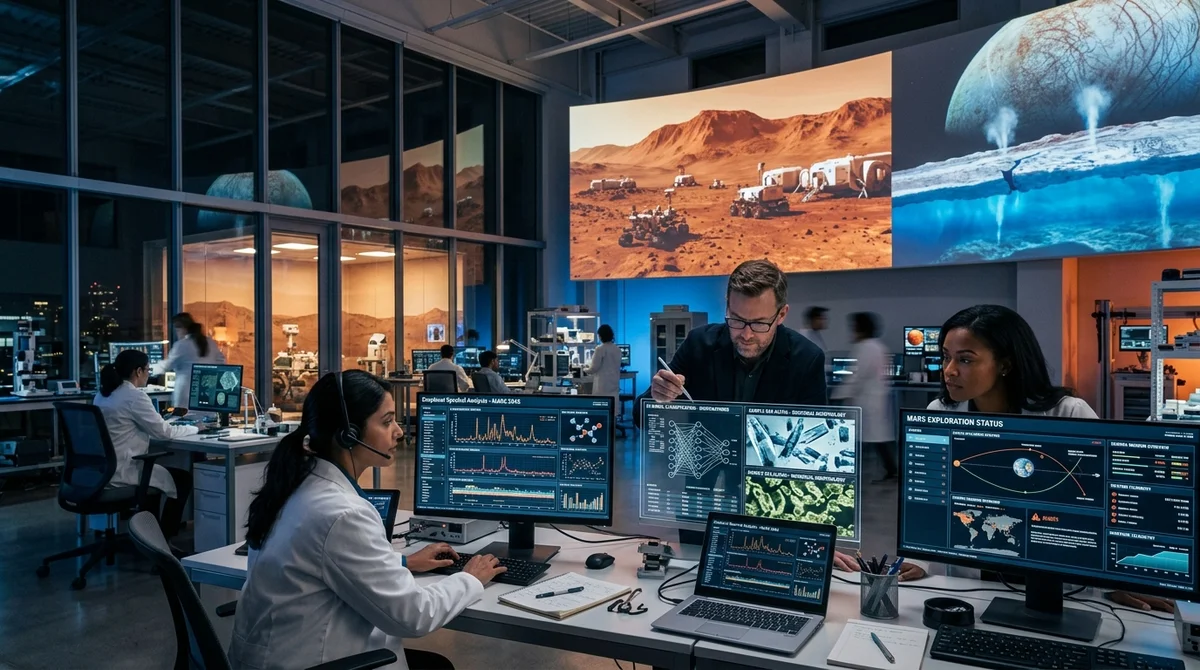
A team of researchers from NASA, SETI, and several universities has proposed building not a collection of disparate AI tools for astrobiology, but a unified multimodal foundation model. It should help both in the search for biosignatures and in planning space missions, as well as in analyzing vast arrays of scientific data.
Why a New Approach Is Needed
Astrobiology operates on multiple levels simultaneously: from chemistry and molecular structures to planetary observations, field studies of Earth analogues, and space mission documentation. The authors proceed from the premise that life cannot be described by a single marker or a single instrument. It manifests as a complex process with many characteristics, so the models need to be able to link images, spectra, geochemistry, text reports, and environmental context in a single system. This is where foundation models appear stronger than conventional narrow ML.
The article summarizes findings from a workshop conducted by NASA's Ames Research Center and the SETI Institute in February 2025. The preprint itself was released on arXiv on October 8, 2025. The researchers note that groundwork already exists: NASA is developing its own large language models, including Goddard LLM and INDUS, as well as the geospatial model Prithvi; ESA has TerraMind. In other words, this is not science fiction for decades to come, but the next logical step — to assemble a specialized stack specifically for astrobiology tasks.
Three Working Scenarios
The authors propose viewing such a system not as a single chatbot, but as a foundation for several applied modes. The logic is simple: a single multimodal foundation can serve different tasks if separate interfaces and application scenarios are built on top of it.
The first mode is searching for signs of life in complex data, the second is assistance in designing and managing missions, and the third is a scientific interface for working with literature, reports, and hypotheses.
- Biosignature Detection. The model should correlate chemical, morphological, spectral, and ecological features and distinguish possible traces of life from abiotic mimics.
- Astrobiology Mission Model. A separate AI layer will help select payloads, evaluate instrument constraints, prioritize samples, and support more autonomous spacecraft operations.
- AB-Chat. A specialized interface for astrobiology will be able to read articles, technical reports, and mission archives, identify knowledge gaps, and suggest new hypotheses.
Importantly, the authors do not propose removing humans from the process. Rather, both AMM and AB-Chat are described as human-in-the-loop tools: they expand the team's field of view, but critical decisions remain with scientists and engineers. For space missions this is particularly important because the cost of error is high, and onboard autonomy must undergo extensive testing, validation, and edge-case verification before launch.
What Is Hindering Progress Right Now
The main barrier is not a lack of ideas, but the state of the data. Astrobiological information is already scattered across different archives, formats, and disciplines: spectral databases, geochemistry, imagery, mass spectrometry, mission reports, field observations, and historical printed materials. To train a truly useful model, this data must first be found, brought to common standards, described with metadata, and made suitable for machine learning.
A separate issue is sensitive mission data: schematics, internal procedures, and engineering documentation will require protected infrastructure. Therefore, the first practical step looks quite down-to-earth: not to immediately build a "superintelligence," but to re-run existing datasets through the model. The authors specifically mention visible imagery, VNIR reflectance, elemental and isotopic composition, GC-MS, Raman, XRF/XRD, and topography. If such sources are combined with data from Earth, Mars, the Moon, and asteroids, the system can begin to learn to distinguish between biotic, abiotic, and similar signatures. Moreover, the outcome could be not a rigid boundary between "living" and "non-living," but a multidimensional gradient — which for astrobiology is even more realistic.
What This Means
If this approach reaches working prototypes, astrobiology will gain not just another LLM, but a domain-specific AI layer on top of science and space engineering. For researchers, this is an opportunity to gather knowledge from scattered sources more quickly, plan missions more precisely, and increase the likelihood that a truly important signal of possible life will not be lost in the noise of data. The key question now is not whether such a system is technically feasible, but who will first assemble for it a quality and compatible data ecosystem.
Need AI working inside your business — not just in your newsfeed?
I build production AI for companies — custom CRM, internal tools, autonomous agents, workflow automation. Owned by you, shaped to your process, no per-seat tax. Built by Zhemal Khamidun, CPO of AlpinaGPT (AI platform, 6,000+ users).
The AI world, distilled — once a week
Seven stories that actually mattered, hand-picked. No noise, no reposts, no press releases.
Done! Check your inbox for a confirmation.