Eclipse hires first chief AI officer from Meta to speed up AI adoption across its portfolio
Eclipse is taking its AI strategy a step further: the firm has hired its first Chief AI Officer, who comes from Meta. The job is to help portfolio companies go beyond trying out generative tools and build AI into their product, processes and decision-making. For the market, it is a signal that venture firms are starting to sell startups not just capital but applied expertise. *Meta has been designated an extremist organization and is banned in Russia.
AI-processed from Bloomberg Tech; edited by Hamidun News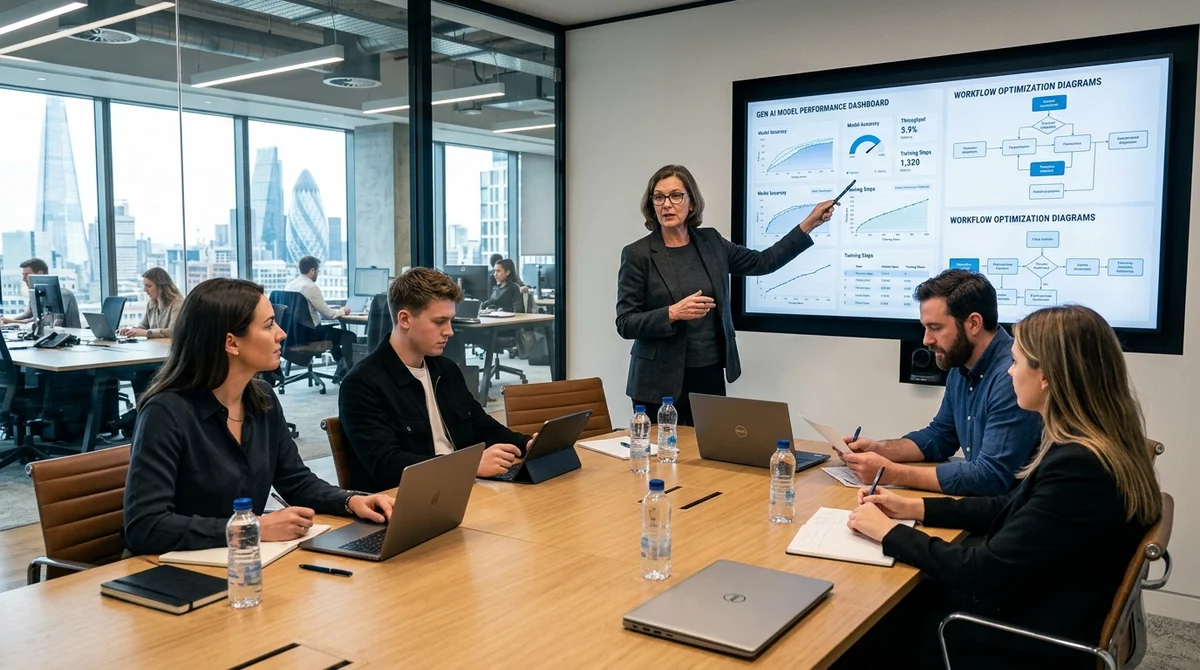
Eclipse has hired its first chief AI officer, a specialist who comes from Meta. For a venture fund this is not a decorative title: the new role exists to help portfolio companies adopt AI faster and more deliberately in their products, operations and internal processes.
Why Eclipse needs the new role
For venture firms, AI is no longer a topic confined to investment memos. It used to be enough for a fund to assess how "AI-native" a startup looked. Now a different question arises: how to make sure teams inside the portfolio actually get returns from models, automation and new interfaces.
Against this backdrop, Eclipse is formalizing AI expertise as a dedicated leadership position. It shows that the fund wants to take part not only in choosing companies but also in how they build the next versions of their products.
The move is especially logical for a fund that works with complex technology and industrial companies. In such projects, AI rarely comes down to a chatbot on the home page. More often it means shorter development cycles, faster support, analysis of internal data, document handling and more accurate decision-making. A dedicated Chief AI Officer is needed so these use cases do not sprawl into ad hoc experiments with no measurable result.
How it will help the portfolio
For portfolio startups, the benefit of such a position can be fairly down-to-earth. Instead of each company separately testing dozens of models, arguing over its stack and spending budget on failed pilots, the fund gets a person who gathers best practices and helps carry them across teams. That lowers the cost of mistakes and speeds up adoption.
Essentially, Eclipse is trying to turn AI competence into a service for founders: not abstract advice about the future of the market, but concrete help with choosing tools, processes and priorities.
- choosing models and infrastructure for the task
- automating teams' internal operations
- adding AI features to the product without unnecessary noise
- controlling costs, privacy and answer quality
- sharing working cases among portfolio companies
The approach matters too: "using AI more smartly" does not mean simply adding generative features for the sake of presentations. For the fund it is more about discipline in adoption: where a model really saves time, where it raises revenue, and where it only creates a new line of expenses. If the role works that way, startups will get not a fashionable title in the ecosystem but a real growth lever. That is the difference between a one-off demo and systematic adoption.
Why Meta experience matters
That Eclipse took someone from Meta adds weight to the news. Meta remains one of the key companies in the race for applied AI: it has deep experience scaling models, infrastructure, recommendation systems and products used by huge audiences. For a venture fund, such a background matters not because of the brand as such but because of the practice. The market needs people who have seen how AI goes from experiment to industrial deployment, where bottlenecks appear and how to remove them before a project starts burning money.
It also reflects a broader shift in venture. Funds increasingly compete not only on checks and networks but on how useful they are after the deal. A few years ago the argument was help with hiring, go-to-market and sales. Now applied AI is being added to that list. If a fund has an in-house team, or at least a strong leader who can help with AI strategy, it becomes a separate advantage in the fight for the best startups.
What it means
Eclipse's hire of its first Chief AI Officer shows that AI is becoming an operational function for venture funds, not just an investment theme. For startups this is a good signal: capital increasingly arrives together with practical expertise. For the market it is a reminder that the winners will not be those who talk loudest about AI, but those who can put it into working processes.
*Meta has been designated an extremist organization and is banned in Russia.
- Nov 1, 2026MoneyGate safety layer blocked all 42 fraudulent requests to local AI models
- Oct 31, 2026Open-source LLM gateway KTMS 1.0 plugs your own GPUs into the cloud and survives outages
- Oct 31, 202622B-Parameter LTX-2.5 Runs on a 10 GB RTX 3080, but Takes 5 Minutes per Shot
- Oct 29, 2026T-Tech Introduces LIMe, a Method That Trains Language Models With 15% Less Compute
Key Questions Answered
Why Eclipse needs the new role?
For venture firms, AI is no longer a topic confined to investment memos. It used to be enough for a fund to assess how "AI-native" a startup looked. Now a different question arises: how to make sure teams inside the portfolio actually get returns from models, automation and new interfaces. Against this backdrop, Eclipse is formalizing AI expertise as a dedicated leadership position. It shows that the fund wants to take part not only in choosing companies but also in how they build the next versions of their products. The move is especially logical for a fund that works with
How it will help the portfolio?
For portfolio startups, the benefit of such a position can be fairly down-to-earth. Instead of each company separately testing dozens of models, arguing over its stack and spending budget on failed pilots, the fund gets a person who gathers best practices and helps carry them across teams. That lowers the cost of mistakes and speeds up adoption. Essentially, Eclipse is trying to turn AI competence into a service for founders: not abstract advice about the future of the market, but concrete help with choosing tools, processes and priorities. choosing models and infrastructur
Why Meta experience matters?
That Eclipse took someone from Meta adds weight to the news. Meta remains one of the key companies in the race for applied AI: it has deep experience scaling models, infrastructure, recommendation systems and products used by huge audiences. For a venture fund, such a background matters not because of the brand as such but because of the practice. The market needs people who have seen how AI goes from experiment to industrial deployment, where bottlenecks appear and how to remove them before a project starts burning money. It also reflects a broader shift in venture. Funds
Ship AI Faster with Founders, Engineers & Weekly Architecture Reviews
Inside Vibe Club (hamidun.com/club) — weekly live masterminds with Zhemal Khamidun, Tech Radar, full LMS access, and 370+ production Claude Code skills.
The AI world, distilled — once a week
Seven stories that actually mattered, hand-picked. No noise, no reposts, no press releases.
Done! Check your inbox for a confirmation.