Poland warns of more cyberattacks as advanced AI tools spread
Poland warns that cyberattacks will multiply as advanced AI tools become more widely available. Authorities are already recording a rise in attacks they attribute to Russia, and new models may make phishing, email localization and the mass production of plausible deception scenarios much easier. For businesses and government bodies, this is a signal to strengthen basic defenses now rather than wait for "super-sophisticated" hacks.
AI-processed from Bloomberg Tech; edited by Hamidun News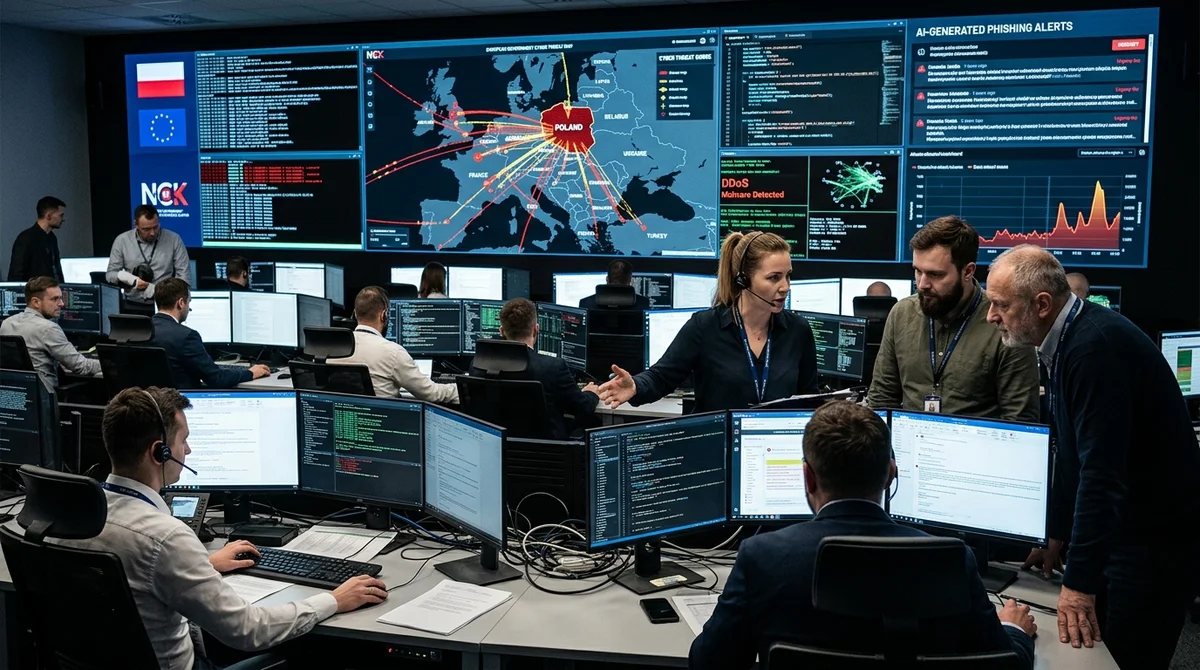
Poland expects cyberattacks to keep rising as more powerful AI tools spread rapidly. According to Polish authorities, pressure on government systems, companies and citizens will intensify, and some attacks will become cheaper, faster and more convincing for the attackers.
Why the risk is growing
For Poland, this is not a theoretical issue. The country already faces a growing number of cyberattacks that authorities link to Russia, and a new factor now adds to that pressure: the availability of advanced artificial intelligence models. Sophisticated phishing campaigns, forged emails and the preparation of malicious scenarios once required considerable resources and time; now a significant part of that work can be automated. As a result, attackers can run more operations at once and adapt them to specific targets more quickly.
The main problem is not only that AI makes attacks smarter. It also lowers the barrier to entry: less experienced groups gain tools that help them write plausible messages, gather open-source data on a victim and test dozens of social engineering variants almost without pause. For a country under constant digital pressure, this means threats grow not only in sophistication but also in density — there may simply be more attacks.
How AI helps attackers
In practice, generative models can speed up almost the entire attack cycle, from reconnaissance to delivery of malicious content. AI can already summarize large volumes of information quickly, adapt text to the recipient's language and style, and create convincing correspondence templates. This is especially dangerous for government bodies, critical infrastructure and large companies, where one successful attack on a single employee can open access to several internal systems at once.
This does not necessarily mean fully autonomous hacks. What matters far more is that attackers gain speed and scale at the most mundane stages of their work:
- Personalized phishing without lengthy manual preparation
- Fast translation and localization of emails into Polish and the local context
- Mass generation of message variants to evade filters
- Automated analysis of public profiles, documents and leaks
- Preparation of plausible conversation scenarios posing as colleagues or government agencies
A separate risk is that such tools are useful for more than hacking in the narrow sense. They can support disinformation campaigns, imitate internal official messages and amplify chaos during politically sensitive moments or security incidents. When a forgery is produced quickly, in good language and with local details, it becomes harder for recipients to spot the deception by familiar signs such as clumsy text or an unnatural tone.
What defenders should do
For defense, this shifts priorities. It is not enough to assume that only rare, technically sophisticated attacks are dangerous: AI boosts the effectiveness of mass campaigns in particular, which were often constrained by attackers' lack of time. Defenders should therefore assume that fake emails, messenger approaches and fraudulent official requests will look ever more convincing and increasingly use local context.
The practical answer is fairly down-to-earth: update verification processes faster, strengthen multi-factor authentication, restrict unnecessary access and regularly train teams on realistic social engineering scenarios. Another task is early detection of campaigns that scale through automation. The sooner organizations notice repeating patterns, the lower the chance that one successful trick grows into a series of incidents.
What it means
Poland's experience shows that AI strengthens not only defenders but also attackers. For governments and businesses, the signal is that cyber threats will grow not only in quality but also in volume, so the winners will be those who rebuild their basic digital hygiene and incident response processes fastest.
- Nov 2, 2026Karpathy builds a YouTube clone with 6454 videos from Hacker News recommendations in two hours
- Nov 2, 2026Karpathy used Claude to build HackerTube from 6,454 videos recommended on Hacker News
- Nov 2, 2026Arca gives AI agents finance tasks lasting up to 10 days, but leaves the trades to humans
- Nov 2, 2026DeepSeek open-sources Super-agent prototype: p95 task completion time of 15.7 minutes vs. 29.5
Key Questions Answered
Why the risk is growing?
For Poland, this is not a theoretical issue. The country already faces a growing number of cyberattacks that authorities link to Russia, and a new factor now adds to that pressure: the availability of advanced artificial intelligence models. Sophisticated phishing campaigns, forged emails and the preparation of malicious scenarios once required considerable resources and time; now a significant part of that work can be automated. As a result, attackers can run more operations at once and adapt them to specific targets more quickly. The main problem is not only that AI makes
How AI helps attackers?
In practice, generative models can speed up almost the entire attack cycle, from reconnaissance to delivery of malicious content. AI can already summarize large volumes of information quickly, adapt text to the recipient's language and style, and create convincing correspondence templates. This is especially dangerous for government bodies, critical infrastructure and large companies, where one successful attack on a single employee can open access to several internal systems at once. This does not necessarily mean fully autonomous hacks. What matters far more is that attac
What defenders should do?
For defense, this shifts priorities. It is not enough to assume that only rare, technically sophisticated attacks are dangerous: AI boosts the effectiveness of mass campaigns in particular, which were often constrained by attackers' lack of time. Defenders should therefore assume that fake emails, messenger approaches and fraudulent official requests will look ever more convincing and increasingly use local context. The practical answer is fairly down-to-earth: update verification processes faster, strengthen multi-factor authentication, restrict unnecessary access and regu
Ship AI Faster with Founders, Engineers & Weekly Architecture Reviews
Inside Vibe Club (hamidun.com/club) — weekly live masterminds with Zhemal Khamidun, Tech Radar, full LMS access, and 370+ production Claude Code skills.
The AI world, distilled — once a week
Seven stories that actually mattered, hand-picked. No noise, no reposts, no press releases.
Done! Check your inbox for a confirmation.