Wallmates: How Projectors, Drones and AI Are Changing the Design and Decoration of Commercial Spaces
Wallmates, which has worked on more than 3,500 projects, has outlined a technology shift in interior decoration. Projectors already speed up artwork transfer by 4–5 times, AR is more useful for presentations and cutting revisions than for installation, and AI and drones are emerging as the next working tools. The article's main point is simple: technology removes the mechanics, not the creativity.
AI-processed from Habr AI; edited by Hamidun News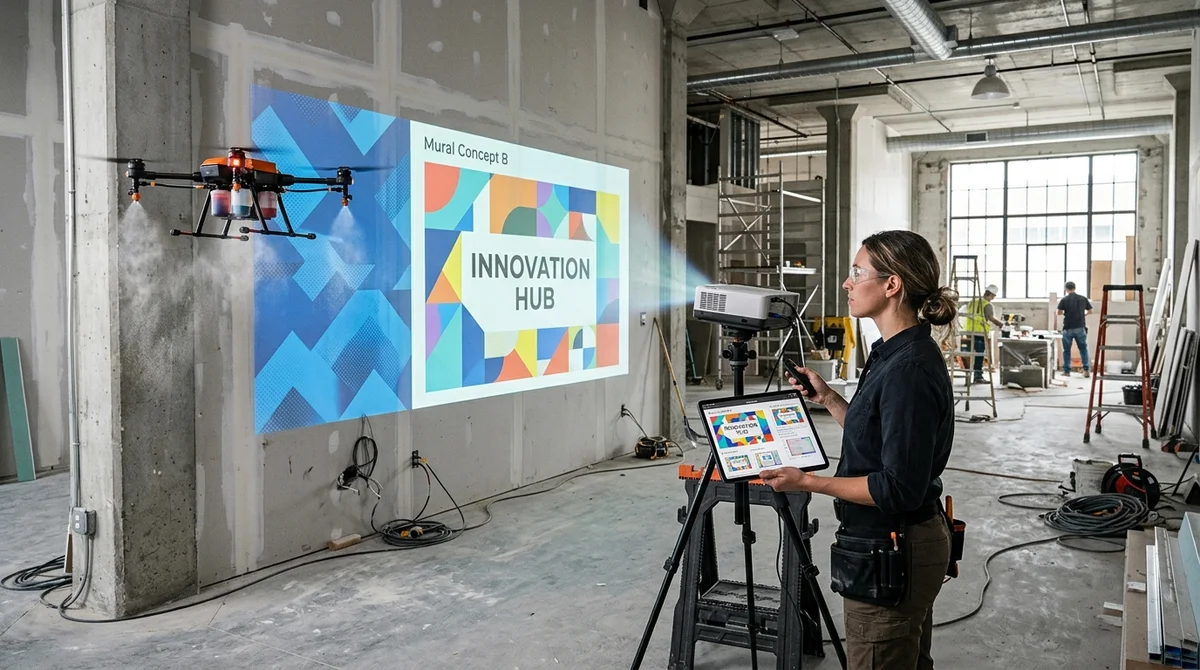
Wallmates, an agency with more than 3,500 projects behind it, has described how technology is already changing the decoration of commercial interiors. The article's central thesis: machines are gradually taking over the routine work (transferring outlines, fills, repeating elements), while people keep the creative and design side.
Where projectors help
The team estimates that in a typical office decoration project, about 30–40% of the work is pure mechanics. It is not about finding an idea, but about transferring outlines precisely, filling areas evenly and reproducing repeating fragments. Here, the first genuinely useful tool turned out to be an ordinary projector.
The finished digital sketch is projected onto the wall and the outlines are traced, instead of marking the surface by hand with a grid. In a market where custom spaces are becoming more common, this already changes the production logic.
Wallmates says this approach speeds up transferring a drawing by 4–5 times. On a large wall with complex graphics, that can be the difference between a day and a half of work and a single morning.
But the technology does not work in a vacuum: daylight washes out the projection, textured walls and arches distort the image, and large areas require stitching several frames together. The author's separate conclusion: expensive equipment does not always beat simple, proven gear.
- Bright light reduces the legibility of the projection
- Arches, niches and textured surfaces require manual correction
- On large surfaces, several frames have to be joined
- Short-throw projectors proved less practical than basic Epson models
Why AR has not taken off
The next logical step is to overlay the sketch directly on the wall through AR glasses. Technically this is already possible, and some studios are indeed experimenting with the scenario. But field use still has too many limitations: an artist or installer spends 8–10 hours on site, moves a lot, works at height and must constantly sense the space.
A heavy headset, eye fatigue and short battery life make AR inconvenient exactly where it was supposed to replace the projector.
VR and AR are, however, already useful at another stage: communicating with the client. If you load the future project into a virtual environment and let the customer literally "walk into" the interior, they grasp scale, composition and color choices faster. In the author's experience, this can roughly halve the number of revisions. The tool has matured for presentations, but not yet for full production work, especially over a long shift.
"Technology does not take away creativity.
It takes away the mechanics."
AI and drones
The most noticeable change right now is not about flashy demos, but about how AI is embedded in routine workflow. Instead of long iterations in a graphics editor, a team can get a dozen concept variants within minutes from a text description or a sketch, show them to the client and quickly lock in a direction.
The article says approval gets 3–5 times faster this way, and the designer spends less time on rough drafts and more on refining the chosen idea.
AI is then applied to practical tasks: it analyzes photos of the site and suggests palettes for the light and materials, generates seamless patterns and wayfinding elements, and helps adapt a flat layout to arches, domes and cylindrical surfaces.
The author also advises keeping a close eye on drones with paint sprayers. For high-rise facades, large background fills and precise repeating elements, this may become the next big shift in the economics of the work.
What this means
In design and spatial decoration, the coming changes will not be about "replacing humans with neural networks" but about redistributing labor. Projectors have already removed part of the manual marking, AR remains a presentation tool for now, AI speeds up approvals and layout preparation, and drones may take over dangerous and monotonous operations at height.
For studios, this means less time on mechanics and more on the decision that truly cannot be automated: how a space should feel.
Key Questions Answered
Where projectors help?
The team estimates that in a typical office decoration project, about 30–40% of the work is pure mechanics. It is not about finding an idea, but about transferring outlines precisely, filling areas evenly and reproducing repeating fragments. Here, the first genuinely useful tool turned out to be an ordinary projector. The finished digital sketch is projected onto the wall and the outlines are traced, instead of marking the surface by hand with a grid. In a market where custom spaces are becoming more common, this already changes the production logic. Wallmates says this app
Why AR has not taken off?
The next logical step is to overlay the sketch directly on the wall through AR glasses. Technically this is already possible, and some studios are indeed experimenting with the scenario. But field use still has too many limitations: an artist or installer spends 8–10 hours on site, moves a lot, works at height and must constantly sense the space. A heavy headset, eye fatigue and short battery life make AR inconvenient exactly where it was supposed to replace the projector. VR and AR are, however, already useful at another stage: communicating with the client. If you load th
What are the key details on AI and drones?
The most noticeable change right now is not about flashy demos, but about how AI is embedded in routine workflow. Instead of long iterations in a graphics editor, a team can get a dozen concept variants within minutes from a text description or a sketch, show them to the client and quickly lock in a direction. The article says approval gets 3–5 times faster this way, and the designer spends less time on rough drafts and more on refining the chosen idea. AI is then applied to practical tasks: it analyzes photos of the site and suggests palettes for the light and materials, g
Test Frontier LLMs & Autonomous Agents in One Workspace
Run Claude Opus 5.5, GPT-6, Gemini 3.1, and DeepSeek side-by-side in Nomad AI (nomadnet.ai) — unified model routing, deep research, and multimodal workflows under one subscription.
The AI world, distilled — once a week
Seven stories that actually mattered, hand-picked. No noise, no reposts, no press releases.
Done! Check your inbox for a confirmation.