China Moves to Block Meta's Manus AI Purchase: Can Meta Save the $2 Billion Deal?
China has demanded that Meta cancel its purchase of Manus, even though the deal has already closed. The issue goes beyond the price tag of more than $2 billion: Beijing has made clear it considers the Chinese origin of the team and technology more important than Singapore incorporation. For Meta, it is a blow to its bet on AI agents; for the market, it signals that the era of "Singapore washing" is ending. *Meta is designated an extremist organization and banned in Russia.
AI-processed from Bloomberg Tech; edited by Hamidun News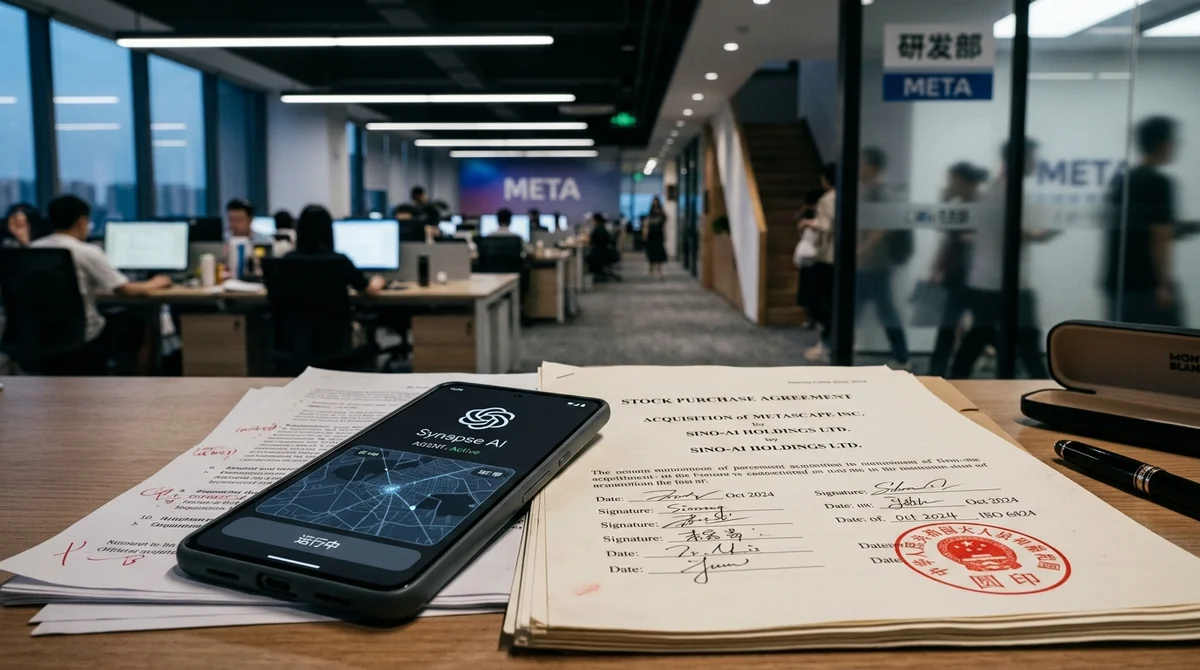
China has demanded that Meta cancel its purchase of Manus, even though the deal, worth more than $2 billion, closed back in December 2025. The story quickly went from routine M&A news to a test of who controls AI technology when a startup was born in China but legally relocated to Singapore.
Why Manus matters
Manus is not just a chatbot but an agentic AI service that takes a high-level goal and breaks it into steps on its own. It can search the web for data, write and run code, analyze files, and assemble a result without constant prompting from a human. Systems like this are now seen as the next big market after ordinary conversational assistants.
When Manus launched in early 2025, the project quickly gained attention far beyond China. Meta agreed to the purchase in December 2025 because it wanted to speed up in the AI agent race and build the technology into Meta AI, its advertising products, and enterprise tools. For the company, it was a chance to buy a ready-made team and working stack rather than catch up with competitors piece by piece.
- Searching for and gathering information on the web
- Writing and running code for a given task
- Analyzing spreadsheets, documents, and data
- Running multi-step office workflows
Why China stepped in
Formally, Manus was already a Singapore company, but the project has Chinese roots: the team and part of the technology grew out of structures created in Beijing. After the deal was announced, Beijing began a review of whether the parties had violated rules on technology exports, cross-border data transfers, and foreign involvement in sensitive AI business. In January 2026, Chinese authorities confirmed the review, and on April 27, 2026 they demanded that the purchase be cancelled.
The key signal goes beyond the fate of one deal. China is showing that what matters to it is less the legal address and holding structure than the origin of the team, the intellectual property, and the core developments. The model in which a startup moves to Singapore, raises international capital, and is then sold to a US corporation no longer looks like a safe workaround.
"The transaction fully complied with applicable law.
We expect an appropriate resolution of the review."
Can it all be rolled back?
In practical terms, this is the hardest part of the story. By the time of the ban, the deal was already operating as completed: more than 100 Manus employees had moved into Meta's offices in Singapore back in March 2026, the startup's leaders had received roles inside Meta, and investors, including early Chinese backers, had already been paid. If code, processes, and the team are partly embedded in Meta's infrastructure, "cancelling" this is easier on paper than in reality.
Still, Beijing has leverage. Meta barely depends on the Chinese market, since its main services are already blocked there. But China can pressure the founders, local investors, and any assets or rights that remain within its jurisdiction. So the ban looks not only like an attempt to recover a specific asset but also like a warning to the whole market: strategic AI companies cannot simply change flags and escape control.
For Meta, this is an unpleasant blow but not a catastrophe for the business. For the ecosystem, by contrast, it is a very important precedent. It shows that in the era of AI agents, a company's value is determined not only by model quality or revenue but also by where the technology was created, who controls the team, and which states consider this code part of their own security.
What this means
The Manus case shows that the AI agent market is entering a phase in which deals will be judged not only by investment bankers and lawyers but also by national security regulators. For startups, this is bad news: even after relocating and closing a deal, the country of origin may try to regain control of the technology.
*Meta is designated an extremist organization and banned in Russia.
- Nov 2, 2026Meta's Muse assistant keeps dossiers on loved ones and gets root on Ubuntu by default
- Nov 2, 2026The Verge reviewer builds a $50 Meta Muse Charm alternative with Claude Code
- Nov 1, 2026MoneyGate safety layer blocked all 42 fraudulent requests to local AI models
- Oct 31, 2026Open-source LLM gateway KTMS 1.0 plugs your own GPUs into the cloud and survives outages
Key Questions Answered
Can it all be rolled back?
In practical terms, this is the hardest part of the story. By the time of the ban, the deal was already operating as completed: more than 100 Manus employees had moved into Meta's offices in Singapore back in March 2026, the startup's leaders had received roles inside Meta, and investors, including early Chinese backers, had already been paid. If code, processes, and the team are partly embedded in Meta's infrastructure, "cancelling" this is easier on paper than in reality. Still, Beijing has leverage. Meta barely depends on the Chinese market, since its main services are a
Why Manus matters?
Manus is not just a chatbot but an agentic AI service that takes a high-level goal and breaks it into steps on its own. It can search the web for data, write and run code, analyze files, and assemble a result without constant prompting from a human. Systems like this are now seen as the next big market after ordinary conversational assistants. When Manus launched in early 2025, the project quickly gained attention far beyond China. Meta agreed to the purchase in December 2025 because it wanted to speed up in the AI agent race and build the technology into Meta AI, its adver
Why China stepped in?
Formally, Manus was already a Singapore company, but the project has Chinese roots: the team and part of the technology grew out of structures created in Beijing. After the deal was announced, Beijing began a review of whether the parties had violated rules on technology exports, cross-border data transfers, and foreign involvement in sensitive AI business. In January 2026, Chinese authorities confirmed the review, and on April 27, 2026 they demanded that the purchase be cancelled. The key signal goes beyond the fate of one deal. China is showing that what matters to it is
Test Frontier LLMs & Autonomous Agents in One Workspace
Run Claude Opus 5.5, GPT-6, Gemini 3.1, and DeepSeek side-by-side in Nomad AI (nomadnet.ai) — unified model routing, deep research, and multimodal workflows under one subscription.
The AI world, distilled — once a week
Seven stories that actually mattered, hand-picked. No noise, no reposts, no press releases.
Done! Check your inbox for a confirmation.