Nvidia and Big Tech push the tech sector to the front of earnings season
The tech sector is taking the lead in US earnings season. The main engine is chipmakers, which are profiting from record investment by Microsoft, Amazon, Alphabet and Meta in AI data centers. Sector profit in the first quarter may have grown 41% year over year, and Nvidia, Micron, Broadcom and other AI infrastructure suppliers are already the key beneficiaries in the S&P 500. *Meta has been designated an extremist organization and is banned in Russia.
AI-processed from Bloomberg Tech; edited by Hamidun News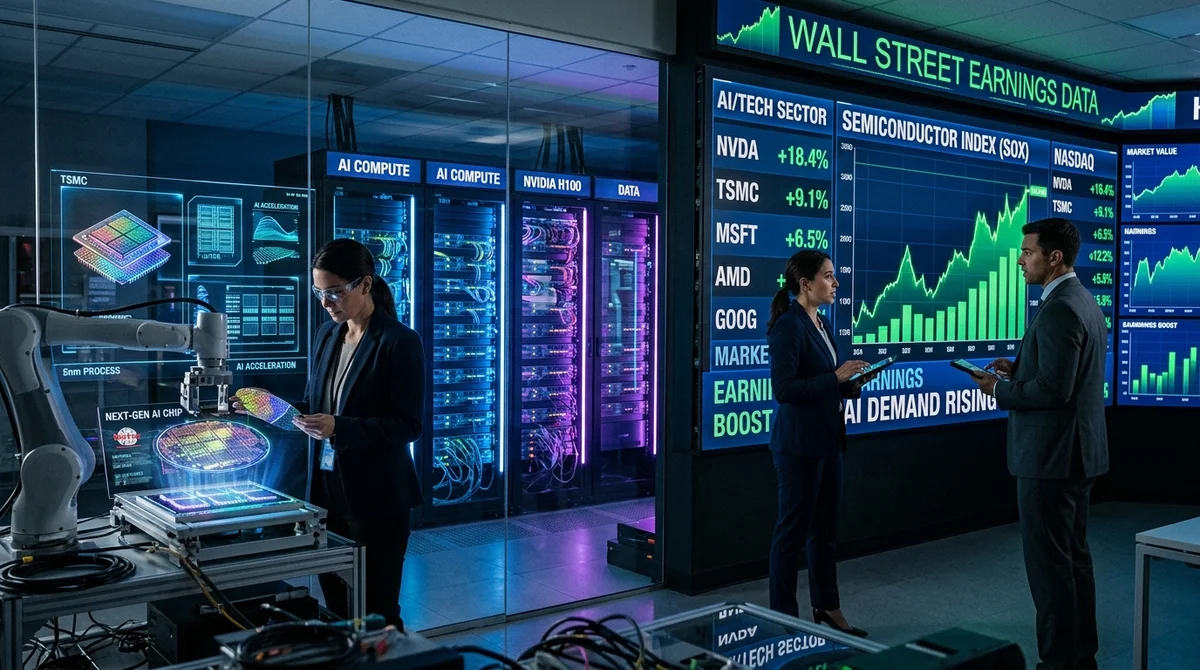
The US technology sector enters earnings season as the main beneficiary of the AI boom. While Big Tech spends record sums on data centers and computing infrastructure, chipmakers are turning that investment into faster revenue and profit growth.
Why tech is ahead
According to Bloomberg Intelligence, US tech sector profit in the first quarter of 2026 may have grown 41% year over year. That is the best result among all S&P 500 sectors and nearly double that of the next-best performer, the materials sector. Against a broadly strong earnings backdrop, this stands out: as of April 24, FactSet estimated combined profit growth for index companies at 15.1%, and 84% of issuers that had already reported beat earnings-per-share forecasts.
The main reason for the gap is the scale of the largest platforms' AI spending. In February, Bloomberg reported that Alphabet, Amazon, Meta and Microsoft together plan to put around $650 billion of capital expenditure to work in 2026. That money goes into new data centers, servers, networking, memory and accelerators. For infrastructure makers, this is not an abstract bet on the future but a stream of orders that already shows up in quarterly results.
Who earns the most
Not all tech companies benefit equally. While the platforms keep explaining to investors when their gigantic AI spending will pay off, hardware suppliers are already skimming the cream off current demand. This is not only about GPUs, but also memory, networking equipment, server components and the whole ecosystem on which new cloud capacity is built. This is where the market sees the most direct and fastest monetization of AI demand.
- Nvidia, according to FactSet, remains the largest contributor to profit growth not only among the "Magnificent Seven" but across the entire S&P 500.
- After Nvidia, analysts single out Micron, Broadcom and SanDisk among the notable growth drivers.
- Morningstar also counts Arista, Amphenol and Marvell among the clear beneficiaries of the AI buildout.
- High prices for DRAM and NAND memory, as well as supply shortages in certain segments, provide additional momentum.
This detail matters: the whole effect cannot be attributed to the Big Tech label alone. FactSet estimates first-quarter profit growth for the "Magnificent Seven" at 22.8%, but without Nvidia that figure drops to 6.4%. For comparison, the remaining 493 companies in the index together show 10.1%. In other words, the market is increasingly separating the platforms that finance the AI expansion from the suppliers that are earning from it right now.
What the market is watching
The next test of this logic is the reporting of the coming weeks. According to Morningstar's schedule, Microsoft and Amazon are due to report after the market close on April 29, AMD on May 5, and Nvidia on May 20. Investors care not only about the quarterly numbers but also about management commentary: whether the previous pace of capital spending will hold, how quickly new capacity is coming online, and whether demand for AI compute really remains close to full utilization.
The market is not looking at the sector without nerves, though. In the first quarter, Morningstar's technology index fell 9%, while the semiconductor index lost only 4.8%. In April the situation began to turn: by April 22, the semiconductor index had gained 25.2% over the month. This shows that investors are ready to pay again for companies tied to AI infrastructure if earnings confirm demand, rather than just promises.
What this means
At this stage of the AI cycle, the biggest winner is not necessarily the company that sells finished AI services the loudest. The fastest to monetize are companies that supply compute, memory, networking equipment and data center components. If the coming reports confirm durable demand and Big Tech's willingness to keep investing, chipmakers and infrastructure suppliers will remain at the center of tech growth in 2026.
*Meta has been designated an extremist organization and is banned in Russia.
- Nov 2, 2026Anthropic needs to grow revenue 32% a year to cover $850 billion in contracts
- Nov 2, 2026TensorFold 1.2.0 boosts Qwen3.8-27B throughput on M3 Ultra by 44.2% at 16 streams
- Nov 1, 2026Local models lose to Opus and Codex: 0.21 on a MacBook versus 1.00 for Codex
- Nov 1, 2026Habr author fine-tunes YOLOv8l on dental X-rays and pushes mAP50 to 0.642
Key Questions Answered
Why tech is ahead?
According to Bloomberg Intelligence, US tech sector profit in the first quarter of 2026 may have grown 41% year over year. That is the best result among all S&P 500 sectors and nearly double that of the next-best performer, the materials sector. Against a broadly strong earnings backdrop, this stands out: as of April 24, FactSet estimated combined profit growth for index companies at 15.1%, and 84% of issuers that had already reported beat earnings-per-share forecasts. The main reason for the gap is the scale of the largest platforms' AI spending. In February, Bloomberg rep
Who earns the most?
Not all tech companies benefit equally. While the platforms keep explaining to investors when their gigantic AI spending will pay off, hardware suppliers are already skimming the cream off current demand. This is not only about GPUs, but also memory, networking equipment, server components and the whole ecosystem on which new cloud capacity is built. This is where the market sees the most direct and fastest monetization of AI demand. Nvidia, according to FactSet, remains the largest contributor to profit growth not only among the "Magnificent Seven" but across the entire S&
What the market is watching?
The next test of this logic is the reporting of the coming weeks. According to Morningstar's schedule, Microsoft and Amazon are due to report after the market close on April 29, AMD on May 5, and Nvidia on May 20. Investors care not only about the quarterly numbers but also about management commentary: whether the previous pace of capital spending will hold, how quickly new capacity is coming online, and whether demand for AI compute really remains close to full utilization. The market is not looking at the sector without nerves, though. In the first quarter, Morningstar's
Test Frontier LLMs & Autonomous Agents in One Workspace
Run Claude Opus 5.5, GPT-6, Gemini 3.1, and DeepSeek side-by-side in Nomad AI (nomadnet.ai) — unified model routing, deep research, and multimodal workflows under one subscription.
The AI world, distilled — once a week
Seven stories that actually mattered, hand-picked. No noise, no reposts, no press releases.
Done! Check your inbox for a confirmation.