Whisper and Faster-Whisper: How to Transcribe Audio Locally Without Sending Files to the Cloud
Local audio transcription is back in focus: Faster-Whisper enables transcribing recordings via Python without uploading files to the cloud. The approach…
AI-processed from KDnuggets; edited by Hamidun News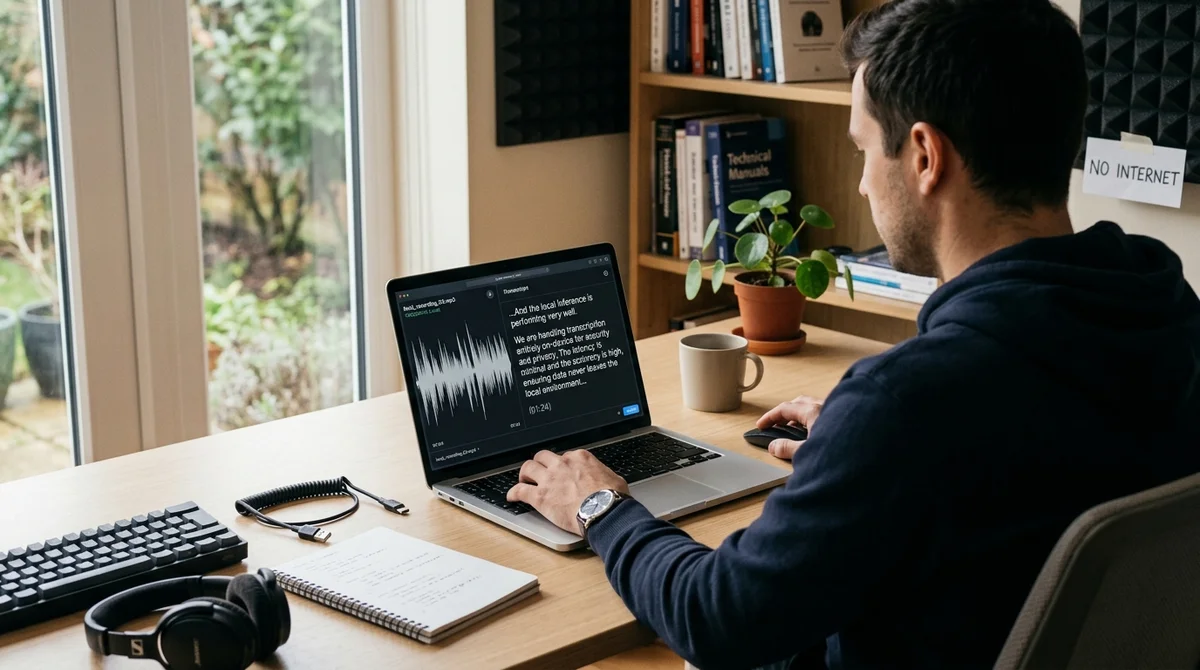
Local audio transcription is back in focus: a piece on Faster-Whisper shows how to run transcription on your own computer through Python without uploading files to cloud services. The main emphasis is on privacy, data control, and the ability to work on both CPU and GPU.
Why Locally
The main argument for this approach is privacy. If a recording of an interview, conference call, or client call contains sensitive data, local processing reduces some of the risks: the file does not go to an external server, does not depend on a third-party provider's storage policy, and remains within your own perimeter. For companies, this is especially important where there are security requirements, NDAs, or internal restrictions on sending audio to external services.
The second plus is predictability. You yourself choose the model, quality parameters, and processing speed, and you also don't depend on API tariffs and queues in the cloud. Faster-Whisper is interesting here because it provides a lighter and more practical way to work with Whisper family models in a local environment. This is not an experiment for the sake of an experiment, but a fully workable scenario for daily file transcription. There is also a purely operational bonus: local transcriptions are easier to integrate into archive or batch mode. You can run dozens of files in a row without thinking about external service limits, internet availability, and fluctuating cost per minute of audio.
How It's Set Up
The scheme is quite straightforward: a Python script loads the Faster-Whisper model, takes an audio file, and returns text broken down by segments and timestamps. This format is convenient not only for simple transcription, but also for further automation — for example, if you need to collect subtitles, extract meeting notes, or run the text through summarization.
The approach remains universal: the same pipeline can run on a laptop, workstation, or server.
- Loading the model into memory
- Reading a local audio file
- Speech recognition by segments
- Returning text with timecodes
Hardware is a separate important question. Running on a GPU provides noticeable speed gains, especially on long recordings and larger models. But what's more important is this: the material is not tied only to an expensive graphics card. If you only have a regular CPU at hand, local transcription is still accessible, just processing will take more time. This makes Faster-Whisper a convenient option both for a solo developer and for a small team that doesn't want to immediately build complex infrastructure.
Where This Will Be Useful
There are many practical scenarios. Journalists can transcribe interviews without sending source files to third parties. Product teams can quickly convert call recordings to text and search through them for solutions or bugs. Podcasters can collect draft subtitles and episode descriptions. Inside companies, such a stack is useful in that it is easy to integrate into your own process: uploaded a file, got text, passed it on to search, analytics, or an internal AI assistant.
At the same time, local execution does not cancel out the basic limitations of speech recognition. Quality is still affected by noise, multiple speakers at once, strong accents, and poor recordings. Therefore, the real workflow is usually built like this: first select the model size for the task, then test the speed on your hardware, and only then scale the solution.
It is this practicality that makes local transcription relevant again, especially against the backdrop of growing interest in private AI tools.
What This Means
Interest in local AI is shifting from the realm of enthusiasts to everyday work scenarios. If Faster-Whisper solves the quality problem at an acceptable level, teams gain a simple way to transcribe audio without cloud compromises, unnecessary API costs, and loss of control over their data.
Want to stop reading about AI and start using it?
AI News is a curated feed of AI/tech news. Hamidun Academy teaches you to use AI systematically in your work.