Claude for Science: Anthropic Says Its Model Is Speeding Up Research at Stanford and MIT
Anthropic reports that Stanford and MIT are successfully using its Claude model for scientific research. Claude helps researchers analyze data, automate experiments, and generate new hypotheses, significantly speeding up the scientific process. The model is especially useful for processing large volumes of information.
AI-processed from Jiqizhixin (机器之心); edited by Hamidun News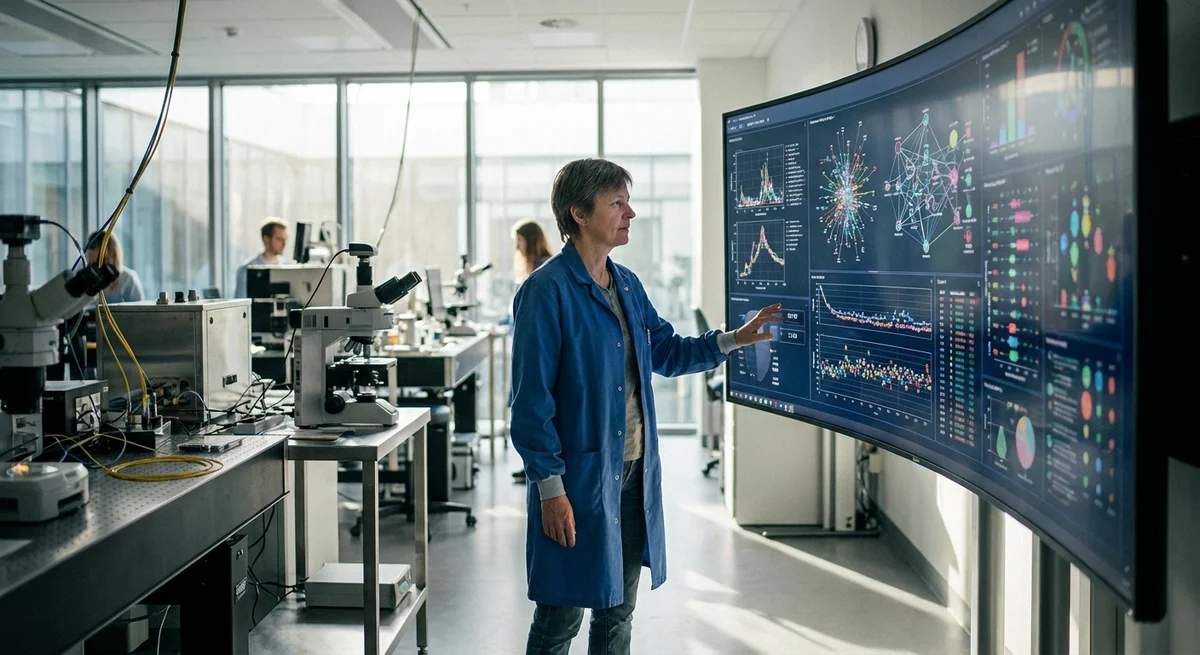
The AI industry is constantly searching for models that can do more than generate text or images — models that can tackle hard scientific problems. Anthropic says its large language model (LLM) Claude is actively used at leading universities such as Stanford and the Massachusetts Institute of Technology (MIT) to speed up scientific research. The claim raises an important question: what makes Claude so well suited to scientific work, and what concrete advantages does it give researchers?
Until recently, scientists mostly used large language models to analyze large volumes of text, such as research papers and reports. According to Anthropic, however, Claude goes beyond simple text analysis. The model can automate routine tasks like searching for information, processing experimental data, and even generating new hypotheses. That opens up new possibilities for researchers, freeing them to focus on the more creative and strategic parts of their work.
One of Claude's key strengths is its ability to understand and work with complex scientific concepts. The model was trained on a huge body of scientific text, which lets it handle specialized terminology and grasp the connections between different scientific fields. Claude also has strong reasoning and data analysis capabilities, so it can spot patterns and make predictions based on the available information.
Claude's use at Stanford and MIT shows the potential of large language models to transform scientific research. Scientists use Claude to analyze genomic data, model climate change, develop new drugs, and tackle other hard problems. By automating routine tasks and speeding up data analysis, researchers can significantly cut the time it takes to run studies and get results. That, in turn, helps accelerate scientific progress and leads to new discoveries.
Still, it's important to remember that large language models like Claude are not a replacement for scientists. They are a powerful tool that can help researchers in their work, but they cannot replace human knowledge, experience, and intuition. Results produced with Claude need critical evaluation and must be checked against scientific methodology.
In short, Claude's use at Stanford and MIT is a clear example of how large language models can be used to speed up scientific research. Claude has unique capabilities that let it automate routine tasks, analyze data, and generate new hypotheses. That opens new prospects for scientific progress and lets researchers focus on the more creative and strategic parts of their work. Going forward, we will likely see even more examples of large language models being successfully applied across different fields of science.
- Nov 1, 2026OpenAI Rewrites GPT Behavior Rules: Five Values and a Chain of Command
- Nov 1, 2026Google admits AI Mode cuts search revenue, shares fall 15%
- Oct 31, 2026Author puts his script before an AI jury: the verdict cost 850 thousand tokens
- Oct 31, 2026Anthropic: Fold Subagents Back Into a Single Loop — One Customer's Tasks Ran Twice as Fast
Test Frontier LLMs & Autonomous Agents in One Workspace
Run Claude Opus 5.5, GPT-6, Gemini 3.1, and DeepSeek side-by-side in Nomad AI (nomadnet.ai) — unified model routing, deep research, and multimodal workflows under one subscription.
The AI world, distilled — once a week
Seven stories that actually mattered, hand-picked. No noise, no reposts, no press releases.
Done! Check your inbox for a confirmation.