NextFilm describes movie recommendation model: cold start, taste vector and GPT layer
The NextFilm project showed how to solve the cold start problem in movie recommendations without relying solely on genres. The system first collects initial ratings of watched movies, then builds a taste vector based on more nuanced features, compares it with MovieLens 25M patterns and then uses GPT for re-ranking, more intelligible output and brief explanations of the selection.
AI-processed from Habr AI; edited by Hamidun News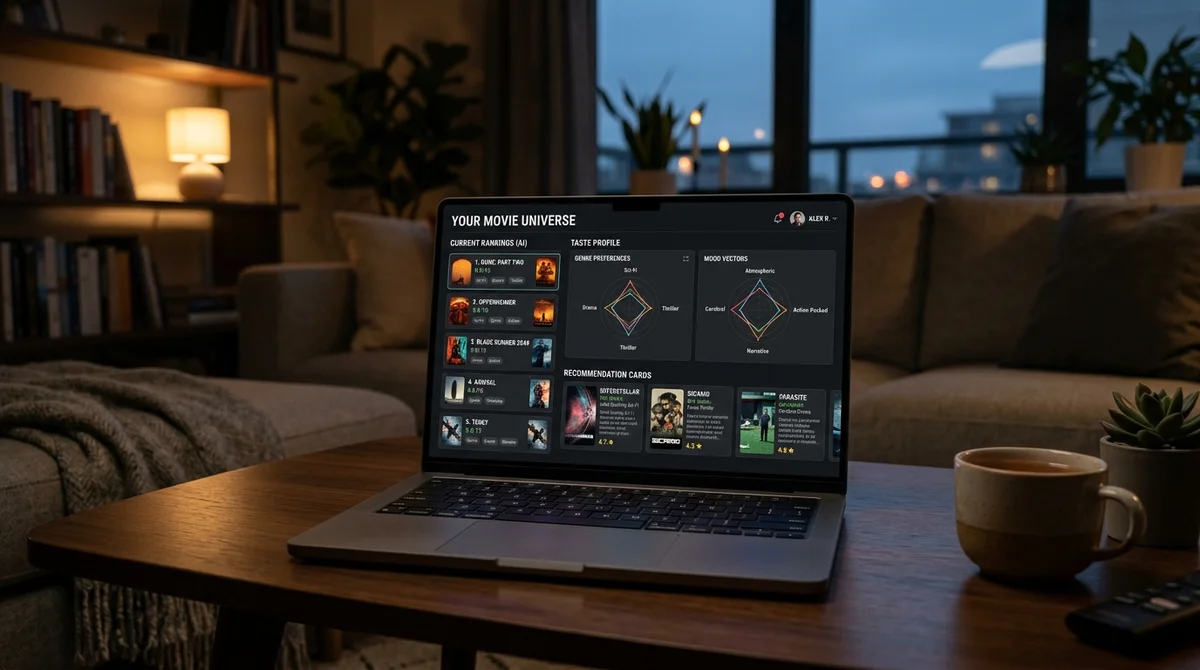
NextFilm described how it builds a movie recommendation system for users about whom almost nothing is known at the start. Instead of simple genre-based curation, it offers a hybrid pipeline: collect initial signals, build a taste vector, cross-check it against collective patterns, and only then connect GPT.
Why genres aren't enough
The problem begins with the fact that the same genre guarantees nothing. Two viewers may love science fiction, but one needs slow and philosophical stories while the other wants dense plot and spectacle. For a couple, the task becomes even harder: you need to find not just a "popular movie," but an option that won't be random for both. That's why "what to watch tonight" lists work as a storefront but quickly break down as personal recommendations.
In NextFilm, the author doesn't rely on genres but on actual viewer experience. At the start, the system needs to understand what a person has already seen, what they rated highly, and what they haven't watched at all. This is critical for cold start: without this distinction, the model easily confuses missing data with negative reaction and starts drawing conclusions from nothing. This context determines how risky it is to suggest obvious or already-watched options.
The system must understand not just "what they like," but what kind of
viewing experience the user has.
How the pipeline works
After initial ratings, the model moves from a list of watched content to a more precise profile. Taste is broken down into subtle features: pace, emotional tone, depth, spectacle, familiarity of form, and plot density. This creates an internal vector of preferences that explains why two films from the same genre can be very far apart for a specific person. This gives the model a more interpretable foundation for initial accurate hypotheses.
- The user first marks already-watched films and provides initial ratings
- The system builds an initial profile and separates strong signals from noise
- A taste vector is then formed based on a set of features, not just genres
- The model then matches this profile with patterns from MovieLens 25M
- After ranking candidates, the output is refined for final presentation
A separate layer in the scheme is the collective signal. The author uses MovieLens 25M, which contains 25 million ratings across more than 62,000 films. The logic is simple: if a user likes a certain set of films, the system looks at what else is consistently liked by people with similar patterns. This isn't a replacement for a personal profile but a way to make recommendations more robust and reduce the share of random matches. This is how the hybrid scheme gains scale without losing personalization entirely.
Where GPT is needed
GPT doesn't substitute the recommender itself here. It engages after the stages of signal collection, profile building, and basic ranking. Its role is to reorder candidates, group results, and explain to the user why the selection looks the way it does. This approach matters because LLM can improve the perception of results, but won't fix poor basic relevance if the ranking was poorly assembled from the start. Essentially, it handles packaging the result, not its origin.
The scheme has limitations too. The most sensitive point is onboarding: for recommendations to become useful, a new user must spend time on initial ratings. There's also a risk of drift toward overly popular films if collective data begins to dominate over the personal profile. Additionally, tastes change over time, so the model needs to be retrained on new signals rather than treating the profile as fixed after initial login. Without updates, the system will quickly become repetitive and lose accuracy.
What this means
The NextFilm story illustrates well how the role of LLM is changing in recommendation products. The main value still comes from data, ranking, and careful handling of cold start, while GPT becomes not "magic" but an interface and interpretive layer. For media services, this is a practical guideline: first build the signal, then add the generative layer on top. This approach can be useful not only for movie services but for any product where recommendations need to be explained to the user.
Want to stop reading about AI and start using it?
AI News is a curated feed of AI/tech news. Hamidun Academy teaches you to use AI systematically in your work.
The AI world, distilled — once a week
Seven stories that actually mattered, hand-picked. No noise, no reposts, no press releases.
Done! Check your inbox for a confirmation.