Elon Musk Testified in Court That He Launched OpenAI to Defend Against 'Terminator' Scenario
Elon Musk testified in court for the first time in the case against OpenAI, stating that he created the organization as a non-profit project for safe AI development, not profit. OpenAI responds that it made no such promises, while the judge separately ordered Musk and Sam Altman to stop their mutual attacks on social media during the trial.
AI-processed from Wired; edited by Hamidun News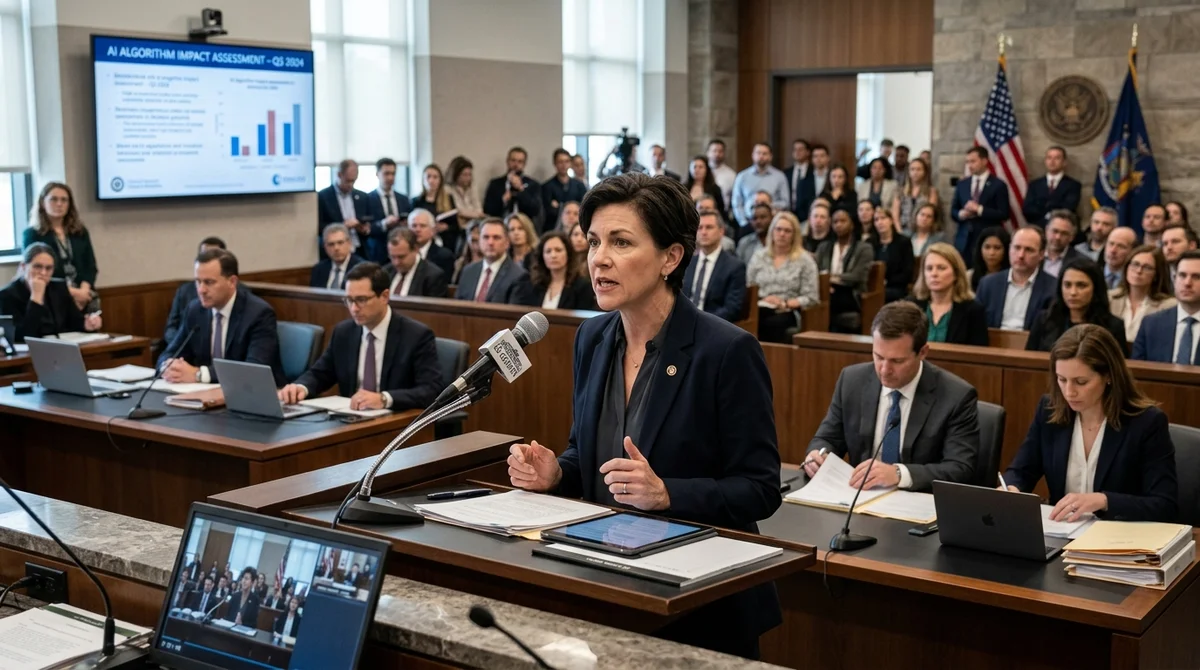
Elon Musk testified in federal court for the first time, detailing his version of why he created OpenAI. According to him, the project was conceived as an open and non-commercial alternative to Google, designed to reduce the risk of dangerous AI development.
Why Musk Created OpenAI
At the April 28, 2026 hearing, Musk stated that he had long feared a scenario where computers become smarter than humans and slip out of control. His lawyers reminded the jury that as far back as the mid-2010s, he tried to discuss AI regulation with American authorities but saw insufficient response. After that, according to Musk's version, he decided to act himself and, together with Sam Altman, launched OpenAI as a non-commercial laboratory that would compete with Google while prioritizing safety over the race for profit.
Musk described OpenAI's early idea quite sharply: if the biggest players are advancing AI without sufficient safeguards, a counterweight is needed that works in humanity's interest. In court, he tied this not only to business but also to the broader ethics of AGI development. According to him, the technology can bring enormous benefits—from new scientific discoveries to increased prosperity—but if managed incorrectly, it can end in catastrophe.
"We'd better end up in the Star Trek universe rather than in a James Cameron film,"
Musk said, explaining his fears around AGI.
What the Dispute Is About
The key dispute in the case is whether OpenAI transformed from a structure with a public mission into a regular commercial company. Musk argues that he allowed only limited commercial extension as a tool for raising money for computing, hiring, and infrastructure. But according to his version, after the Microsoft deal for $10 billion in 2023, the balance shifted definitively: intellectual property and employees increasingly concentrated within the commercial structure, while the original non-commercial mission took a back seat.
- The company did not promise Musk to remain non-commercial forever and did not commit to publishing all code.
- Musk, according to the defense, knew about plans to attract huge corporate investments as far back as 2018.
- The lawsuit, as OpenAI's lawyers claim, was filed too late—already after Musk founded competing xAI in 2023.
- Musk himself, according to the defendants, promised to invest up to $1 billion but actually contributed about $38 million and at the same time wanted to gain control of OpenAI.
OpenAI's lawyers are trying to show the jury that Musk is not defending the company's original mission but is in a dispute with a competitor. An important detail of the case is that not only possible monetary payments are at stake. The court may also touch on issues of OpenAI's governance, which is directly related to its corporate structure and could complicate the company's IPO plans for 2026. For the company itself, this is not just a reputational risk but a strategic one: any decision on the control model could affect future investors.
What Happened in Court
The atmosphere at the trial quickly went beyond a typical corporate conflict. Judge Yvonne Gonzalez Rogers separately reacted to the parties' mutual attacks on social media and demanded that the public escalation stop during the proceedings. The reason was Musk's posts and complaints from OpenAI's lawyers, who complained about a stream of publications fueling the conflict outside the courtroom. As a result, both Musk and Altman agreed to temporarily reduce their activity on the topic of the case.
The hearing itself showed both the political and symbolic weight of the case. Musk was the first witness to testify, and Altman was in the courtroom, though he left before Musk's testimony began. In parallel, the OpenAI CEO missed an Amazon Web Services event in San Francisco where the company was presenting new initiatives in agentic AI. This shows the scale of the conflict well: the dispute is not about old agreements themselves, but about who and under what conditions will control one of the most influential AI companies of the decade.
What This Means
The Musk v. Altman case is turning into a public test of whether it's possible to combine the declared public mission of an AI laboratory with billion-dollar investments and preparation for an IPO. If the court seriously intervenes in OpenAI's governance model, the consequences will extend far beyond the personal conflict between the two founders and will become a benchmark for the entire industry of AI companies with a "missionary" history. For the market, this will be a signal of where the boundary lies between mission, the board of directors, and investor interests.
Need AI working inside your business — not just in your newsfeed?
I build production AI for companies — custom CRM, internal tools, autonomous agents, workflow automation. Owned by you, shaped to your process, no per-seat tax. Built by Zhemal Khamidun, CPO of AlpinaGPT (AI platform, 6,000+ users).
The AI world, distilled — once a week
Seven stories that actually mattered, hand-picked. No noise, no reposts, no press releases.
Done! Check your inbox for a confirmation.