AWS explains how to turn a text AI agent into a voice assistant on Nova 2 Sonic
AWS has published a detailed guide to migrating a text AI agent to a voice assistant on Amazon Nova 2 Sonic. The central point: adding speech recognition and synthesis is not enough. Prompts, dialogue management, latency and tool handling all need rework. Some of the logic and sub-agents can be kept if they are separated from the conversational layer, and the assistant's behavior is redesigned for live conversation.
AI-processed from AWS Machine Learning Blog; edited by Hamidun News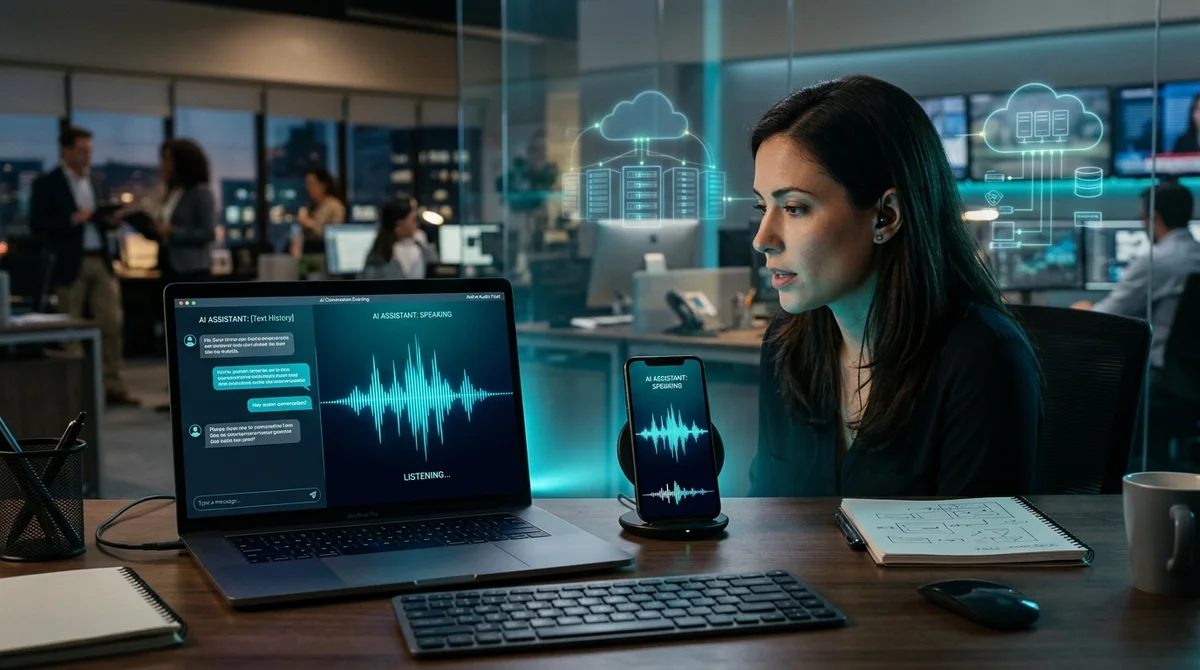
AWS has shown that moving from a text AI agent to a voice assistant is not an interface swap but a rework of the entire dialogue logic. In its write-up on Amazon Nova 2 Sonic, the company explains which parts can be reused and which must be designed from scratch so that the conversation sounds natural and does not break down in real-world scenarios.
Why voice is harder
A text agent has the luxury of a pause: the user types a request, the model replies with a paragraph, and then the user can think about the next step. Voice does not work that way. Pace, sentence length, not interrupting, reacting quickly to clarifications and holding context without seeming to have "frozen" all matter. So migrating to voice is not a cosmetic layer on top of a finished bot but a shift toward conversational UX, where every extra word affects perception almost as much as the quality of the model itself.
Another difference is the goal of the interaction. For a text agent, a long, detailed answer often looks helpful. For a voice assistant, the same answer can be tiring. AWS notes that designers need to understand the use case from the start: customer support, task execution, an internal assistant for employees, or navigation of a service. In each case the priority shifts between speed, accuracy, naturalness of speech, and the number of steps the system can take without extra confirmation.
What to change in the architecture
The key idea of the post is that an existing text agent does not have to be thrown away. Decision logic, tools and even some sub-agents can be kept if they are moved into separate modules with a voice layer added on top. In this setup, Amazon Nova 2 Sonic becomes the live-conversation interface: it helps organize a more natural exchange of turns, while the underlying agent keeps calling the needed functions and business rules. But this requires making the architecture more event-driven and more sensitive to response time.
- Reuse tools and business logic if they already work reliably in the text agent
- Keep sub-agents for narrow tasks, but cut their latency and the volume of intermediate responses
- Rewrite the system prompt for spoken language rather than copying the text style one-to-one
- Add handling for confirmations, pauses and user interruptions
- Explicitly separate the agent's internal reasoning from the short spoken reply
Adapting the system prompt is a separate question. In text, the model can be asked to answer at length, list options and give full context at once. In voice mode, such instructions often get in the way. The assistant does better when it speaks more briefly, confirms understanding, asks a clarifying question at the right moment and does not read out internal details to the user. Otherwise even a strong agent starts to sound like a chat being read aloud rather than a partner who can hold a conversation.
The main migration traps
The main mistake in migration is assuming a voice assistant is the same text agent plus speech synthesis. In practice, problems appear in places that were not critical before: long delays before answering, overly formal phrasing, inability to handle interruptions, and confusion in multi-step tasks. If in a chat the user tolerates an extra two or three seconds and can reread a long answer, in voice the same delay quickly destroys the sense of natural conversation and lowers trust in the system.
AWS also addresses concerns around tools and sub-agents. If they work opaquely, the user hears either prolonged silence or an overly wordy recap of internal steps. So it is important to decide in advance when the assistant should say "let me check," when it is better to perform the action silently, and when it is safer to stop and ask for confirmation. This control is especially needed in scenarios where the agent orders a service, changes user data or goes through several dependent steps in a row.
What this means
For teams that already have a text AI agent, the AWS article is useful as a practical migration map rather than an abstract model demo. The main takeaway is simple: a voice product wins not from a new model alone, but from how carefully you separate logic, tools, prompts and dialogue behavior. If that boundary is drawn correctly, the path from chat to assistant gets noticeably shorter.
- Nov 2, 2026Anthropic needs to grow revenue 32% a year to cover $850 billion in contracts
- Nov 2, 2026The Verge reviewer builds a $50 Meta Muse Charm alternative with Claude Code
- Oct 31, 2026Worldwide Express hands disputed invoices to AI agents and cuts unresolved disputes by 75%
- Oct 31, 202610 million people have activated Meta's Muse agent, but Hilton and eBay barely see any orders
Key Questions Answered
Why voice is harder?
A text agent has the luxury of a pause: the user types a request, the model replies with a paragraph, and then the user can think about the next step. Voice does not work that way. Pace, sentence length, not interrupting, reacting quickly to clarifications and holding context without seeming to have "frozen" all matter. So migrating to voice is not a cosmetic layer on top of a finished bot but a shift toward conversational UX, where every extra word affects perception almost as much as the quality of the model itself. Another difference is the goal of the interaction. For a
What to change in the architecture?
The key idea of the post is that an existing text agent does not have to be thrown away. Decision logic, tools and even some sub-agents can be kept if they are moved into separate modules with a voice layer added on top. In this setup, Amazon Nova 2 Sonic becomes the live-conversation interface: it helps organize a more natural exchange of turns, while the underlying agent keeps calling the needed functions and business rules. But this requires making the architecture more event-driven and more sensitive to response time. Reuse tools and business logic if they already work
What are the key details on The main migration traps?
The main mistake in migration is assuming a voice assistant is the same text agent plus speech synthesis. In practice, problems appear in places that were not critical before: long delays before answering, overly formal phrasing, inability to handle interruptions, and confusion in multi-step tasks. If in a chat the user tolerates an extra two or three seconds and can reread a long answer, in voice the same delay quickly destroys the sense of natural conversation and lowers trust in the system. AWS also addresses concerns around tools and sub-agents. If they work opaquely, t
Test Frontier LLMs & Autonomous Agents in One Workspace
Run Claude Opus 5.5, GPT-6, Gemini 3.1, and DeepSeek side-by-side in Nomad AI (nomadnet.ai) — unified model routing, deep research, and multimodal workflows under one subscription.
The AI world, distilled — once a week
Seven stories that actually mattered, hand-picked. No noise, no reposts, no press releases.
Done! Check your inbox for a confirmation.