Meta may cut more than 700 workers at Irish contractor Covalen who trained its AI
Meta may leave more than 700 employees of its Irish contractor Covalen without jobs. They handled moderation and data labeling for Meta's AI systems. About 500 of them reviewed model responses and tested ways of bypassing safety restrictions. Meta now says outright that it will depend less on contractors and move such tasks to in-house AI tools more aggressively. *Meta is designated an extremist organization and banned in Russia.
AI-processed from Wired; edited by Hamidun News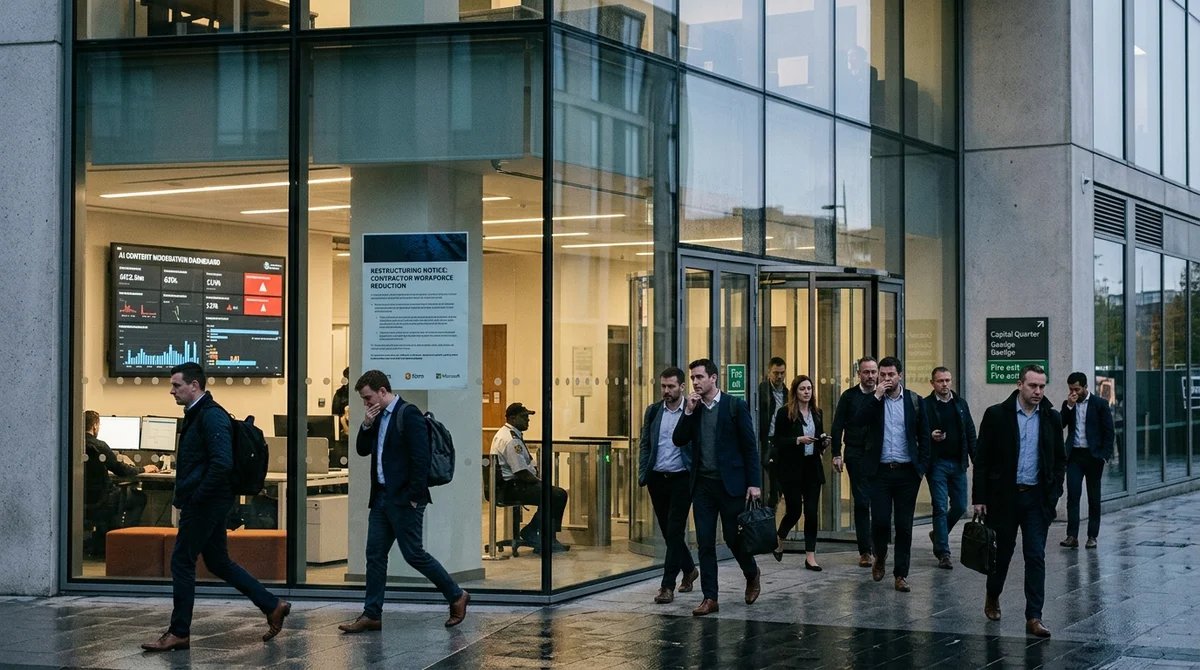
More than 700 employees of Covalen, a Meta contractor that handles moderation and data labeling for its AI systems, face layoffs in Ireland. What makes the case stand out is that these are the people whose work helped the company train safety models and automate content review.
Who is affected
The cuts put at risk employees at Covalen's Dublin office, which provides Meta with content moderation and data services. According to reports based on internal documents and notices sent to staff, more than 700 jobs are affected out of roughly 2,000 in the local unit. About 500 people in this group are data annotators: they check AI model responses, compare them against Meta's internal rules and help the system tell acceptable, dangerous and illegal content apart.
People were told about the coming layoffs on a short video call on April 27, 2026, with no proper question-and-answer session. For Covalen, this is already the second major wave in recent months.
What their work involved
These teams did more than routine review of posts or complaints. Their job was to test how Meta's AI systems behave in difficult and borderline scenarios: how a model answers questionable requests, whether it withstands attempts to bypass safety restrictions, and whether it avoids giving out prohibited instructions. In some cases, employees had to deliberately write provocative prompts involving suicide, child sexual abuse and other severe topics to find exactly where the system breaks and how to retrain it. In effect, the human became the template for a decision that the AI was later supposed to reproduce.
"Basically, we're training AI to take our jobs," one
Covalen employee said, describing the situation.
The workers say the problem is not only the possible loss of income but also the toll the work took. One person described it as exhausting: you spend the whole day thinking like an offender to show the system where the line is. That is why the current situation feels especially painful: people are being cut just as the fruits of their labor begin working at scale every day.
Why Meta is changing course
Back in March 2026, Meta said publicly that in the coming years it would deploy more advanced AI systems in user support and content enforcement. At the same time, the company said explicitly that it intends to gradually reduce its reliance on third-party contractors and strengthen its internal systems. Against that backdrop, the new round of cuts looks less like a local measure at one contractor and more like part of a broader restructuring, which coincided with Meta's announced layoffs of about 10% of its workforce.
The company explains the shift by pointing to early test results: according to Meta, the new tools catch fraud better, identify violations more accurately and can scale to a far wider range of languages than the previous review processes. That is what pushes the platform to move more of these tasks from an external operational layer into internal AI systems. The company also gets an argument that this is about more than savings; it is about higher accuracy.
- AI systems help find up to 5,000 additional scam attempts per day
- complaints about fake celebrity accounts have fallen by more than 80%, according to the company
- in some violation categories, the new systems find twice as much problematic content as the previous review teams
- these tools can work with languages spoken by about 98% of internet users
For the business, this looks like a move from costly manual review to a more centralized AI infrastructure. For workers, it is a signal that Meta will lean less on external teams, even though those very teams helped test, label and improve the future automation.
The CWU union is demanding negotiations over the terms of the layoffs and criticizes a rule under which laid-off employees allegedly cannot work for another Meta contractor for six months.
What it means
The Covalen case shows one of the harshest scenarios of the AI transition: companies first hire people to collect data, build rules and train models, then reduce their dependence on those same specialists once automation reaches a quality the business finds acceptable. For the market, it is one more signal that jobs at the intersection of moderation, labeling and trust & safety will change faster than labor rules and employment protections can be updated.
*Meta is designated an extremist organization and banned in Russia.
- Nov 1, 2026MoneyGate safety layer blocked all 42 fraudulent requests to local AI models
- Oct 31, 2026Open-source LLM gateway KTMS 1.0 plugs your own GPUs into the cloud and survives outages
- Oct 31, 202622B-Parameter LTX-2.5 Runs on a 10 GB RTX 3080, but Takes 5 Minutes per Shot
- Oct 29, 2026T-Tech Introduces LIMe, a Method That Trains Language Models With 15% Less Compute
Key Questions Answered
Who is affected?
The cuts put at risk employees at Covalen's Dublin office, which provides Meta with content moderation and data services. According to reports based on internal documents and notices sent to staff, more than 700 jobs are affected out of roughly 2,000 in the local unit. About 500 people in this group are data annotators: they check AI model responses, compare them against Meta's internal rules and help the system tell acceptable, dangerous and illegal content apart. People were told about the coming layoffs on a short video call on April 27, 2026, with no proper question-and
What their work involved?
These teams did more than routine review of posts or complaints. Their job was to test how Meta's AI systems behave in difficult and borderline scenarios: how a model answers questionable requests, whether it withstands attempts to bypass safety restrictions, and whether it avoids giving out prohibited instructions. In some cases, employees had to deliberately write provocative prompts involving suicide, child sexual abuse and other severe topics to find exactly where the system breaks and how to retrain it. In effect, the human became the template for a decision that the A
Why Meta is changing course?
Back in March 2026, Meta said publicly that in the coming years it would deploy more advanced AI systems in user support and content enforcement. At the same time, the company said explicitly that it intends to gradually reduce its reliance on third-party contractors and strengthen its internal systems. Against that backdrop, the new round of cuts looks less like a local measure at one contractor and more like part of a broader restructuring, which coincided with Meta's announced layoffs of about 10% of its workforce. The company explains the shift by pointing to early test
Ship AI Faster with Founders, Engineers & Weekly Architecture Reviews
Inside Vibe Club (hamidun.com/club) — weekly live masterminds with Zhemal Khamidun, Tech Radar, full LMS access, and 370+ production Claude Code skills.
The AI world, distilled — once a week
Seven stories that actually mattered, hand-picked. No noise, no reposts, no press releases.
Done! Check your inbox for a confirmation.